

Table of Contents
- What Is a Wire Tag?
- Main Applications of Wire Tags
- Types of Wire Tags
- Methods for Printing Text on Wire Tags
- What Information Should a Wire Tag Contain?
- Standards and Consistent Naming
- Choosing the Right Wire Tag
- Best Practice for Panels and Machinery
- Common Errors (and How to Prevent Them)
- References and Sources
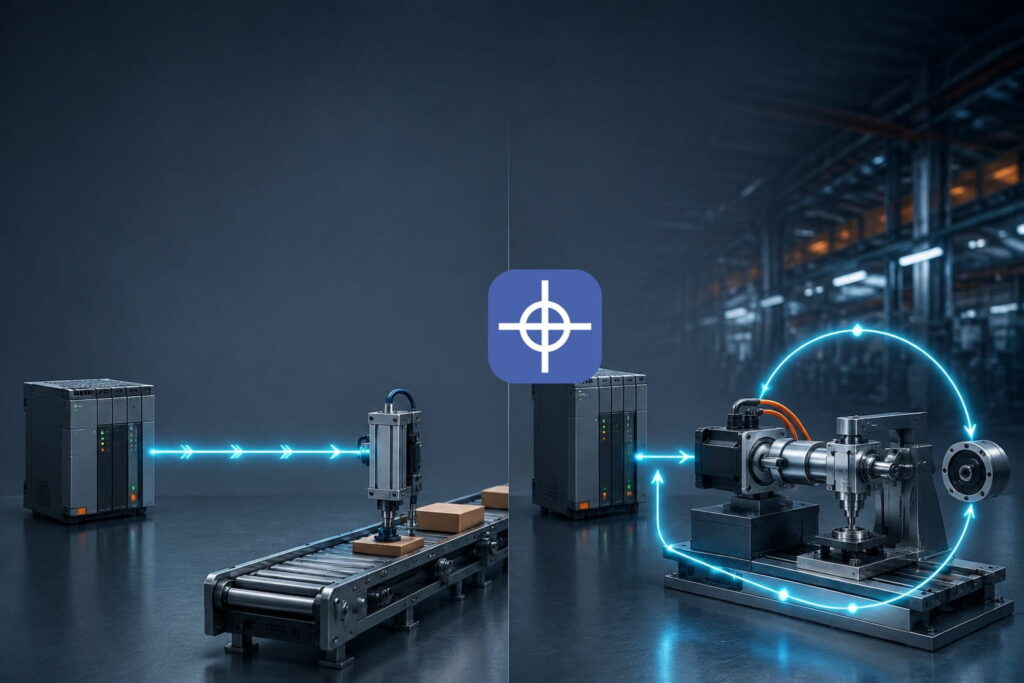
In industrial control literature, the main difference between Open Loop control and Closed Loop control is that in closed loop control, the system measures the “actual result” and corrects itself based on it; but in open loop control, the system only gives a “command” and assumes the output has become exactly what it should be.
1. Precise Definition, Schematic, and Applications
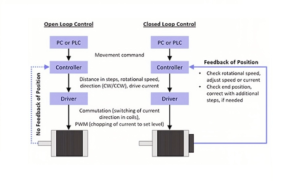
Open Loop Control
- The controller takes an input/command (Setpoint) and produces a control output.
- It receives no feedback at all from the actual output.
- If the load changes, friction increases, voltage drops, or a disturbance occurs, the controller does not notice.
Conceptual block diagram:
Setpoint → Controller/Drive → Actuator → Plant (Process) → Output
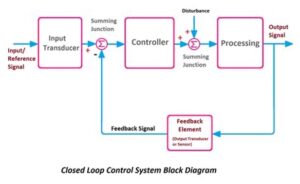
Closed Loop Control
- The actual output is measured by a sensor (such as an encoder, tachometer, or a position/pressure/temperature sensor…).
- The measured output is compared with the desired value, generating an “error”:
- e(t) = r(t) − y(t), where r is the desired value and y is the actual value.
- The controller corrects the command based on the error.
Conceptual block diagram:
Setpoint → (Σ) Error → Controller → Drive/Actuator → Plant → Output → Sensor → Feedback → (Σ)
Applications of Open Loop Control
This model is suitable when the process is predictable and load/condition changes do not have a critical effect on the result, or are covered by a “safety margin.”
- Simple positioning movements with a stepper motor (Stepper Open Loop)
- Light tables, short sliders, simple light Pick & Place mechanisms
- Repetitive movements with moderate acceleration
- Applications where a single error is not a serious risk or high scrap cost
- Time-based controls
- Turning a fan, pump, heater, or solenoid valve on/off for a set duration
- Timed cycles in machinery (for example, a 2-second pause, then movement)
- Approximate speed control of DC/AC motors without feedback
- Speed adjustment with PWM or voltage/frequency without a speed sensor
- Simple conveyors with a relatively constant load
- Mixers, blowers, fans (where “precise speed” is not critical)
- Simple (approximate) dispensers/dosing
- Peristaltic pump or dosing pump with an on-time setting (without a flow meter)
- Suitable when an error of a few percent is acceptable
- ON/OFF actuators
- Pneumatic cylinder forward/return with a 5/2 valve and an optional end sensor
- Many systems work purely on timing, even without a sensor (limited accuracy)
Applications of Closed Loop Control
This model is needed when accuracy, stability, disturbance rejection, and guaranteed performance under variable load matter.
- Precise and heavy CNC axes (Servo or Closed Loop Stepper)
- CNC milling/turning, large routers, heavy gantries
- Where “Following Error” matters and must be detected
- Preventing lost steps and accumulated error
- Precise speed control (Speed Regulation)
- Spindle with encoder feedback (precise RPM under variable load)
- Conveyors that must maintain precise speed (for example, synchronizing multiple conveyors)
- Printing/packaging/roll-cutting applications where speed uniformity is critical
- Position control and synchronization (Position & Synchronization)
- Synchronizing X/Y axes or Master-Slave setups, such as two motors on one gantry
- Robots and multi-axis systems
- Applications requiring high repeatability and compensation for backlash/load
- Industrial process control with sensors (Process Control)
- Temperature control: heater + thermocouple/RTD sensor + PID (ovens, extruders, hot runners)
- Pressure control: pump/compressor + pressure transducer
- Level control: tank + level sensor (ultrasonic/pressure/float) + valve/pump
- Flow control: flow meter + control valve (Flow Control)
- Tension control (Tension Control)
- Roll-to-roll lines, winders/unwinders
- With a load cell or dancer roll for constant tension
- Error-compensation systems that adapt to real conditions
- Systems that must compensate for changes in friction, wear, part weight, temperature changes, and so on
- Applications sensitive to output quality and scrap
Combined Applications (An Important Note)
Many machines are “hybrid”:
- Main axes with Closed Loop control for accuracy and safety
- Secondary/less-critical functions with Open Loop control to reduce cost and simplify the design
Example in CNC:
- Axis movement: Closed Loop servo or closed-loop stepper
- Suction/fan/water pump: Open Loop on/off or approximate control
- Pneumatic valves: usually Open Loop, or semi-closed-loop with an end sensor
2. Key Differences (Practical Comparison)
| Criterion | Open Loop | Closed Loop |
| Feedback sensor | None | Present (encoder/sensor…) |
| Final accuracy | Depends on conditions; weak against changes | Higher; with error correction |
| Load/disturbance compensation | Practically none | Strong (Disturbance Rejection) |
| Complexity | Low | Higher (sensor, feedback, tuning) |
| Cost | Lower | Higher |
| Maintenance/troubleshooting | Simpler | Requires more expertise |
| Risk of oscillation/instability | Usually low | Can occur with poor tuning |
| Sensitivity to sensor noise | None | Present (needs filtering/tuning) |
3. Industrial and CNC Examples — Exactly Where Many People Get It Wrong
Example 1: A Common CNC Axis with an Ordinary Stepper (Open Loop)
- You send N pulses and assume the axis has moved by that exact amount.
- If the motor loses steps under high load or gets stuck:
- The system still thinks the position is correct.
- Accumulated error occurs (damaged part, tool collision, lost zero reference).
Example 2: A Servo Motor or Closed-Loop Stepper (Closed Loop Control)
- An encoder reads the actual position.
- The controller reduces the Following Error.
- If the load changes or the axis falls behind, the system increases torque/command to compensate.
- It usually has protections such as an Alarm for “excessive error.”
4. Real Advantages and Disadvantages
Open Loop — Advantages
- Simple implementation, fewer components
- Lower cost
- Suitable for low-sensitivity processes or a relatively constant load
- Fewer failures related to sensors/feedback cables
Open Loop — Disadvantages
- No detection of mechanical errors/slippage/lost steps
- Accuracy and repeatability depend on conditions (load, friction, acceleration, voltage, temperature)
- High risk of error for fast dynamics and variable loads
Closed Loop Control — Advantages
- Better accuracy and repeatability (especially under variable load)
- More reliable speed/position/torque control
- Error detection and alarm capability (Overload, Following Error, Encoder Fault…)
- Better response to disturbances and environmental changes
Closed Loop — Disadvantages
- Higher cost (sensor, shielded cable, a more powerful drive/controller)
- Requires tuning, such as PID and servo settings
- Sensitive to noise, grounding, and EMC; poor implementation causes errors and oscillation
- More complex troubleshooting
5. An Important Note: Being “Closed Loop” Does Not Always Mean “Better”
If your process:
- Has a nearly constant load,
- Does not require very high speed/acceleration,
- Can tolerate a small error,
- And has a low risk of lost steps,
then open loop can be more economical and more logical.
But if:
- You need precise machining,
- There is high acceleration, large load changes, or a chance of jamming/slippage,
- Downtime and scrap are costly,
then closed loop is usually the more professional choice.
6. A Quick Selection Guide for CNC and Automation
Open loop is recommended when:
- The axis is light and short (low inertia)
- The load is uniform
- Speed and acceleration are moderate
- The budget is limited
- Tolerances are not strict
Closed loop is recommended when:
- The axis is heavy or has variable load (such as large gantries)
- High acceleration and cycle time matter
- Strict accuracy/repeatability is required
- There is a risk of collision/mechanical jamming
- You need error monitoring and alarms
7. Brief Summary
- Open Loop: gives a command and assumes it has been executed correctly; simple and inexpensive, but vulnerable to changes and errors.
- Closed Loop: measures the actual output and corrects itself; more accurate and reliable, but more complex, more expensive, and requires tuning.
Author: Nima Rad