
Automatic Tool Changer in CNC
Author: Nima Rad
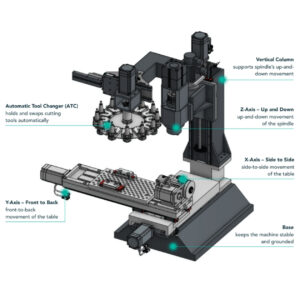
In modern CNC machining, an Automatic Tool Changer (ATC) is a coordinated mechanical and control system that enables a machine to automatically replace cutting tools without operator intervention.
Tools such as drills, end mills, taps, reamers, and face mills are stored in a tool magazine, transferred to the spindle when required, and returned after use. The direct result is higher productivity, reduced human error, improved safety, and the ability to execute multi-operation machining cycles on a single setup.
Why Automatic Tool Changers Are Critical in CNC Machines
Automatic tool changing directly addresses one of the biggest inefficiencies in machining: non-productive time. Manual tool changes interrupt machining cycles, introduce variability, and expose operators to rotating tools and sharp edges.
With a properly designed ATC system, tool changes occur with consistent timing, verified positioning, and sensor-controlled logic. This improves repeatability, stabilizes part quality, and allows complex machining strategies where multiple tools are used sequentially without stopping the program.
In vertical and horizontal machining centers, ATC systems are fundamental to achieving high spindle utilization and lights-out production.
Core Components of an Automatic Tool Changer System
An ATC is not a single mechanism but an integrated system composed of several critical elements working together:
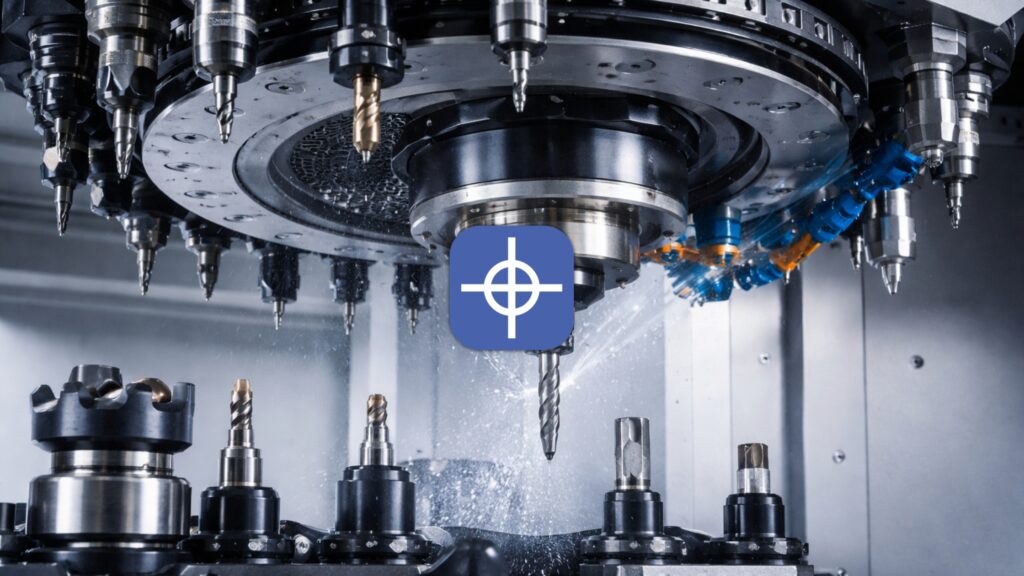
The tool magazine stores tools in dedicated pockets or holders. Depending on the design, this may be a carousel, chain, drum, linear rack, or turret-style system.
The tool transfer mechanism moves tools between the magazine and the spindle. This may be accomplished through direct spindle engagement, a swing arm, a double-arm exchanger, or a robotic interface.
The spindle drawbar system clamps and releases the tool holder. In BT and CAT interfaces, a retention knob (pull stud) connects the tool holder to the drawbar and transmits significant tensile force during machining.
Sensors and interlocks confirm critical conditions such as spindle orientation, pocket position, tool presence, clamp/unclamp status, and air or hydraulic pressure.
The CNC controller and PLC logic manage tool numbering, tool offsets, tool life, recovery routines, and fault handling through the tool table and ladder logic.
Typical Tool Change Cycle (High-Level View)
While exact sequences differ by manufacturer, most ATC systems follow a structured cycle:
The machine stops cutting and orients the spindle to a defined angular position. The Z-axis moves to a safe tool change height. The drawbar releases the current tool, the transfer mechanism exchanges tools between the spindle and the magazine, and the drawbar clamps the new tool. Sensors confirm correct seating before the machine returns to the machining position and resumes the program.
This controlled sequence ensures repeatability, collision avoidance, and reliable recovery if a fault occurs.
Practical Classification of Automatic Tool Changers
Carousel / Umbrella Tool Changers
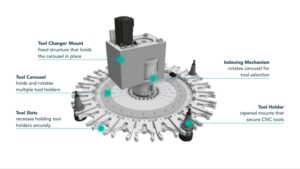
In this design, tools are arranged around a rotating plate positioned near the spindle. The spindle moves directly to the selected pocket to pick up or drop off a tool.
In many machines, common pocket counts include 10, 20, 24, 32 (and higher depending on the model). This is why umbrella/carousel ATCs are widely used in compact vertical machining centers and drill–tap centers: they cover typical multi-tool jobs without the footprint of a large magazine.
They are mechanically simpler, cost-effective, and easier to maintain, but typically support fewer tools and lower tool weight/length limits compared to chain magazines and larger production-focused systems.
Swing Arm and Double-Arm Tool Changers
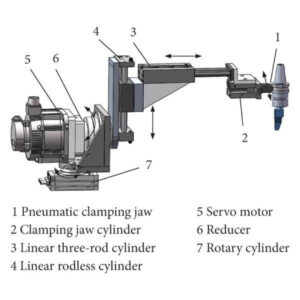
Swing-arm systems use one or two arms to simultaneously remove the current tool and insert the next one. This parallel action significantly reduces tool change time.
They are well suited for production environments where cycle time is critical. However, their increased mechanical complexity requires precise alignment and regular maintenance.
Chain Tool Magazines
Chain magazines store tools on a circulating chain mounted beside or behind the machine column. They offer high tool capacity and are widely used in horizontal machining centers and large vertical machining centers.
These systems support complex parts requiring many tools, but they demand more installation space and careful mechanical upkeep.
Drum and Rotary Magazines
Drum-style magazines rotate tools around a cylindrical body. They are found in some compact machines and CNC routers where space efficiency is important.
Linear Rack Tool Changers
Tools are arranged along a linear rail, and either the spindle or a transfer unit moves along the rack. This design offers direct access and straightforward logic but requires sufficient machine length.
Turret Systems in CNC Lathes
In turning centers, tool changes are performed by indexing a turret rather than using a magazine. While functionally different, turrets serve the same role as ATCs in milling machines by enabling rapid, repeatable tool selection.
Robot-Assisted Tool Changing
In flexible manufacturing systems, industrial robots may handle tool exchange, integrating tool storage, measurement, and logistics. These systems provide maximum flexibility but come with higher integration cost and complexity.
Where Automatic Tool Changers Are Used
Automatic tool changers are standard in vertical and horizontal machining centers used for mold making, die machining, automotive components, and aerospace parts. They are equally important in drilling and tapping centers, CNC routers for wood and composites, and automated production cells operating with minimal human supervision.
Selecting the Right ATC: Decision Criteria
Choosing the appropriate ATC depends on several engineering and production factors.
The required number of tools is a primary driver. As a practical rule in many shops, 10–32 tools often fits well with umbrella/carousel systems (depending on the machine model), while applications that routinely need 40, 60, 80+ tools typically benefit from chain magazines.
Cycle time requirements influence whether a swing-arm system is justified. Tool size and weight dictate pocket strength and drawbar capacity. Available machine space, holder interface standards (BT, CAT, HSK), and access to spare parts all affect long-term reliability.
Equally important is maintainability: sensor count, recovery logic, and the ability to safely re-home the tool changer after a fault.
Maintenance Practices and Common Failure Points
Cleanliness is critical. Contamination on the spindle taper or tool holder interface increases runout and compromises clamping force.
Retention knobs must be inspected for wear, cracks, or incorrect geometry. Because they transmit drawbar force, failure can lead to tool pull-out.
Air or hydraulic pressure must remain within specification. Low pressure often causes clamp or unclamp alarms.
Magazine pockets, grippers, and springs should be checked for looseness or misalignment. Most manufacturers provide dedicated recovery procedures for re-synchronizing the ATC after an interruption.
Quick Selection Summary
For general-purpose workshops with moderate tool counts (often 10–32 tools, depending on the machine), carousel systems are usually sufficient. High-volume production environments benefit from swing-arm or double-arm designs. Complex parts with many tools or horizontal machining centers typically require chain magazines. Flexible manufacturing cells may justify robot-assisted tool changing.
Conclusion
An automatic tool changer is a foundational element of modern CNC machining. Its design directly affects productivity, reliability, and part quality. Understanding how different ATC architectures function, how they integrate with spindle and control systems, and how they are maintained allows manufacturers to select solutions that align with both current production needs and long-term operational goals.
Contact Radonix or use the chatbot in the bottom right corner to learn how linear encoders integrate with Radonix control systems.