
Table of Contents
- What Does IP Rating Mean in Industry?
- What Exactly Does IP Rating Cover?
- How Is the IP Rating Code Structured?
- Where and How Should We Choose an IP Rating in Industry? (Quick Guide)
- A Few Very Common Industrial Examples
1. What Does IP Rating Mean in Industry?
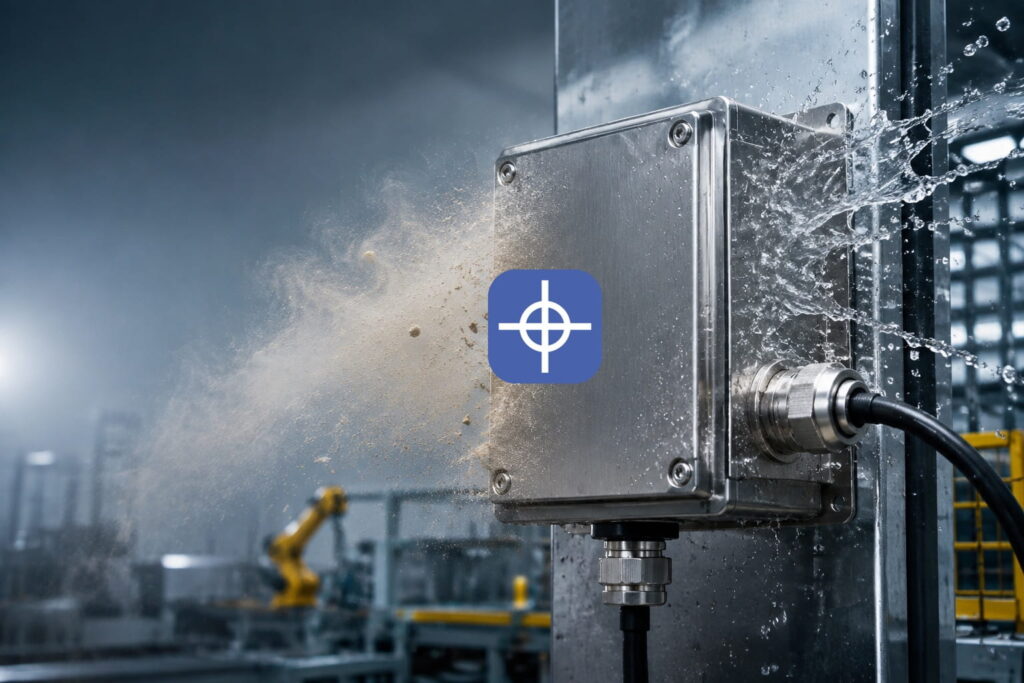
In industry, when people say IP or IP Rating, they mean the degree of protection of the equipment/enclosure against ingress — Ingress Protection; in other words, how well the body/enclosure of a piece of equipment (sensor, electrical panel, drive, connector, industrial light, etc.) keeps out solid objects (such as dust) and water. This code is defined in the series of standards for the degree of protection of enclosures.
2. What Exactly Does IP Rating Cover?
- Ingress of solid objects and dust, as well as accidental contact with hazardous parts inside the enclosure
- Ingress of water under various scenarios (splashing, rain, water jets, immersion, high-pressure washing…)
But IP rating alone does not guarantee: chemical resistance, corrosion, UV/sunlight resistance, gasket lifespan, oil vapor, internal pressure, or mechanical impact. (For impact, the IK rating is typically used.)
3. How Is the IP Rating Code Structured?
The general IP rating format is usually:
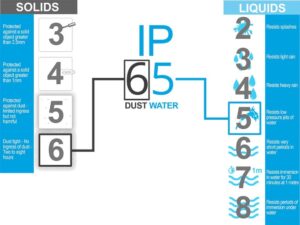
IP + (first digit) solids + (second digit) water + optional letters/suffixes
Examples:
- IP54 -> limited protection against dust + protection against water splashing
- IP65 -> Dust-tight + resistance against water jets
- IPX7 -> solids not tested/declared (X) + short-term immersion
- IP69K / IPX9 -> high-pressure hot-water washdown (depending on the standard)
X means that criterion is not measured/declared, not that it is zero.
First Digit (0 to 6): Protection Against Solid Objects and Dust
Summary of the most commonly used levels:
- 0: no protection
- 1: very large objects, approximately 50mm
- 2: fingers/objects 12.5mm
- 3: tools/thick wire 2.5mm
- 4: wire/particles 1mm
- 5: Dust-protected — not completely impervious, but harmful dust does not enter
- 6: Dust-tight — completely sealed against dust
Second Digit 0 to 9 / K9: Protection Against Water
A few key levels commonly seen in industry:
- 4: water splashing from various directions
- 5: water jet (nozzle)
- 6: stronger water jet
- 7: short-term immersion, usually to a limited depth, under standard test conditions
- 8: longer/deeper immersion — depth/time details must be specified precisely by the manufacturer
- 9 / X9: high-pressure hot water (high-pressure/steam-jet style) as addressed for IPX9 in IEC 60529.
Important note (one of the most common misconceptions): Do not assume the water protection levels are “cumulative” from IPX7 onward. That is, if a piece of equipment is IPX7, it has not necessarily passed IPX5 or IPX6 (water jet). Some manufacturers list both separately if the equipment has passed both tests, for example X5/X7.
IP69K, IPX9, and Their Difference
- IPX9 usually refers to the high-pressure hot-water test within the framework of IEC 60529.
- IP69K is seen more within ISO 20653 (especially in the automotive sector/equipment exposed to intense washdown) and is common for heavy industrial washdown conditions (food/pharma, trucks, concrete mixers…).
In practice, if your environment involves washdown with water jets and hot water, look for equipment with an IP69K or IPX9 rating, along with a material/gasket suited to the cleaning chemicals used, because IP rating alone says nothing about chemical resistance.
Optional Letters (Less Commonly Used, but Important)
Depending on the standard and the product, additional letters may be added (not universal), such as:
- A/B/C/D: the level of protection against access to hazardous parts (with the back of the hand/finger/tool/wire)
- F: suitable for oil (for certain industrial applications)
- H: high-voltage equipment
- M/S: water test while the equipment is in motion/stationary
- W: weather conditions
4. Where and How Should We Choose an IP Rating in Industry? (Quick Guide)
Instead of simply assuming “higher is better,” model the real-world scenario:
- Dust
- Wood/stone/cement/plastic workshop: usually at least IP5X, and often IP6X
- Clean environment/panel inside an electrical room: IP20-IP4X is sufficient
- Water
- Splashing/rain only: often IPX4-IPX5
- Hose washdown: IPX5-IPX6
- Possible immersion (floor drain/flood/inside a tank): IPX7-IPX8
- High-pressure sanitary washdown/hot water: IP69K / IPX9
- Real Failure Points
Most water/dust ingress happens at these points, not through the metal wall:
- Cable gland, connector, panel door, HMI window, screw locations, vents
So the system’s final IP rating equals the weakest link — an unsuitable gland/connector can effectively defeat an IP65 enclosure.
How Is IP Rating Different from IK Rating?
- IP rating = ingress of dust/water
- IK = the enclosure’s resistance to mechanical impact (such as a tool strike or an impact in an industrial environment)
According to IEC/EN 62262
Practical example: a box might be IP66 but weak against impact; for harsh environments you should also want a suitable IK rating.
5. A Few Very Common Industrial Examples
- Control panel inside a dry hall: IP20 to IP54 depending on the dust level in the environment
- Panel next to a production line with dust: IP54/IP55 or higher
- Outdoor environment (rain/dust): IP65 and above
- Sensor/connector near a water nozzle or washdown: IP67/IP68 or IP69K
- Equipment exposed to sanitary washdown (Food/Pharma): usually IP69K + stainless material/gasket suited to cleaning chemicals
Author: Nima Rad