
Table of Contents
- Introduction
- Operating Principles
- Types of Linear Encoders
- Applications and Examples
- Advantages and Limitations
- How It Works in CNC
- Operating Principles of Optical and Magnetic Encoders
- Conclusion
- References
1. Introduction
A linear encoder is a sensor, or transducer, that measures the position or linear movement of an object along an axis. This device usually consists of a scale and a read head that convert position into electrical signals. The linear encoder converts linear motion into digital or analog signals so that the exact position can be determined. This tool is used in measurement and motion control systems and can provide accuracy down to the nanometer level.
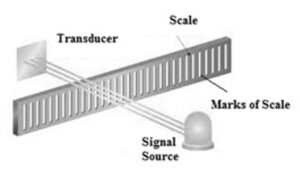
Basic structure of the device: transducer, scale, marks of scale, and signal source.
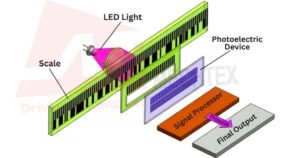
Linear encoder: structure, working, types, wiring, and uses.
2. Operating Principles
Linear encoders use various physical properties to encode position. The read head moves along the scale and detects changes. For example, in optical encoders, light passes through transparent or opaque marks and is analyzed by photodetectors. Resolution is calculated based on the distance between the marks and can reach the micrometer or nanometer level. In the magnetic type, changes in the magnetic field are detected by Hall-effect sensors.
Linear encoders can produce analog signals, such as sine and cosine signals, or digital signals, such as square A and B pulses.
3. Types of Linear Encoders
Linear encoders are classified based on their technology and measurement method. The table below summarizes the main types:
| Technology Type | Description | Advantages | Disadvantages | Applications |
| Optical | Uses light (LED, laser) and photodetectors to detect changes on a glass or metal scale. | High accuracy (down to the nanometer), excellent resolution | Sensitive to dust, vibration, and contamination | Precision machinery, CMMs, printers |
| Magnetic | Detects changes in the magnetic field using Hall-effect or magnetoresistive sensors. | Resistant to contamination, temperature, and vibration; long service life | Lower resolution; sensitive to magnetic interference | Harsh environments, elevators, cranes |
| Inductive | Measures inductive changes in an AC circuit; suitable for contaminated environments. | Resistant to contaminants; non-contact | Sensitive to temperature changes | Waterproof calipers, measuring tools |
| Capacitive | Measures the change in capacitance between the reader and the scale. | Simple and inexpensive | Sensitive to dust and humidity | Digital calipers, low-precision applications |
| Eddy Current | Detects inductance changes in an AC circuit using an encoded scale. | Resistant to harsh environments | Moderate resolution | Specific industrial applications |
In addition, linear encoders can be sealed for dirty environments or exposed (open) for higher accuracy.
4. Applications and Examples
Linear encoders are used across a wide range of industries. The table below shows some common applications:
| Application Area | Examples | Reason for Use |
| Metrology | Coordinate measuring machines (CMMs), laser scanners, digital calipers, tensile testers | High accuracy in measuring position and length. |
| Motion Systems | CNC machines, robotics, PCB assembly equipment, semiconductor machines, printers, digital presses | Precise control of speed and position without intermediate mechanical elements. |
| Specialized Industries | Elevators, cranes, stepper motors, grinding machines | Resistance to harsh conditions and improved efficiency. |
| R&D | Solar telescopes, semiconductor laboratories, linear motor systems | High repeatability and accuracy in dynamic applications. |
In CNC applications, encoders provide cutting-tool position feedback to increase accuracy. In robotics, they ensure the precise movement of arms. Also, compared with rotary encoders, linear encoders measure the load’s position directly and eliminate mechanical errors.
5. Advantages and Limitations
Linear encoders increase accuracy, eliminate mechanical errors, and are useful in servo systems for fast, precise motion. However, the optical type can be sensitive to contamination, while the magnetic type can run into problems in strong magnetic environments. The right type is chosen based on the environment, the required accuracy, and the budget.
Ultimately, linear encoders play a key role in modern automation, and as technology has advanced, their resolution and durability have both increased.
Key Points
High Accuracy: Linear encoders measure the exact position of the axes and compensate for mechanical errors such as backlash or thermal expansion.
Direct Feedback: Unlike rotary encoders, they measure the position of the load or tool directly, which improves repeatability.
Common Applications: They are used in precision cutting, forming, and drilling, especially in the automotive and aerospace industries.
Main Types: Optical for high accuracy, magnetic for harsh environments.
Overall Benefits: Reduced waste, increased production speed, and maintained part quality.
6. How It Works in CNC
Linear encoders work by being mounted on the machine’s linear axes (such as X, Y, and Z). They consist of a fixed scale and a moving read head that convert position changes into electrical signals. These signals are sent to the CNC controller to adjust the tool’s movement. For example, in closed-loop systems, the encoder provides real feedback so that errors can be corrected.
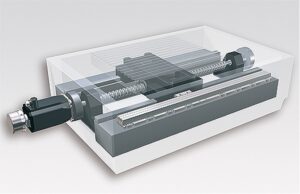
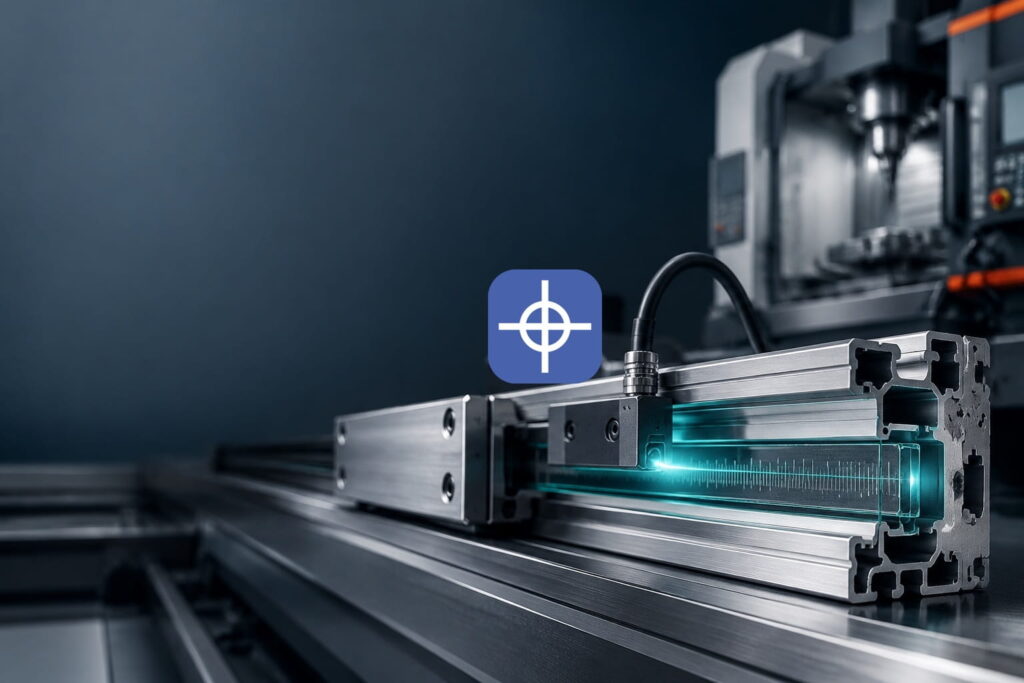
Mounted on a CNC linear axis, alongside the ballscrew and linear guide.
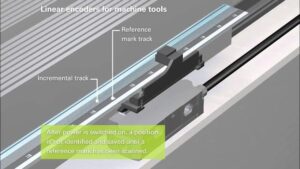
Linear encoders for machine tools: incremental track and reference mark track.
Practical Examples in CNC
CNC Milling and Turning Machines: A linear encoder is mounted on the axes to control the tool’s position. For example, in a 3-axis mill, the table position (X and Y) and the spindle position (Z) are measured so that precise cuts can be made.
Coordinate Measuring Machines (CMM): For precise scanning of parts and quality control, linear encoders determine the probe’s position.
Robotics and Automation: In CNC systems integrated with robots, encoders monitor the linear movement of the arms.
Special Applications: In semiconductor equipment, linear encoders are used for precise alignment in lithography. Models such as the Fagor G2 are suitable for large machines up to 3 meters long.
When retrofitting older CNC machines, adding a linear encoder is essential to achieve modern-day accuracy.
7. Operating Principles of Optical and Magnetic Encoders
Optical encoders work based on photoelectric technology. In this type, a light source (usually an LED or laser) shines light through a coded disc or strip (with transparent and opaque patterns). Photodetector sensors detect the changes in light intensity and convert them into electrical signals. These signals are typically produced as square A, B, and Z (reference) pulses. Resolution is determined by the number of lines on the disc and can be very high (up to thousands of pulses per revolution).
Magnetic encoders, by contrast, use the principles of magnetism. There is a disc or strip with north and south magnetic poles (like a multi-pole magnet), and Hall-effect or magnetoresistive sensors detect the changes in the magnetic field. These changes are converted into electrical signals. Unlike the optical type, no direct line of sight is required, and the air gap can be larger, which increases durability.
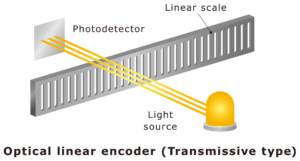
Optical linear encoder (transmissive type): light source, linear scale, and photodetector.
8. Conclusion
Ultimately, linear encoders have brought about a major transformation in CNC, and as technology has advanced, their resolution and durability have increased. These devices not only ensure accuracy, they also help reduce production costs and increase competitiveness.
9. References
- https://en.wikipedia.org/wiki/Linear_encoder
- https://eltra-encoder.eu/news/linear-encoders
- https://www.heidenhain.us/products/linear-encoders/
- https://mechtex.com/blog/understanding-linear-encoders
- https://www.dubai-sensor.com/blog/linear-encoder-types-applications-advantages/
- https://www.renishaw.com/en/linear-optical-encoders–48502
- https://www.sick.com/cn/en/glossary/linear-encoder/g/p515646
- https://walkermachinery.ca/5-common-applications-of-linear-encoders.html
- https://www.linkedin.com/pulse/unveiling-expanding-role-linear-encoders-automation-robotics-tlsff
Author: Mahboubeh Sajjadi