
Author: Radonix R&D Team – CNC Motion Control Specialists
CNC controllers are the core of any CNC system. They interpret machining instructions (G-code), manage motion control, and coordinate machine components such as motors, drives, and sensors.
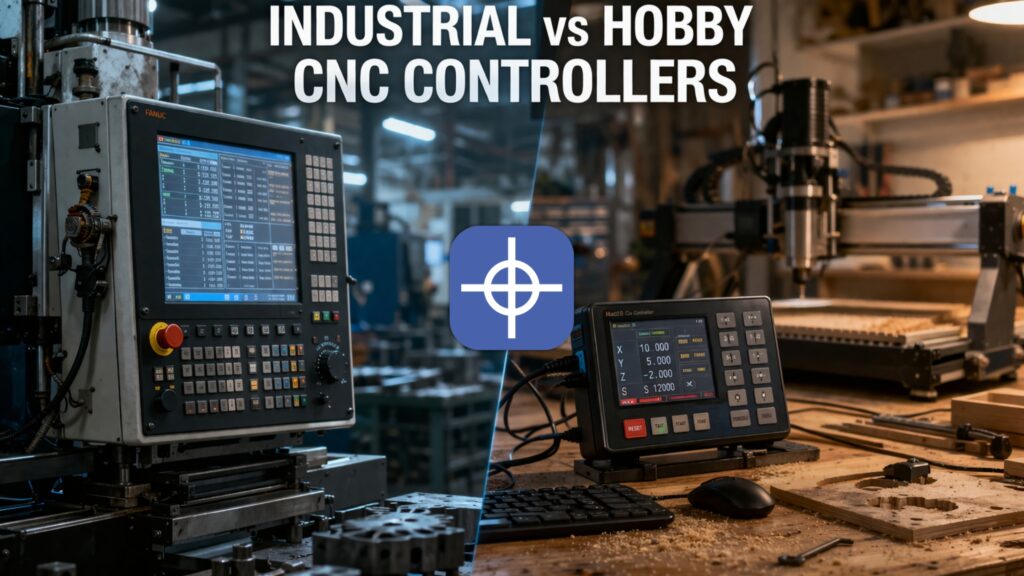
However, not all CNC controllers are built the same. Broadly, they fall into two categories: hobby (entry-level) and industrial (professional-grade) controllers. Understanding the differences is critical when selecting the right control system for your application.
If you’re deciding between industrial and hobby CNC controllers, the right choice depends on your production needs, required precision, and long-term reliability expectations.
This guide helps you understand which CNC controller type fits your application before making a costly decision.
What is a CNC Controller?
A CNC controller is an electronic system responsible for:
- Interpreting G-code commands
- Controlling motion (position, speed, acceleration)
- Communicating with drives (stepper or servo)
- Managing inputs/outputs (limit switches, sensors, safety signals)
In short, the controller defines the precision, reliability, and performance of the entire CNC machine.
Hobby CNC Controllers
Hobby CNC controllers are designed for low-cost, small-scale, and non-industrial applications.
Typical Characteristics
- PC-based control (USB or parallel port)
- Limited real-time performance
- Basic motion control algorithms
- Lower cost hardware
- Often used with stepper motors
Common Use Cases
- DIY CNC machines
- Small woodworking or engraving projects
- Educational environments
- Light-duty prototyping
Advantages
- Affordable and accessible
- Easy to set up and use
- Large online community support
Limitations
- Limited precision and stability
- Not suitable for continuous operation
- Weak real-time communication
- Higher risk of motion errors or interruptions
Industrial CNC Controllers
Industrial CNC controllers are engineered for high-performance, reliability, and continuous operation in production environments.
In real production environments, even minor motion instability can lead to material waste and machine downtime, which is why industrial controllers are essential for consistent output.
Typical Characteristics
- Dedicated real-time control hardware
- High-speed communication (e.g., EtherCAT)
- Advanced motion control algorithms
- Support for servo systems (closed-loop control)
- Robust I/O and safety integration
Common Use Cases
- Production lines
- Metal machining and milling
- Plasma, laser, and waterjet cutting
- OEM machine manufacturing
Advantages
- High precision and repeatability
- Stable and reliable operation
- Real-time performance (no lag or jitter)
- Scalable for complex multi-axis systems
Limitations
- Higher initial cost
- Requires engineering knowledge for setup
Key Differences: Industrial vs Hobby Controllers
| Feature | Hobby Controllers | Industrial Controllers |
|---|---|---|
| Performance | Basic | High-performance |
| Precision | Moderate | Very high |
| Reliability | Limited | Industrial-grade |
| Communication | USB / Parallel | EtherCAT / Industrial networks |
| Motor Support | Mostly stepper | Servo + closed-loop systems |
| Operation Time | Short / intermittent | Continuous (24/7) |
| Use Case | DIY / small projects | Industrial production |
Which CNC Controller Should You Choose?
Choosing the right controller depends on how the machine will be used in real conditions:
- Choose hobby CNC controllers if you are working on small-scale projects, learning environments, or non-continuous operations where cost is the main factor.
- Choose industrial CNC controllers if you require precision, stability, continuous operation, and integration with automation systems.
For any application involving production, consistency, or business-critical output, industrial controllers provide significantly better long-term value.
Why the Controller Choice Matters
The CNC controller directly impacts:
- Machine accuracy
- Surface finish quality
- Production speed
- System reliability
- Downtime and maintenance
Choosing an unsuitable controller can result in lost precision, unstable motion, and reduced efficiency.
Understanding how controller limitations lead to real-world issues is critical—many of these problems are explained in real CNC controller failures and how to prevent them.
Industrial Trend: Moving Beyond Hobby Systems
As production environments become more automated and precision-driven, reliance on hobby-level controllers is decreasing in favor of industrial systems that support real-time control and scalability.
Key reasons include:
- Need for higher precision
- Integration with automation systems
- Increased production volume
- Reduced downtime
Real-World Considerations Before Choosing a CNC Controller
When selecting between hobby and industrial CNC controllers, the decision should not be based on price alone. In production environments, controller limitations translate directly into operational risks.
Key considerations include:
- Tolerance requirements and consistency over long production cycles
- Machine downtime costs due to instability or communication delays
- Compatibility with servo systems and industrial automation workflows
- Long-term scalability for multi-axis or high-speed machining
In practice, manufacturers that start with hobby-grade systems often face performance bottlenecks, forcing costly upgrades later. Selecting the right controller from the beginning reduces total cost of ownership and ensures stable production.
Expert Insight: Why Industrial Controllers Dominate Modern CNC Systems
From an engineering standpoint, the fundamental difference lies in real-time determinism.
Industrial CNC controllers operate on dedicated real-time systems, ensuring that motion commands are executed with precise timing—measured in microseconds. This level of control is critical for:
- Maintaining toolpath accuracy at high speeds
- Preventing vibration, chatter, and surface defects
- Synchronizing multiple axes without drift
In contrast, hobby controllers relying on non-real-time environments (such as standard PC systems) cannot guarantee consistent timing, leading to cumulative positioning errors and unstable machining behavior.
This is why industrial controllers are the standard across manufacturing sectors where precision, repeatability, and uptime are non-negotiable.
Conclusion
Hobby CNC controllers are suitable for entry-level and light applications, but they fall short in demanding environments. Industrial CNC controllers, on the other hand, provide the performance, stability, and scalability required for real-world production.
For any application involving continuous production, precision machining, or automation, industrial CNC controllers are the only reliable choice.
If you need help choosing the right CNC controller for your application, contact us or use the chatbot for expert guidance tailored to your machine and production needs.
About Radonix
Radonix specializes in the development of industrial CNC controllers designed for reliability, precision, and seamless integration in modern automation environments.
With extensive experience in industrial motion control systems, Radonix focuses on delivering stable, real-time CNC performance for demanding applications used by machine builders and production environments.
Radonix controllers are engineered with a strong emphasis on:
- Real-time motion accuracy
- Industrial communication protocols (e.g., EtherCAT)
- Long-term operational stability
- Compatibility with modern manufacturing ecosystems
This expertise allows manufacturers and OEMs to build machines that meet strict industrial standards while maintaining efficiency and scalability.