

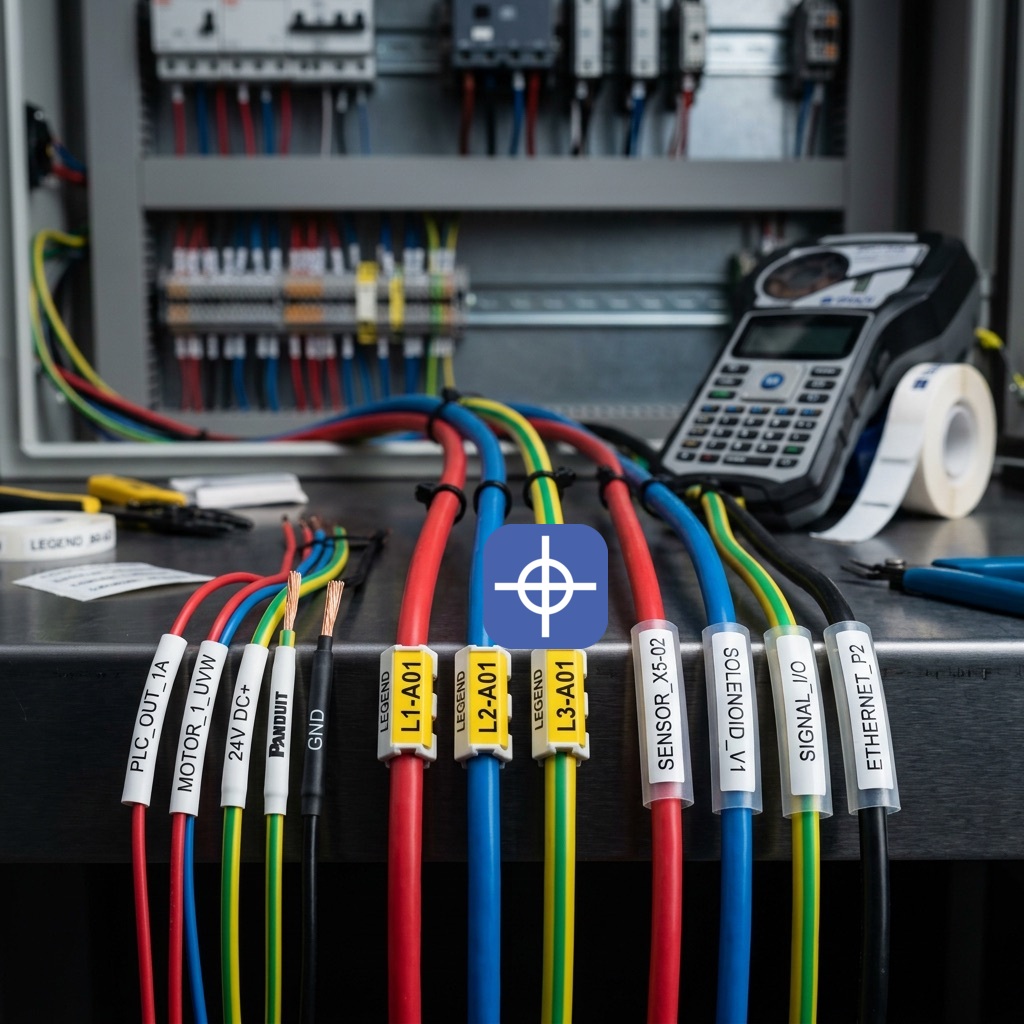
Wire Labeling System: A Practical Comparison of Methods
Choosing how to identify your conductors is a bigger decision than it looks. The wire labeling system you pick determines how fast a technician can troubleshoot a fault, whether your marking survives years of oil and vibration, and whether the panel passes inspection. Get it right and identification stays legible for the life of the machine; get it wrong and you are re-labeling — or worse, chasing an unmarked fault under production pressure.
This is a commercial decision with real trade-offs. A hand-written tag costs almost nothing but fades and reads inconsistently. A laser-printed sleeve is durable and professional but needs equipment and access to the wire end. Between those extremes sit printed wrap-around labels, embossed metal markers, and several hybrids, each with its own balance of cost, durability, and compliance.
This guide compares the main methods honestly — what each does well, where each fails, and how to match one to your environment — so you can buy the right marking for your application rather than the cheapest or the most expensive by default.
What to Evaluate in a Wire Labeling System
Before comparing products, fix the criteria. Five factors decide whether a wire labeling system is right for your project, and their relative weight changes with the application.
Durability and abrasion resistance. Will the mark survive the environment for the service life of the wire? Oil, heat, UV, chemicals, and repeated handling all attack labels. In a clean indoor cabinet, almost anything lasts; in an outdoor or high-vibration installation, only rugged methods survive.
Cost per mark. Look at the total: consumables, printer or tooling, and labour to apply. A cheap label that takes a minute to write by hand can cost more in labour than a printed one produced in seconds. On a large build, cost per mark compounds quickly.
Speed and volume. How many conductors, and how fast can you mark them? A repetitive panel build with hundreds of wires rewards a system that prints in bulk from a marking list. A one-off repair does not justify the setup.
Compliance. Does the marking meet the identification and durability expectations for your market and application? Standards such as IEC 60445 govern conductor and terminal identification, while UL 969 is commonly referenced for marking and label durability. Regulated or third-party-serviced installations lean heavily on recognised, permanent marking.
Legibility. Can the identifier be read easily at the viewing distance and angle inside the enclosure, and will it stay readable? Print quality, character size, and marker format (flag, wrap, sleeve) all affect this.
No single method wins on all five. The right choice is the one that scores well on the factors that matter most for your specific panel.
The Main Labeling Methods Compared
Below are the four method families you will actually evaluate, with an honest read on strengths and limitations.
Printed Self-Adhesive / Wrap-Around Labels
Printed labels — produced on a thermal-transfer or industrial printer and applied to the conductor — are the workhorse of automation panels. Wrap-around variants circle the insulation and adhere to themselves; self-laminating versions add a clear overlaminate tail that wraps over the printed area to shield it from abrasion and chemicals.
Strengths: fast to produce in volume from a marking list, excellent print quality and legibility, and a good durability-to-cost ratio, especially in self-laminating form. They can be applied mid-run without disconnecting the wire, which matters for retrofits.
Limitations: adhesive performance depends on the environment — high heat, oil, or solvents can eventually lift a label that is not rated for them. Plain (non-laminated) printed labels are the most vulnerable to abrasion. Material and ribbon selection largely determine how long they last, so specify for the environment rather than defaulting to the cheapest stock.
Hand-Written Tags
Hand-written tags — a marker pen on a blank tag or write-on marker — are the lowest-cost, lowest-setup option. Every electrician has done it, and for a quick temporary fix or a tiny one-off job it is perfectly serviceable.
Strengths: near-zero consumable cost, no equipment, instant. Nothing beats it for a single temporary conductor.
Limitations: this is not a method for production or permanent work. Legibility varies with handwriting, ink fades and smears, and inconsistent formatting undermines the traceability the label is supposed to provide. Industrial guidance generally restricts hand-written marking to temporary or very small jobs precisely because durability and readability are unreliable. If the marking is tied to safety, compliance, or long-term maintenance, hand-written tags are a false economy.
Embossed / Stamped Metal Markers
Embossed or stamped metal markers carry the identifier as physically deformed characters in a metal tag — often stainless steel — fixed to the conductor or bundle with a tie. Because the text is formed into the material rather than printed onto it, it cannot fade, smear, or wash off.
Strengths: outstanding durability and permanence. Metal tags resist heat, UV, chemicals, corrosion, and abrasion, which makes them the go-to for the harshest environments — outdoor, marine, petrochemical, and hazardous areas. Legibility does not degrade with age.
Limitations: highest cost per mark and slowest to produce, especially if embossed manually. The tags are bulkier than sleeves or labels, which can be awkward in dense terminal areas, and they suit cable and bundle identification more than fine individual conductors. You pay for permanence, so reserve them for where permanence is genuinely required.
Laser-Printed and Heat-Shrink Sleeves
Heat-shrink sleeves slip over the conductor and contract with heat to grip it tightly; the identifier is printed onto the sleeve (thermal-transfer or laser) before shrinking. The result is a clean, tube-shaped label bonded to the wire.
Strengths: excellent durability in vibration, oil, dust, and demanding industrial conditions, with a professional appearance and strong abrasion resistance. Because the sleeve grips the whole circumference, it cannot slip off or peel like an adhesive label. Laser-printed sleeves in particular offer crisp, permanent print.
Limitations: they must be installed over the end of the conductor, so the wire has to be accessible from one end — you cannot add a shrink sleeve to the middle of an already-terminated run without disconnecting it. That makes them ideal for new builds and awkward for some retrofits. Setup (printer plus heat source) is higher than for adhesive labels.
Cost vs. Durability vs. Compliance — Side by Side
The table scores each method on the three factors buyers weigh most. Ratings are relative and assume appropriate material selection for each type.
| Method | Cost per mark | Durability | Compliance fit | Best for |
| Printed self-adhesive / wrap-around | Low–Medium | Medium (High if self-laminating) | Medium–High | High-volume panel builds; retrofits (mid-run application) |
| Hand-written tags | Low | Low | Low | Temporary work and very small one-off jobs only |
| Embossed / stamped metal | High | High | High | Harsh, outdoor, chemical, and hazardous environments |
| Laser-printed / heat-shrink sleeves | Medium | High | High | New builds needing durable, professional, permanent marking |
Read the table against your priorities: a data-centre patch panel weights legibility and neatness; an offshore junction box weights durability and compliance above all; a workshop retrofit weights cost and mid-run application. There is no universally “best” row — only the best fit for your column.
How to Match a Method to Your Environment
The environment usually makes the decision for you. Use these as starting points, then confirm the material rating against the manufacturer’s data.
Indoor control panel (clean, climate-controlled). Printed self-adhesive or wrap-around labels are the sensible default — fast, legible, economical, and durable enough. Self-laminating versions add margin where handling is frequent.
Outdoor or UV-exposed. Prioritise UV and weather resistance. Heat-shrink sleeves rated for outdoor use or embossed metal markers hold up where standard adhesive labels would fade or lift.
High-heat. Adhesives soften and prints can degrade near heat sources. Heat-shrink sleeves in a suitably rated material, or metal markers, are the reliable choices.
Chemical or oil exposure. Solvents and oils attack adhesives and inks first. Self-laminating labels offer some protection; heat-shrink sleeves and metal markers offer more. Match the material to the specific chemical exposure.
High-vibration. Anything that can peel or slip is a risk. Heat-shrink sleeves grip the full circumference and stay put; embossed metal tags secured with a tie are effectively immovable. Avoid plain adhesive labels here.
A practical rule: pick the least expensive method that comfortably meets the environmental and compliance demands — not one grade below (which fails early) and not three grades above (which wastes budget).
Radonix Wire Tags as a Wire Labeling System
Radonix wire tags fit squarely into this landscape as a durable, standards-aware wire labeling system for industrial panels and machine builds — not the only choice on the market, but a strong one where readable, compliant, long-lasting marking matters.
Where they fit: Radonix wire tags map directly to whatever identification scheme you already use, carrying the wire number, source and destination, cable and core number, function name, and drawing reference on the conductor. Because the range spans formats — from wrap-around labels to heat-shrink sleeves and clip-on markers — you can match the physical marking to the environment rather than forcing one format onto every job.
Key advantages: format flexibility so you are not locked into a single durability tier; alignment with recognised identification and marking practices, including IEC 60445 conductor and terminal marking and UL 969-style durability expectations; and integration with the way panels are actually documented, so the tag on the wire matches the schematic and terminal list.
Honest positioning: if you only need to mark one temporary conductor, a write-on tag is fine and cheaper. If your entire installation lives outdoors in a corrosive atmosphere, dedicated stainless-steel markers may still be the right call. For the large middle ground — automation panels, CNC builds, machine wiring that must stay legible and compliant for years — Radonix wire tags are a well-matched, cost-effective solution.
FAQ
What is the most durable wire labeling system?
For extreme environments, embossed or stamped metal markers are the most durable because the identifier is formed into the metal and cannot fade or wash off. Laser-printed heat-shrink sleeves are close behind and more practical for fine conductors and neat panel work. Both far outlast plain adhesive labels and hand-written tags.
Are hand-written wire tags ever acceptable?
For temporary work or a very small one-off job, yes. For permanent, production, or safety-related wiring, no — legibility and durability are too inconsistent. Industrial best practice reserves hand marking for temporary use and specifies printed or formed marking for anything that must last.
Which method is cheapest overall?
Hand-written tags have the lowest consumable cost, but on any real volume the labour makes them expensive per usable mark. For volume work, printed self-adhesive labels usually give the lowest true cost per mark once you account for speed and consistency.
Do wire labels need to meet a specific standard?
It depends on your market and application. IEC 60445 covers conductor and terminal identification, and UL 969 is widely referenced for label and marking durability. Whether either is contractually required varies, but choosing marking that aligns with them is good practice and eases inspection and third-party maintenance.
Can I use one method for the whole panel?
Often, but not always. A single method keeps things simple, yet mixed environments (a panel with both clean interior wiring and a hot or oily section) can justify combining methods. Match the method to the exposure of each conductor group rather than forcing uniformity where it does not fit.
Choose the Right Marking for Your Build
The best wire labeling system is the one that meets your durability and compliance needs at the lowest sensible cost — and that will differ between a clean indoor cabinet and a corrosive outdoor enclosure. Weigh durability, cost per mark, speed, compliance, and legibility against your actual environment, and buy to that, not to habit.
When durable, standards-aware, flexible marking is what you need, explore Radonix wire tags to match the right format to your panel — or contact the Radonix team for guidance on marking your build end to end.
For industrial implementation, explore Radonix PC-based CNC controllers, control software and machine-specific HMI systems. Radonix PC-based CNC controller systems.