
Introduction
Linear guide rails are one of the most important mechanical components in a CNC machine. They guide the movement of machine axes while supporting cutting loads and maintaining positioning accuracy. Whether machining wood, metal, stone, or composite materials, the performance of the linear guide system has a direct impact on machine rigidity, repeatability, surface finish, and overall productivity.
Even the most advanced CNC controller cannot compensate for poor mechanical guidance. High-quality guide rails combined with precise motion control from industrial controllers such as Radonix enable CNC machines to achieve smooth, stable, and accurate machining.
What Are Linear Guide Rails?
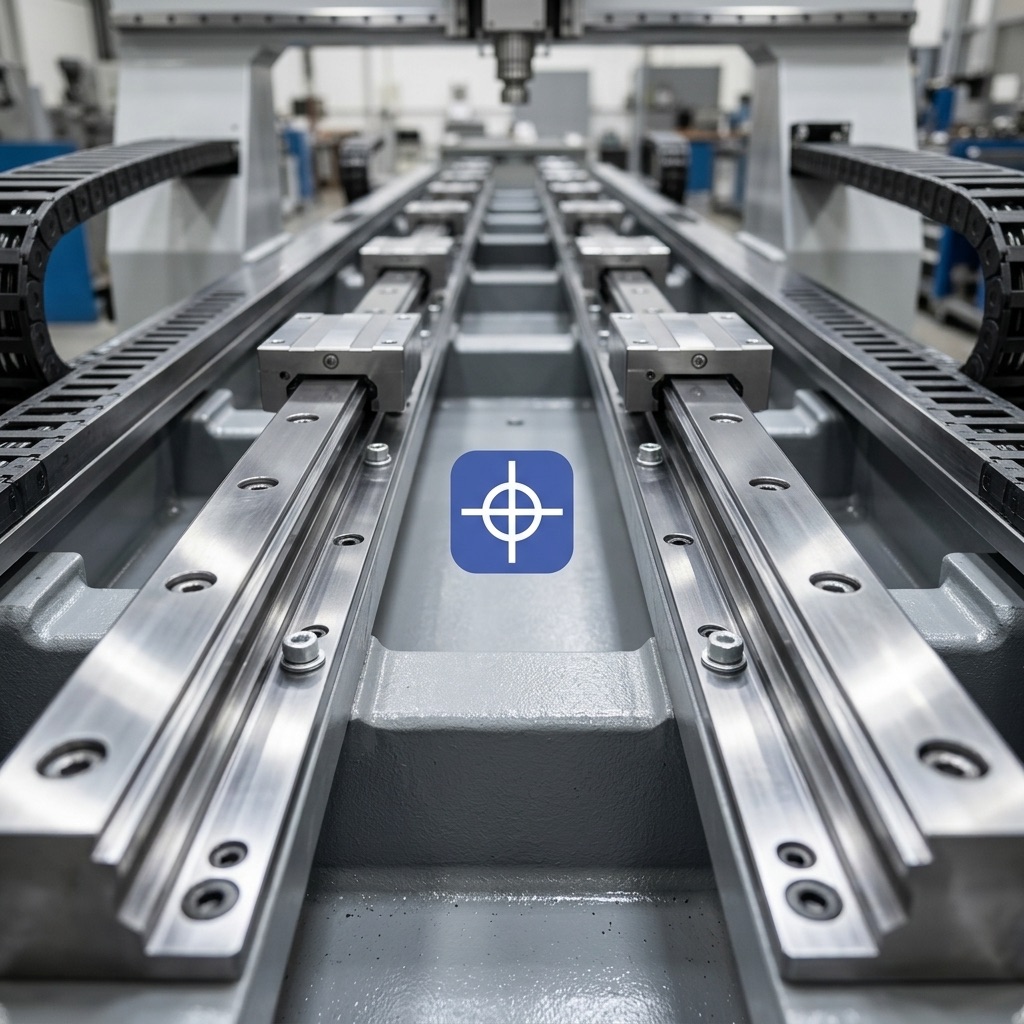
Linear guide rails, also known as linear motion guides or linear guideways, are precision mechanical components that allow machine axes to move along a straight path with minimal friction.
Unlike traditional sliding guides, modern linear guides use recirculating rolling elements—either balls or rollers—to reduce friction while maintaining high stiffness and load capacity.
A typical linear guide system consists of:
- Guide rail
- Linear carriage (guide block)
- Rolling elements (balls or rollers)
- End caps
- Seals
- Lubrication ports
Together, these components provide precise and repeatable linear motion.
How Linear Guide Rails Work
A guide block moves along a hardened steel rail while recirculating balls or rollers carry the load.
As the carriage travels:
- Rolling elements continuously circulate inside the guide block.
- Friction remains very low.
- Movement stays smooth and accurate.
- Machine rigidity is maintained.
This rolling contact significantly reduces wear compared to conventional sliding surfaces.
Types of Linear Guide Rails
Ball-Type Linear Guides
Ball-type guides use hardened steel balls as rolling elements.
Advantages
- Low rolling resistance
- High travel speed
- Smooth motion
- Cost-effective
- Suitable for most CNC routers and machining centers
Applications
- Woodworking routers
- Furniture production
- Laser cutting
- Plasma cutting
- General-purpose CNC machines
Roller-Type Linear Guides
Roller guides replace balls with cylindrical rollers.
Because rollers have a larger contact area, they provide:
- Higher rigidity
- Greater load capacity
- Better resistance to deformation
Applications
- Heavy-duty machining centers
- Large milling machines
- Stone processing equipment
- High-load industrial machines
Although roller guides are generally more expensive, they offer superior performance in demanding machining applications.
Key Characteristics of Linear Guide Rails
Load Capacity
Guide rails must support several types of loads simultaneously:
- Vertical loads
- Horizontal loads
- Side loads
- Moment loads caused by cutting forces
Selecting a guide with insufficient load capacity can reduce machine accuracy and shorten component life.
Rigidity
Rigidity refers to the guide’s resistance to elastic deformation under load.
Higher rigidity provides:
- Better machining accuracy
- Reduced vibration
- Improved surface finish
- Greater dimensional consistency
Machine rigidity depends on both the guide rail and the machine structure.
Accuracy Grade
Manufacturers classify linear guides according to their positioning accuracy.
Higher accuracy grades provide:
- Better straightness
- Reduced positioning error
- Improved repeatability
Precision-grade guides are commonly used in:
- CNC machining centers
- Precision milling machines
- High-end woodworking equipment
- Semiconductor manufacturing equipment
Preload in Linear Guides
Preload is the internal force applied between the rolling elements and the guide rail to eliminate internal clearance.
Proper preload improves:
- Rigidity
- Positioning accuracy
- Vibration resistance
However, excessive preload may increase:
- Friction
- Heat generation
- Bearing wear
- Required drive force
Selecting the appropriate preload depends on the machine’s application and operating conditions.
Factors Affecting Linear Guide Performance
Several factors influence guide rail performance.
Lubrication
Proper lubrication:
- Reduces friction
- Minimizes wear
- Extends service life
- Prevents corrosion
Automatic lubrication systems are commonly used in industrial CNC machines.
Contamination
Dust, chips, coolant, and abrasive particles can damage guide rails if they enter the rolling elements.
Protective components such as:
- Wipers
- Seals
- Bellows
- Covers
help maintain guide performance in harsh environments.
Alignment
Improper installation may result in:
- Uneven loading
- Increased friction
- Premature wear
- Reduced positioning accuracy
Precision alignment during machine assembly is essential for long-term reliability.
Linear Guide Rails vs Sliding Guideways
Older CNC machines often used sliding guideways instead of rolling-element guides.
| Feature | Linear Guide Rails | Sliding Guideways |
| Friction | Very low | Higher |
| Positioning Accuracy | Excellent | Good |
| High-Speed Motion | Excellent | Limited |
| Maintenance | Lower | Higher |
| Rigidity | High | Very High (depending on design) |
| Efficiency | High | Lower |
While sliding guideways remain suitable for some heavy-duty applications, linear guide rails dominate most modern CNC machines due to their efficiency and precision.
Common Causes of Linear Guide Failure
Guide rail failures are often caused by:
- Poor lubrication
- Contamination
- Incorrect installation
- Overloading
- Corrosion
- Misalignment
- Lack of preventive maintenance
Routine inspection and maintenance significantly extend guide life.
How Linear Guide Rails Affect Machining Quality
The quality of the linear guide system directly influences:
- Positioning accuracy
- Repeatability
- Surface finish
- Vibration levels
- Tool life
- Machine stability
Even with advanced servo systems and precise CNC controllers, worn or improperly installed guide rails can reduce machining performance.
The Relationship Between Linear Guides and CNC Controllers
Although guide rails are purely mechanical components, their performance directly affects motion control.
Industrial CNC controllers such as Radonix generate highly accurate motion commands and coordinate axis movement in real time. However, the machine’s ability to follow these commands depends on the condition and quality of its mechanical guidance system.
By combining precision linear guide rails with reliable motion control from Radonix, manufacturers can achieve smooth axis movement, stable machining, and consistent production quality.
Selecting the Right Linear Guide Rail
When choosing linear guides, engineers should consider:
- Machine type
- Maximum load
- Required positioning accuracy
- Travel speed
- Machine rigidity
- Environmental conditions
- Lubrication method
- Maintenance requirements
Proper selection improves machine performance while reducing maintenance costs and extending service life.
Conclusion
Linear guide rails are fundamental components of modern CNC machines, providing the precision, rigidity, and smooth motion required for high-quality machining. Their selection, installation, and maintenance have a direct impact on accuracy, repeatability, and machine reliability.
When combined with a high-performance CNC controller such as Radonix, a well-designed linear guide system enables manufacturers to achieve precise motion control, superior surface finish, and reliable operation across a wide range of CNC applications.
For industrial implementation, explore Radonix PC-based CNC controllers, control software and machine-specific HMI systems. Radonix PC-based CNC controller systems.