
Author: Nima Rad
Table of Contents
- Motion Control Quality and Smoothness
- Axis Count and Interpolated Axes
- Axis Control Method
- Communication and Industrial Protocols
- Ease of Installation, Setup, and Calibration
- Simplicity and Quality of the User Environment
- Documentation
- Standardization for Series Production and OEM
- Overall Suitability by Machine Type and Level
- Summary
Introduction
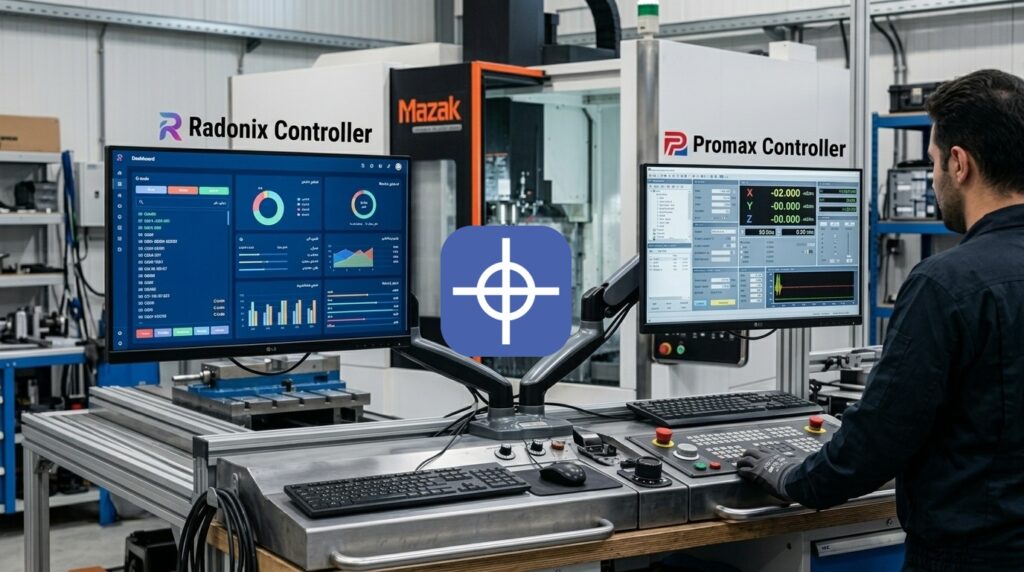
A Radonix vs Promax controller comparison is one of the common questions for machine builders choosing a control system for their CNC machine. Choosing the right control system is one of the most important steps in designing and building a CNC machine. A machine’s final quality doesn’t depend only on mechanical precision, the servo drive, or CAM software — the CNC controller has a direct effect on motion quality, axis coordination, I/O management, ease of operator use, and how far the machine can be developed.
Radonix and Promax are both systems designed for motion control and industrial applications, but their design philosophies differ to some extent.
Rather than being just a CNC controller, Promax is a Motion & Automation platform that gives designers capabilities such as:
- Step/Direction
- CANopen
- Analog Control
- PLC Logic
- Electronic Gear
- eCAM
- Software development
Radonix, by contrast, has tried to bring the controller, CAM-Pro software, machine interface, calibration, simulation, and commissioning tools together into one integrated CNC ecosystem.
So in a Radonix vs Promax controller comparison, comparing hardware specs alone isn’t enough — the whole process of turning a controller into a production-ready CNC machine needs to be considered.
The two systems are compared below across 16 main criteria.
1. Motion Control Quality and Smoothness
Motion quality is one of the most important criteria for evaluating a CNC controller.
A good motion system needs to execute the machine’s path with smooth, continuous, and predictable motion.
Factors such as the following affect final motion quality:
- Interpolation
- Acceleration
- Deceleration
- Speed profile
- Look ahead
- Path planning
- Corner handling
- Buffering
- Short segment processing
Radonix On controllers such as the PC-Smart 4A, Radonix offers features such as:
- 4 independent interpolated axes
- S-curve speed profile
- Hardware FIFO with a 2000-block capacity
- Pulse rate up to 500 kHz per axis
The S-curve profile makes speed and acceleration changes smoother and transfers less mechanical shock to the servo, stepper, ball screw, rack and pinion, gearbox, and the machine’s structure.
The hardware FIFO also lets a number of motion blocks be stored before they’re executed, helping the path run continuously.
Promax The Promax NGM EVO is also a professional motion controller, with diverse capabilities for interpolation and motion planning.
Features of the NGM EVO family include:
- Multi-axis interpolated control
- Look ahead
- Electronic gear
- eCAM
- CANopen motion
- Step/direction
Promax’s documentation for the NGM EVO reports up to 128 blocks at the second look-ahead level, and processing of around 500 blocks/sec over an Ethernet connection.
Electronic gear and eCAM are also a significant advantage for certain specialized synchronization and motion applications.
Comparison result In terms of motion, both systems sit at an industrial level. Promax, thanks to features like electronic gear, eCAM, and CANopen, offers more flexibility in specialized motion applications.
Radonix, on the other hand, offers a package of S-curve + hardware FIFO + interpolation + high pulse rate in one defined, CNC-ready architecture.
For a large share of 3-to-6-axis CNC machines, Radonix can deliver the required motion quality with relatively simpler configuration.
2. Axis Count and Interpolated Axes
Axis count alone isn’t the only criterion; the number of axes that can be interpolated simultaneously matters a great deal too.
Radonix The Radonix family includes 3-axis, 4-axis, and 6-axis controllers. For example, the PC-Smart 4A has four independent interpolated axes.
Promax The NGM EVO can control up to 6 axes in interpolation and a larger number of axes in positioning mode via CANopen. Promax’s technical resources cite control of up to 32 CANopen axes in position mode and six axes in interpolation mode for the NGM EVO.
Comparison result For typical 3, 4, and 6-axis CNC machines, both systems have suitable capacity. Promax has more room to scale in projects requiring a large number of networked axes. But for most conventional CNC machines, Radonix’s capacity matches the machine’s needs well and has a simpler structure.
3. Axis Control Method
One important criterion for choosing a controller is how it communicates with the servo drive or stepper drive.
Common methods include:
- Pulse/direction
- Analog ±10V
- CANopen
- EtherCAT
- Other real-time industrial networks
Radonix In the common Smart and Pro-LAN families, axis position control is mainly based on pulse/direction. On the PC-Smart 4A, the pulse rate is 500,000 pulses/sec per axis. This method is compatible with a wide range of servo and stepper drives.
Promax Promax has more flexibility in axis control methods. The NGM EVO can use step/direction and CANopen. With NGMsX expansions, it’s also possible to add step/dir outputs up to 500 kHz, analog ±10V, and encoder input. EtherCAT is also available in the Promax High-End family.
Comparison result If the machine is designed around pulse/direction, Radonix offers a very simple, direct solution. But in projects where CANopen, analog servo, EtherCAT, or network-based motion are part of the machine’s architecture from the start, the Promax family gives the designer more options.
4. Number and Type of I/O
On a CNC machine, the motion axes are only part of the system.
The controller also has to manage a large number of signals, such as:
- Home
- Limit
- Emergency stop
- Servo alarm
- Servo ready
- Tool sensor
- Vacuum
- Spindle
- Lubrication
- Pneumatic valve
- Clamp
- Safety sensor
Radonix For example, the PC-Smart 4A has 16 digital inputs, 8 digital outputs, 2 analog inputs (0–10V), and 2 analog outputs (0–10V). The PC-Pro LAN 4A model has 24 digital inputs, 16 digital outputs, 2 analog outputs, and 2 PWM outputs.
Promax The NGM EVO’s base configuration has 16 digital inputs, 14 digital outputs, 8 analog inputs (12-bit), and 1 analog output (0–10V). One of Promax’s strengths is its expansion capability. With the relevant expansions, I/O count can grow to 128 digital inputs and 112 digital outputs.
Comparison result For a mid-sized CNC, both systems offer suitable I/O. Radonix gives the machine builder I/O counts matched to the machine’s class directly on the controller across its various models. Promax has a more extensive expansion architecture for projects that need very large amounts of I/O.
5. Communication and Industrial Protocols
The type of communication matters a great deal for the machine’s stability, scalability, and architecture.
Radonix On many Radonix controllers, communication between the PC and controller happens over 100 Mbps Ethernet/TCP-IP. On the PC-Smart 4A, with a suitable cable, the communication distance can exceed 20 meters with UTP and 50 meters with SFUTP.
Promax The NGM EVO has Ethernet 10/100 Mbps, RS232, RS485, CANopen, and Modbus. EtherCAT is also available in the High-End family.
Comparison result For a standalone CNC, Radonix’s Ethernet creates a simple, suitable architecture. Promax offers more protocols for projects where the controller needs to communicate with a wider network of industrial equipment.
6. Ease of Installation, Setup, and Calibration
One important, and often hidden, cost with any controller is machine commissioning time.
Radonix Radonix offers tools such as CAM-Pro, CAM-Pro Calibrator, CAM-Pro Test, and Simulation Mode within one ecosystem. The machine builder can configure axes, inputs, outputs, velocity, acceleration, calibration, and the interface within a defined framework. Having a dedicated calibrator also makes axis calibration simpler.
Promax Promax also gives developers various professional tools, including IsoNs, VTB, NGProg, and CANopen Configuration. These tools offer a lot of capability, but the engineer needs to become familiar with a larger number of concepts and environments.
Comparison result Promax provides extensive development capability for a system integrator or automation engineer. Radonix has mostly tried to shorten the path from controller to CNC machine. For many CNC machine builders, this can reduce training and commissioning time.
7. Simplicity and Quality of the User Environment
The software environment is what the operator works with every day.
Radonix One important feature of CAM-Pro is the Machine-Specific Interface concept — meaning a machine’s interface can be designed exactly around that machine’s function. As a result, the operator isn’t necessarily exposed to every CNC setting. Only the buttons, information, alarms, and processes the operator needs can be placed on the main screens.
Promax Promax, through IsoNs, offers a complete CNC environment for G-code, axis position, offset, tool, work coordinate, and machine parameters. It’s also possible to develop a custom user interface with Promax’s software tools.
Comparison result Promax is very flexible in terms of software development capability. But in Radonix, designing an HMI matched to the machine has been part of CAM-Pro’s philosophy from the start. For a machine builder aiming for a simple operator environment, the Radonix workflow can be faster and more direct.
8. Interface/HMI Design and Editing Capability
On a commercial machine, the software’s appearance is part of the product itself.
Radonix CAM-Pro has an Interface Editing Environment. The machine builder can change buttons, text, images, position, size, font, color, and alignment. Interface elements can also be linked to functions, parameters, inputs, and outputs. This makes it possible to build a custom HMI without developing an independent software application.
Promax Promax also allows custom application development. VTB is a development environment for motion, logic, and applications, and allows building custom projects. This structure is very powerful, but it’s more developer-oriented.
Comparison result For a team with a software developer, Promax creates a high degree of freedom. For a machine builder that wants to change the interface’s look and behavior without deep involvement in software development, Radonix offers a simpler path.
9. Software Development and Machine Logic Capability
A modern CNC machine doesn’t just have motion — process logic matters a great deal too.
Radonix CAM-Pro allows the use of functions, parameters, variables, inputs, and outputs to build the machine’s various processes.
Promax Promax is very strong in this area. The NGM EVO supports PLC Cycle, VTB Language, Gear, eCAM, Modbus, and CANopen, making it possible to build very complex automation logic.
Comparison result For typical CNC logic, Radonix’s function-based structure can be faster and easier to understand. In projects where motion and PLC logic are very complex and fully custom, Promax offers a higher level of development capability.
10. Simulation, Diagnostics, and Troubleshooting Tools
Diagnostics matter a great deal during manufacturing and after-sales service.
Radonix Radonix offers Simulation Mode, CAM-Pro Test, I/O Monitoring, and Parameter Monitoring for testing the machine. Simulation Mode allows testing G-code, toolpaths, and parts of the logic without actually running the machine.
Promax Promax also offers suitable debug and development tools. VTB is used for programming and debugging motion and automation projects, and NGProg is used for firmware/application management.
Comparison result Both systems have suitable tools. Promax offers deeper tools from a software developer’s point of view. Radonix has created a simpler, more direct environment from a machine builder and service technician’s point of view.
11. Documentation Quality and Completeness
Having proper documentation is one of the most important factors in preserving a machine builder’s technical knowledge.
Radonix Radonix’s documentation covers topics such as the controller, installation, input, output, calibration, interface, functions, parameters, simulation, and interface editing.
Promax Promax also offers professional, extensive documentation for the NGM EVO, IsoNs, VTB, CANopen, expansion boards, and programming. This extensive documentation is one of the system’s strong points.
Comparison result Both systems are in a good position on documentation. Promax offers in-depth engineering documentation. Because Radonix’s CNC ecosystem is more centralized, the learning path for a machine builder can be shorter and simpler.
12. Industrial Robustness, Isolation, and Noise Resistance
A CNC controller typically operates in an environment that includes servo drives, VFDs, contactors, relays, spindles, and power cables.
Radonix The PC-Smart 4A uses optocoupler isolation, and its I/O is designed to work in an industrial environment. The PC-Pro LAN also has isolated inputs and protected outputs.
Promax The NGM EVO uses industrial 24V PNP I/O, and its structure is designed for industrial automation.
Comparison result Both systems can perform well in an industrial environment if the panel, grounding, and shielding are designed correctly. No decisive difference can be declared on this criterion without checking the actual installation.
13. Ease of After-Sales Service and Maintenance
In machine building, a controller’s real cost isn’t determined solely on the day the machine is sold.
Radonix Having the controller, CAM-Pro, interface, calibration, and test tools in one unified ecosystem can make troubleshooting simpler for a technician. A single machine’s configuration can also be replicated on similar machines.
Promax Promax is also a professional, maintainable system, but depending on its architecture, a project may include the controller, expansion, VTB application, IsoNs, and CANopen configuration.
Comparison result On complex projects, both systems require trained technical staff. For conventional CNCs, Radonix’s centralized architecture can make training and troubleshooting simpler.
14. Standardization Capability for Series Production and OEM
In series production, a machine’s configuration needs to be repeated many times.
Radonix A specific controller, interface, I/O, parameters, and calibration can be defined for one machine model, and the same structure can be applied to subsequent machines.
Promax Promax is also designed for OEM and industrial automation, and allows developing a standard application and replicating it across multiple machines.
Comparison result Both are suitable for OEM use. For OEMs with a strong automation/software team, Promax provides a great deal of development freedom. For companies that want to produce several standard CNC models with a smaller software team, Radonix can offer a simpler workflow.
15. Development Capability for Complex, Special-Purpose Machines
A machine’s complexity isn’t determined by axis count alone. A machine may have an automatic loader, tool changer, pneumatic system, many sensors, analog processes, safety logic, and automatic sequences.
Radonix Radonix allows building custom processes through its interface, functions, parameters, and I/O. This structure is practical for machines where much of the complexity lies in the HMI and process side.
Promax Promax has very extensive capabilities in this area. PLC Cycle, eCAM, Gear, CANopen, analog control, and expansion I/O make it suitable for very complex automation machines too.
Comparison result Radonix is a flexible option for many special-purpose CNCs. Promax offers more advanced capabilities on machines where complexity lies more in motion synchronization, PLC, and industrial networking.
16. Overall Suitability by Machine Type and Level
For choosing a controller, it’s better not to categorize machines by application name alone, but to look at their level of complexity.
Standard CNC machines A machine with 3 to 6 axes, servo or stepper motors, pulse/direction control, a moderate amount of I/O, a spindle, sensors, an HMI, and a few side processes can be considered a conventional industrial CNC. In this class, both systems have suitable technical capability. Because of the integration between the controller, CAM-Pro, calibration, and interface, Radonix can simplify the build and commissioning process.
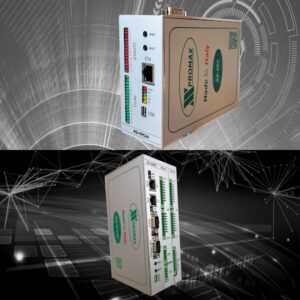
Real examples of the Promax NGM EVO family and related equipment
Machines with dedicated processes and HMI On some machines, axis count isn’t high, but the machine has an automatic sequence, multiple sensors, tool change, a loader, a pneumatic system, and dedicated operator screens. On this type of machine, Radonix is a notable option thanks to its interface editor and the direct link between the HMI and functions, parameters, and I/O.
Complex motion and automation systems At a higher level, a project may need a large number of axes, CANopen, electronic gear, eCAM, analog servos, advanced PLC logic, and fieldbus integration. In this group, Promax gives a system integrator very powerful tools.
Series production and OEM In OEM work, besides technical capability, factors such as repeatability, commissioning speed, technical staff training, after-sales service, price, and software maintenance matter. Both systems can be used in series production. Radonix can be attractive for a machine builder wanting to create a complete CNC product with less software complexity. Promax offers more development freedom for a company with a strong automation and software team.
Summary
Radonix and Promax are both professional motion control systems, and comparing them — unlike comparing an industrial controller against simpler systems — needs to be done carefully.
Promax has notable strengths in CANopen, electronic gear, eCAM, PLC logic, analog control, I/O expansion, and development tools, and is a very powerful platform for projects where complex motion and automation form the core of the machine.
Radonix has a philosophy more focused on CNC machine building. The combination of controller + CAM-Pro + interface + calibration + test + simulation means a large part of a machine builder’s needs can be met without launching an extensive software/automation project. On pricing, market research shows that in the 4-axis class, the base price of both systems is quite close — so Radonix can’t simply be labeled a more expensive or cheaper option.
The main difference lies more in how each system gets from controller to finished machine. Promax gives the engineer a very high degree of development freedom. Radonix tries to have more of that path already prepared in advance.
For this reason, for a machine builder whose priorities include suitable motion quality, a dedicated interface, simple commissioning, a lower learning curve, series production, after-sales service, and reduced development time, Radonix can be a serious option worth considering.
On the other hand, for projects that need a complex motion network, electronic gear, eCAM, or high-level automation, Promax’s development capabilities can offer a significant advantage.
Ultimately, the real difference between these two systems can’t be determined from a datasheet alone. Motion smoothness, actual commissioning time, ease of building an HMI, and operator experience are things best evaluated on a real machine.
For that reason, even for a machine builder currently using Promax, testing Radonix on a real project can produce a valuable practical comparison — especially if the goal is reducing development complexity without losing the core capabilities an industrial CNC needs.
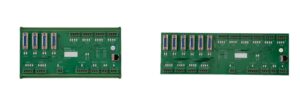
Radonix six-axis and four-axis Smart controllers
For product evaluation, compare Radonix PC-based industrial CNC controllers, expansion hardware, software and machine-specific interfaces. Radonix industrial CNC controller range.