
Author: Nima Rad
Short answer: To select a linear guide rail for a CNC machine, first calculate the moving mass, inertial and process forces, and the moments they create. Then choose ball-type guides for fast, moderate-load axes or roller-type guides for heavy, rigid machining, size the rail and carriage layout to those moments, and finally set accuracy class, preload, sealing and lubrication.
A linear guide rail is a core structural element of CNC machines and precision motion systems. Its role goes far beyond allowing linear movement: the rail determines how accurately the machine positions, how rigidly it resists cutting forces and how reliably it holds performance over time. Even the most advanced CNC controller cannot compensate for poor mechanical guidance.
Why Linear Guide Rails Are Critical
On every motion axis (X, Y and Z), the guide system governs several performance-critical factors:
- Positioning accuracy and repeatability over long production cycles
- Structural rigidity and resistance to bending and torsion
- Static and dynamic load capacity, including moment loads
- Speed and acceleration behaviour during direction changes
- Service life under wear and fatigue
- Resistance to contamination such as chips, dust, coolant and plasma debris
For these reasons a linear guide rail is the backbone of axis precision and durability, not a mechanical accessory. The quality of the guide system directly influences positioning accuracy, repeatability, surface finish, vibration level, tool life and machine stability.
What Linear Guide Rails Are and How They Work
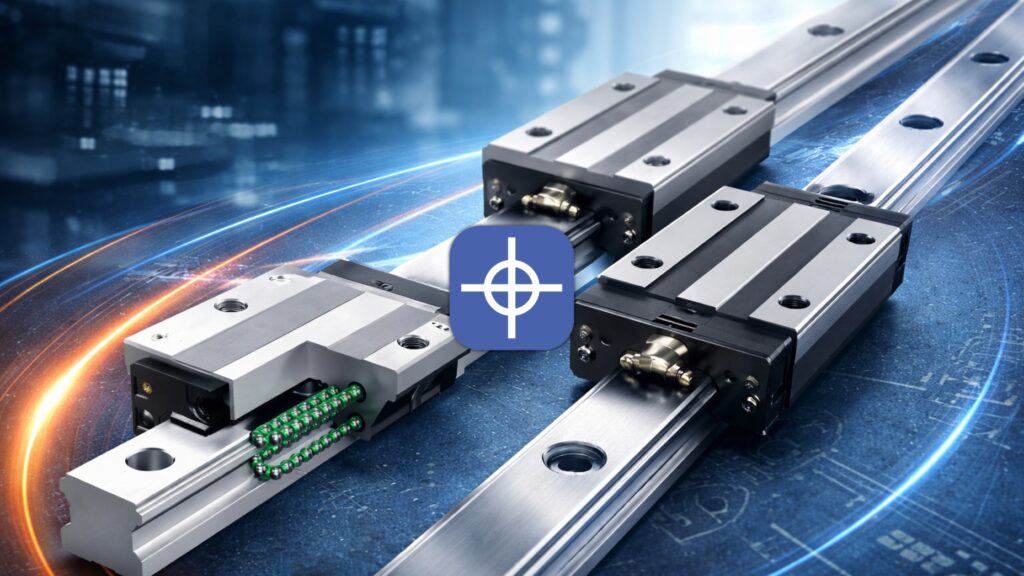
Linear guide rails, also called linear motion guides or linear guideways, are precision components that let machine axes move along a straight path with minimal friction. Unlike traditional sliding guides, they use recirculating rolling elements (balls or rollers) to reduce friction while keeping stiffness and load capacity high.
A guide block moves along a hardened steel rail while the rolling elements circulate inside it. Friction stays very low, movement stays smooth and accurate, and rolling contact greatly reduces wear compared with sliding surfaces.
Main Components and Terminology
- Rail: hardened steel profile with precision raceways
- Carriage (block): houses rolling elements, recirculation paths and sealing
- Rolling elements: balls or rollers carrying the applied loads
- End caps, seals, scrapers and covers: protection against contamination
- Lubrication points: grease nipples or ports for controlled lubrication
When reading manufacturer catalogues, evaluate these parameters:
- Dynamic load rating (C) and static load rating (C0)
- Moment ratings (Mx, My, Mz) for bending and torsional loads
- Preload level, which defines internal clearance and stiffness
- Accuracy class (such as N, H, P, SP, UP, depending on the manufacturer)
- Clearance class (C0, C1, Z0, ZA, and so on)
- Nominal rail size, commonly 15, 20, 25, 30, 35, 45 and above
Types of Linear Guide Rails
Ball-Type Guides
Ball-type guides are the most common solution in CNC and automation. Rolling balls give low friction and smooth motion, allowing high travel speed with relatively low drive force.
- Advantages: low rolling resistance, high speed, smooth motion, cost-effective.
- Applications: woodworking routers, furniture production, laser and plasma cutting, general-purpose CNC axes.
- Trade-off: lower rigidity and shock resistance than rollers, so protection and maintenance matter more.
Roller-Type Guides
Roller guides use cylindrical rollers. The larger contact area gives significantly higher rigidity, load capacity and resistance to moment loads and shock.
- Applications: heavy-duty machining centres, large milling machines, stone processing, machine tools, presses and high-load robotic systems.
- Trade-off: higher cost and more demanding alignment during installation.
Miniature and Curved Guides
Miniature guides suit compact mechanisms with limited space and low loads, such as medical devices and precision instruments. Curved guides allow non-linear motion paths and are used only in specialised applications.
Carriage Types and Their Mechanical Impact
The carriage geometry affects how loads and moments reach the rail. Short carriages are compact with low moving mass, useful for high-speed axes, but their shorter contact length limits moment capacity. Long carriages increase the spacing between rolling elements and improve resistance to bending and torsional moments. Flanged carriages simplify mounting and give a larger contact surface with the machine structure, while non-flanged (square) carriages are used where installation space is limited. Choosing the carriage type is often as important as choosing the rail size.
Rail Size Selection by Application
Smaller rails suit light-duty machines, and larger sizes are reserved for heavier systems with higher forces and moments.
| Rail size | Typical use |
| 15 and 20 | Light CNC machines and small laser systems |
| 25 | Medium-duty CNC machines, including wood routers and plasma cutters |
| 30 and 35 | Heavier axes needing more stiffness and acceleration capability |
| 45 and above | Heavy machine tools and high-load applications |
These rules give orientation only. Accurate selection always requires an engineering evaluation of loads, moments and layout.
Engineering Method for Selecting a Linear Guide Rail
- Define the real operating loads. Include the total moving mass (gantry, spindle, motors, cable chains and accessories), process forces during cutting, and inertial forces from acceleration, which can exceed cutting forces during rapid motion.
- Evaluate the moments. Moments arise whenever forces act at a distance from the rail plane, for example when a spindle is mounted forward of the carriage group on a Z axis. They are often the dominant factor and are commonly underestimated.
- Optimise the layout. Greater distance between parallel rails improves resistance to torsion, and greater spacing between carriages on one rail improves moment capacity. Optimising layout is often more effective and economical than choosing a larger rail.
- Choose the technology. Ball-type for general-purpose, high-speed, moderate-load axes; roller-type for high rigidity and shock resistance.
- Select accuracy class and preload. Higher preload increases stiffness but also raises friction, heat and sensitivity to misalignment.
- Verify rated life. Use the manufacturer’s formulas; for ball-type guides, life is commonly proportional to (C/P)³, where C is the dynamic load rating and P the equivalent load.
- Address the environment. Specify sealing, covers and lubrication, especially in dusty or abrasive conditions.
Key Characteristics Explained
Load Capacity
Guide rails carry vertical, horizontal and side loads together with moment loads caused by cutting forces. Insufficient capacity reduces accuracy and shortens component life.
Rigidity
Rigidity is resistance to elastic deformation under load. Higher rigidity gives better machining accuracy, less vibration, a better surface finish and more consistent dimensions. Machine rigidity depends on both the guide and the structure it is mounted to.
Accuracy Grade
Higher accuracy grades provide better straightness, lower positioning error and improved repeatability. Precision grades are common in CNC machining centres, precision mills, high-end woodworking equipment and semiconductor equipment.
Preload
Preload is the internal force applied between rolling elements and rail to remove internal clearance. Proper preload improves rigidity, positioning accuracy and vibration resistance. Excessive preload increases friction, heat, wear and the drive force required, particularly in poorly aligned structures.
Lubrication, Contamination and Alignment
- Lubrication reduces friction and wear, extends service life and prevents corrosion. Automatic lubrication systems are common on industrial CNC machines.
- Contamination from dust, chips, coolant and abrasive particles damages the rolling elements. Wipers, seals, bellows and covers protect the guides in harsh environments.
- Alignment matters at assembly. Improper installation causes uneven loading, higher friction, premature wear and reduced accuracy.
Linear Guide Rails vs Sliding Guideways
| Feature | Linear guide rails | Sliding guideways |
| Friction | Very low | Higher |
| Positioning accuracy | Excellent | Good |
| High-speed motion | Excellent | Limited |
| Maintenance | Lower | Higher |
| Rigidity | High | Very high (depending on design) |
| Efficiency | High | Lower |
Sliding guideways remain suitable for some heavy-duty applications, but linear guide rails dominate most modern CNC machines because of their efficiency and precision.
Common Mistakes and Causes of Failure
Many failures come from design and installation errors rather than insufficient load capacity. The common ones are:
- underestimating moment loads,
- choosing a larger rail without improving the layout,
- applying excessive preload in poorly aligned structures,
- neglecting lubrication and contamination protection,
- overloading,
- corrosion,
- misalignment and lack of preventive maintenance,
- low-quality rails with poor metallurgy, which can lead to early spalling and rapid loss of accuracy.
Installation Considerations
Mounting surfaces must be flat and accurately aligned, and fasteners tightened to the specified torque. Control rail parallelism with reference edges or locating features. After installation, verify smooth motion across the full stroke to detect any localised binding or misalignment.
Application-Based Guidance
- Woodworking CNC: ball-type guides in size 20 or 25 are common on main axes, with smaller sizes often used on Z axes.
- Plasma CNC: similar sizes, but sealing and regular cleaning matter more than rail size because of metal dust.
- Light to medium metal CNC: size 25 or 30 ball-type guides, or roller guides on critical axes.
- Heavy machine tools: roller-type guides with precise installation and controlled lubrication.
How Guide Rails and the CNC Controller Work Together
Guide rails are purely mechanical, but their condition directly affects motion control. A controller such as Radonix generates accurate motion commands and coordinates the axes in real time, yet the machine can only follow those commands as well as its mechanical guidance allows. Worn or poorly installed rails also make axis tuning harder; see the guide to servo motor tuning and our article on ball screws for zero-backlash precision.
Final Selection Checklist
Before finalising a selection, confirm:
- moving mass, acceleration and speed requirements,
- process forces and moment arms,
- rail spacing and carriage spacing,
- environmental conditions,
- required accuracy and preload,
- lubrication method and maintenance plan,
- budget constraints.
FAQ
What is the difference between ball-type and roller-type linear guides?
Ball-type guides have lower friction and suit fast, moderate-load axes. Roller-type guides have a larger contact area, giving higher rigidity and load capacity for heavy machining at higher cost.
What rail size do I need for a CNC router?
Sizes 20 and 25 are common on CNC routers, but the right size depends on the moving mass, forces and moments, so always check the load calculation.
What is preload in a linear guide?
Preload is an internal force that removes clearance between rolling elements and the rail. It increases stiffness and accuracy but raises friction and heat if excessive.
Why do linear guides fail early?
The usual causes are poor lubrication, contamination, incorrect installation, misalignment, overloading and ignoring moment loads.
Are linear guide rails better than sliding guideways?
For most modern CNC machines, yes: lower friction, higher speed and lower maintenance. Sliding guideways remain useful in some heavy-duty designs.
Choose Guides That Match Your Axis
Linear guide rails provide the precision, rigidity and smooth motion that high-quality machining depends on. Selection, installation and maintenance directly affect accuracy, repeatability and reliability.
Contact Radonix or use the chatbot in the bottom right corner to discuss motion control for your machine. For industrial implementation, explore Radonix PC-based CNC controller systems, control software and machine-specific HMI systems.
For industrial implementation, explore Radonix PC-based CNC controllers, control software and machine-specific HMI systems. Radonix PC-based CNC controller systems.