
Table of Contents
- Workshop Safety and Standards
- Understanding the CNC Machine and Its Main Components
- Vital Concepts of Coordinates and Offsets
- Blueprint Reading and Tolerances
- Tooling Knowledge and Tool Selection
- Fundamentals of Speeds/Feeds and Chip-Removal Logic
- Program Principles and G-code at the CNC Operator Level
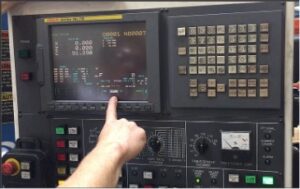
- Best Practice for the Control Panel and Machinery
- Setup and Fixturing
- Safe Program Execution and Process Control
- Common Troubleshooting
- Daily/Weekly Maintenance at the CNC Operator Level
What a CNC Operator Should Know
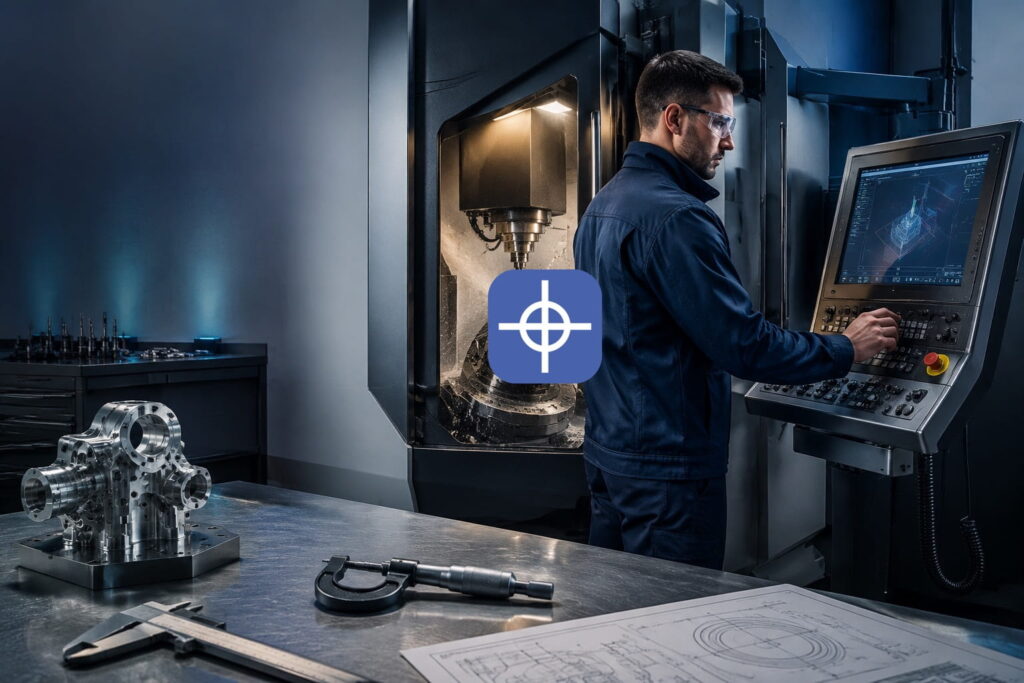
A CNC operator is not just a “button-pusher”; the CNC operator is responsible for turning a blueprint and a program into a sound, accurate, and repeatable part. This means the CNC operator must be skilled at the same time in safety, correct setup, quality control, process monitoring, basic machine maintenance, and communication with the programmer/supervisor.
1. Workshop Safety and Standards — Priority Number One
Every CNC operator should turn the following into daily habits:
- PPE: safety glasses, safety shoes, hearing protection, and gloves only during material handling (never when approaching the rotating tool).
- Common hazards: chip ejection, clothing/hair getting caught in the spindle, tool breakage, coolant splashing, a loose part inside the fixture.
- Lockout/Tagout (LOTO) during serious servicing/cleaning.
- Rules for approaching the part: never put your hand inside the axis travel zone in automatic mode; remove chips only with a brush/hook, never by hand.
- Knowledge of emergency switches and interlocks: E-Stop, Door Interlock, Feed Hold, Reset, and how each one functions.
2. Understanding the CNC Machine and Its Main Components
The CNC operator must know what each part does and what its failure symptoms look like:
- Axes and motion system (X/Y/Z, and A/B/C if present)
- Spindle (RPM, torque, abnormal noises, overheating)
- Servo/stepper motors and encoders — Follow Error and Overload alarms
- Coolant and lubricant — level, concentration, filter clogging, nozzles
- Pneumatics/hydraulics (if present) for clamps and tool changing
- ATC tool holder — tool sequence, sensors, changeover errors
- Limits and Home/Reference — the concept of homing, limit switches, soft limits.
3. Vital Concepts of Coordinates and Offsets (Where Most Costly Errors Occur)
The CNC operator must clearly understand and check the difference between the following:
- Machine Coordinate versus Work Coordinate
- Part zero and G54…G59 offsets, or equivalent Work Offsets
- Tool Length Offset / H and Cutter Radius Compensation / D
- The concept of positive/negative Z and the dangers of getting the Z-axis direction wrong
- Methods of setting zero: part edge, edge finder/probe, feeler gauge, measuring tool, tool sensor plate
Practical note: many accidents come from these three mistakes: wrong G54, wrong tool length, wrong Z zero.
4. Blueprint Reading and Tolerances (For Delivering an Acceptable Part)
The CNC operator must know at least the basics of blueprint reading:
- Dimensioning, datums, tolerances (±, H7/g6, etc.)
- Surface roughness (Ra), chamfers/fillets, threads, and common standards
- Basic GD&T (at minimum: flatness, perpendicularity, concentricity, position)
- Recognizing “critical dimensions” that must be checked during machining.
5. Tooling Knowledge and Tool Selection
Essential knowledge for the CNC operator:
- Tool types: endmill, drill, reamer, tap, insert/turning tools (in turning), form tools, etc.
- Materials: HSS, carbide, TiAlN coatings, and their general applications
- Holders: collet, hydraulic, taper spindle (BT/HSK), and the concept of Runout
- Tool overhang length and its effect on vibration and breakage
- Signs of tool wear: chipping, discoloration, squealing noise, increased spindle load, poor surface finish.
6. Fundamentals of Speeds/Feeds and Chip-Removal Logic
The CNC operator should be able to make “logical” decisions rather than just memorizing numbers:
- The difference between Feed (mm/min) and Feed per Tooth (Chip Load)
- Effect of parameters:
- High RPM + low Feed => thin chips, wear/heat
- High Feed + large DOC => heavy load, tool breakage/vibration
- Influencing factors: workpiece material, tool diameter, number of flutes, fixture rigidity, tool length, coolant
- Signs of incorrect settings:
- Chatter, Built-up edge, dull/burnt surface, powdery or overly blue chips.
7. Program Principles and G-code at the CNC Operator Level
The CNC operator does not need to be a full programmer, but must be able to read the program, verify it, and run it safely:
- The concept of Modal commands and how some codes stay active until the next change
- Initial safety lines (Safety Line) and the meaning of the modes
- Common codes:
- Motion: G0/G1/G2/G3
- Planes: G17/G18/G19
- Units: G20/G21
- Offsets: G54…
- Cutter compensation: G41/G42/G40
- Drilling cycles (if used)
- Main M-codes (spindle, coolant, stops)
- Ability to quickly locate: the first Z move, the first approach to the part, tools, stopping points, macros/subroutines
- Understanding CAM output and the concept of the Post Processor — at least enough to know “where the program came from and why it might differ.”
8. Best Practice for the Control Panel and Machinery — Workholding, the Pillar of Accuracy and Repeatability
Key knowledge for the CNC operator:
- Fixture types: vise, clamp, dedicated fixture, vacuum (wood/composite), 3-jaw/4-jaw chuck (turning)
- Principles:
- Three-point support, preventing warping, chip evacuation path
- Making sure the tool does not collide with the clamp/vise
- Controlling clamping torque and repeatability
- Alignment: parallel to the axis, shimming if needed
- Preventing human error: numbering fixtures/tools/positions, a setup checklist.
9. Setup and Fixturing
Professional job-execution routine for the CNC operator:
- Checking the program and tools (the right tool in the right place, correct length/diameter)
- Dry Run / Simulation at a safe, elevated Z height
- Step-by-step execution: Single Block + low Feed Override
- Checking the first article and recording the results
- Monitoring during production:
- Cutting sound, spindle load, coolant condition, chip shape
- Periodic inspection of critical dimensions (e.g., every 5 or 10 parts)
10. Safe Program Execution and Process Control — Measurement and QC for the CNC Operator
Common tools and required skills for the CNC operator:
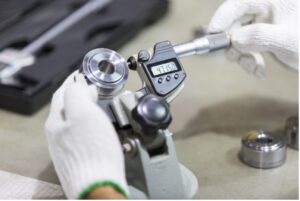
- Calipers, micrometer, dial indicator, depth gauge, thread gauge, reference block
- Measurement principles:
- Clean surfaces, part temperature, hand pressure, repeatability
- Data logging: dimensional report, wear-offset corrections with a clear logic
- Understanding the difference between “offset correction” and “program tampering” (especially in serial production).
11. Common Troubleshooting — With a Cause-and-Effect Approach
Several frequent problems and the diagnosis path for the CNC operator:
- Constant dimensional error on all parts
- Wrong part zero, wrong offset, wrong tool, blueprint/program error
- Dimensional error that worsens over time
- Tool wear, overheating, fixture loosening, changing coolant concentration
- Chatter (wavy vibration)
- Excessive tool length, unsuitable RPM, weak fixture, excessive DOC, dull tool
- Poor surface finish/excessive burr
- Dull tool, unsuitable parameter, poor chip evacuation, insufficient coolant
- Tool breakage
- Collision, excessive feed, poor chip evacuation, loose clamp, wrong toolpath.
12. Daily/Weekly Maintenance at the CNC Operator Level
Goal: preventing production stoppages and preserving machine accuracy.
- Daily:
- Cleaning chips, checking coolant, checking air pressure, checking for abnormal noise/vibration
- Weekly:
- Cleaning filters, checking nozzles, inspecting for leaks, cleaning sensors
- Periodic (coordinated with maintenance):
- Lubricating axes, backlash/play, homing accuracy, spindle/ATC servicing.
Soft Skills and Professionalism of the CNC Operator
- Precise communication with the programmer: reporting “where, with which tool, at which stage” a problem occurred
- Workshop discipline (5S), tool labeling, control of consumable tool inventory
- Documentation: recording offset changes, replaced tools, reasons for stoppages
- Risk management: when unsure, running the program under safe conditions — low Feed, Single Block, safe Z.
Ready-to-Use Checklists
Pre-Shift Checklist
- Machine is homed and has no alarms
- Coolant/air/lubrication OK
- Tools are in the correct positions per the program list
- .. offsets and tool lengths have been checked
- Fixture is secure and has no collision path
First-Article Execution Checklist
- Dry Run at a safe Z
- Single Block for the first approach
- Check the first critical dimensions and record the result
- Adjust the Wear Offset if permitted
End-of-Shift Checklist
- Cleaning and collecting chips
- Recording the production/quality/alarm report
- Preparing consumable tools for the next shift
Author: Nima Rad