

Nima Rad
Table of Contents
- What Is a Temperature Sensor?
- Main Components of a Temperature Sensor
- Types of Temperature Sensors
- Types of Temperature Sensor Physical Forms
- What Is a Thermowell?
- Using a Temperature Sensor in Electrical Panels and CNC Machines
- Important Tips for Selecting and Installing a Temperature Sensor
- Common Mistakes in Using a Temperature Sensor
- Trusted Temperature Sensor Brands
- Summary
What Is a Temperature Sensor?
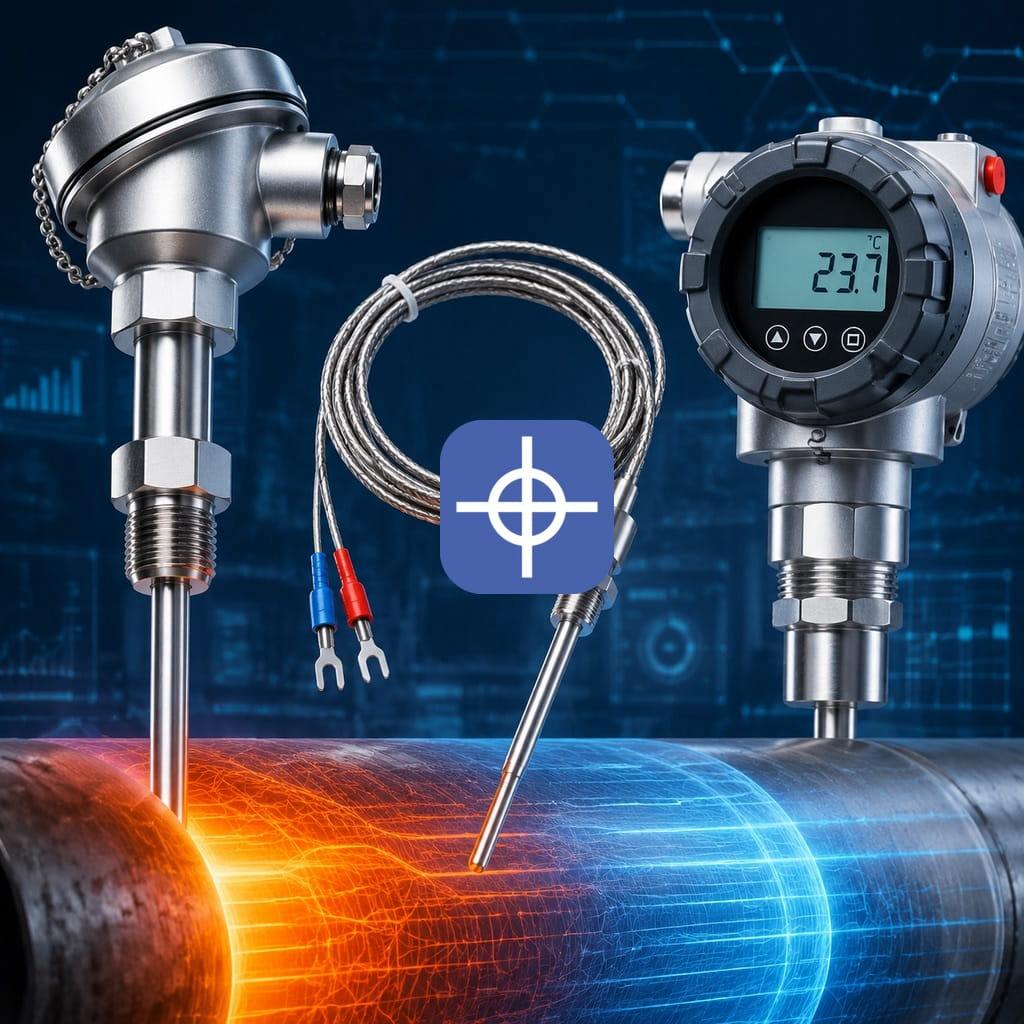
A temperature sensor is a device that measures the temperature of an object, fluid, environment, or machine and converts it into a signal usable by display, control, or automation systems.
A temperature sensor’s output can be one of the following:
- A change in electrical resistance
- A change in voltage
- An analog signal such as 0 to 10V
- A current signal such as 4 to 20mA
- A digital signal
- Industrial communication such as RS-485, Modbus RTU, IO-Link, or Ethernet
These devices are used across various industries to control processes, protect equipment, improve production quality, prevent overheating, and reduce energy consumption.
Main Components of a Temperature Sensor
A temperature sensor’s structure varies by type, but most industrial models are made up of the following parts:
1. Temperature-Sensitive Element
This is the most important part of a temperature sensor and directly detects temperature changes. This element can be one of the following types:
- Thermocouple
- Platinum resistance
- Thermistor
- Semiconductor
- Infrared detector
2. Protective Sheath
In industrial sensors, the sensitive element sits inside a metal sheath. This sheath protects the element against the following:
- Moisture
- Pressure
- Impact
- Chemicals
- Corrosion
- Wear
- Very high temperatures
A sensor’s sheath is usually made of stainless steel, Inconel, ceramic, or heat-resistant alloys.
3. Cable or Connection Terminal
The signal is transmitted to the controller through a cable, connector, or terminal. At high temperatures, heat-resistant, fiberglass, PTFE, or shielded cable should be used.
4. Temperature Transmitter
In some sensors, a Temperature Transmitter converts the raw signal into a standard industrial signal, such as 4-20mA or 0-10V.
How Does a Temperature Sensor Work?
Every type of temperature sensor operates based on a specific physical phenomenon. For example:
- In an RTD, a metal’s resistance increases as temperature rises.
- In a Thermistor, a semiconductor’s resistance changes with temperature.
- In a Thermocouple, a temperature difference between two metal junctions generates a voltage.
- In Infrared sensors, the thermal energy radiated from a surface is measured.
- In semiconductor sensors, changes in the chip’s electrical characteristics are used to calculate temperature.
The generated signal is received by a controller, PLC, thermostat, or temperature display, and is used to control equipment such as fans, heaters, chillers, solenoid valves, or alarm systems.
Types of Temperature Sensors
1. Thermocouple
A Thermocouple is made up of a junction between two different metals. When the junction’s temperature changes, a very small voltage in the millivolt range is generated.
Common Thermocouple Types
- Type K
- Type J
- Type T
- Type E
- Type N
- Type R
- Type S
- Type B
Type K Thermocouple
The Type K thermocouple is one of the most widely used models in industry and is typically used to measure medium to high temperatures.
Advantages:
- Wide temperature range
- Good response speed
- Affordable price
- Good mechanical strength
- Can be used at very high temperatures
Disadvantages:
- Lower accuracy than RTD
- Generates a very weak signal
- Requires cold junction compensation
- Sensitive to electrical noise
- Requires cable specific to that thermocouple type
Applications:
- Industrial furnaces
- Plastic injection machines
- Extruders
- Heaters
- Steam boilers
- Steel and foundry industries
- Thermal equipment
A thermocouple is made up of a junction between two dissimilar metals. The temperature difference between the hot junction and the reference junction produces a very small voltage in the millivolt range, which the controller or display converts into a temperature reading.
2. RTD Temperature Sensor
RTD stands for Resistance Temperature Detector. This temperature sensor works based on the change in a metal’s resistance as temperature changes.
The most common industrial RTD is the Pt100 sensor. “Pt” indicates platinum, and the number 100 indicates the sensor’s resistance at zero degrees Celsius.
Pt100 resistance at zero degrees is approximately: 100 Ω
Common RTD models include:
- Pt100
- Pt500
- Pt1000
- Ni100
- Cu50
Pt100 Wiring Methods
A Pt100 sensor is wired in one of three ways:
2-wire connection The simplest method, but cable resistance adds to the measured value and causes error.
3-wire connection The most common industrial method. In this method, the controller largely compensates for the wire resistance.
4-wire connection The most accurate measurement method, mostly used in laboratories and calibration equipment.
Advantages:
- High accuracy
- Good stability
- Good repeatability
- Better linearity than a thermocouple
- Suitable for precise industrial measurements
Disadvantages:
- Higher price than a thermocouple
- Slower response speed in some models
- Narrower temperature range than some thermocouples
- Sensitive to strong shock and vibration
Applications:
- Tanks and pipelines
- Laboratory equipment
- Industrial machinery
- Precise temperature control systems
An industrial Pt100 sensor’s complete structure includes a connection head, wires, insulation, sheath, and the platinum element.
3. Thermistor
A Thermistor is a type of temperature-sensitive resistor made from semiconductor materials.
Thermistors fall into two main groups:
NTC In the Negative Temperature Coefficient type, resistance decreases as temperature rises.
PTC In the Positive Temperature Coefficient type, resistance increases as temperature rises.
Advantages:
- High sensitivity
- Affordable price
- Small size
- Fast response
- Suitable for electronic circuits
Disadvantages:
- Limited measurement range
- Nonlinear behavior
- Sensitive to self-heating
- Not suitable for very high temperatures
Applications:
- Power supplies
- Electronic boards
- Medical equipment
- Home appliances
- 3D printers
- Battery temperature control
- Motor and winding protection
The two thermistor types behave differently: in NTC, resistance decreases as temperature rises, while in PTC, resistance increases as temperature rises. These components are mostly used in electronic circuits, thermal protection, and temperature control.
4. Semiconductor Temperature Sensor
Semiconductor sensors, or IC Temperature Sensors, are manufactured as chips and can have an analog or digital output.
Well-known examples include:
- LM35
- TMP36
- DS18B20
- TMP117
- MAX31865
Advantages:
- Small size
- Easy connection to a microcontroller
- Digital output on some models
- Affordable price
- Multiple sensors can share one communication bus
Disadvantages:
- Limited temperature range
- Not suitable for very harsh environments
- Lower mechanical strength than industrial models
- Sensitive to noise and installation conditions
Applications:
- Electronics projects
- Smart equipment
- IoT systems
- Electrical panel temperature control
- Home control systems
5. Infrared Temperature Sensor
An Infrared Temperature Sensor measures an object’s surface temperature without physical contact.
Every object above absolute zero emits infrared energy. The sensor calculates the surface temperature by measuring this energy.
Advantages:
- Non-contact measurement
- Very high response speed
- Suitable for moving objects
- Suitable for very hot objects
- No product contamination
Disadvantages:
- Measures surface temperature, not internal temperature
- Affected by dust, steam, and smoke
- Depends on the surface’s emissivity
- Errors on shiny, reflective surfaces
- Higher price for industrial models
Applications:
- Glass industry
- Steel and foundry
- Production lines
- Moving parts
- Furnaces
- Medical equipment
- Food temperature control
- Checking the temperature of electrical components
In non-contact measurement, infrared radiation emitted from the object’s surface is captured by a lens and focused onto a detector. A processing circuit then converts the radiation intensity into a temperature reading shown on the display. This type measures the object’s surface temperature, not its internal temperature.
6. Bimetal Sensors
A Bimetal sensor is made from a junction of two metals with different expansion coefficients. As temperature changes, the bimetal strip bends and opens or closes an electrical contact.
This type is mostly used in thermostats and protective equipment.
Advantages:
- Simple structure
- No power supply needed
- Affordable price
- Can switch directly
Disadvantages:
- Lower accuracy
- Slow response
- Hysteresis
- Not suitable for precise measurement
Contact and Non-Contact Temperature Sensors
Temperature sensors fall into two groups based on their measurement method.
Contact sensor The sensor must be in contact with the object or fluid.
Examples:
- Thermocouple
- Pt100
- Thermistor
- Semiconductor sensor
Non-contact sensor The sensor measures thermal radiation from a surface at a defined distance.
Examples:
- Infrared sensor
- Pyrometer
- Thermal camera
Types of Temperature Sensor Physical Forms
A temperature sensor can be manufactured in various physical forms:
- Rod sensor
- Threaded sensor
- Cable sensor
- Surface sensor
- Ring sensor
- Flat sensor
- Head-type sensor
- Flange sensor
- Duct sensor
- Ambient sensor
- Pipe-specific sensor
- Sheathed sensor
- Sensor with a thermowell
The sensor’s physical form should be chosen based on the installation location, response speed, pressure, fluid type, and environmental conditions.
What Is a Thermowell?
A Thermowell is a protective sheath installed inside a tank or pipe, with the temperature sensor placed inside it.
A thermowell lets the sensor be replaced without stopping the process or draining the tank.
Advantages of a Thermowell
- Protects the sensor against pressure
- Increases mechanical strength
- Prevents direct contact between the sensor and corrosive materials
- Allows sensor replacement while the production line is running
- Extends the sensor’s service life
Using a thermowell may slightly reduce the sensor’s response speed.
Temperature Sensor Outputs
A temperature sensor can have various outputs:
Resistive output Such as: Pt100, Pt1000, NTC, PTC
Millivolt output Such as thermocouples.
Voltage output Such as: 0 to 5V, 0 to 10V, 1 to 5V
Current output A 4 to 20mA output is one of the best choices for industrial environments and signal transmission over long distances.
Digital output Such as: RS-485, Modbus RTU, IO-Link, I²C, SPI, 1-Wire, Ethernet
Using a Temperature Sensor in Electrical Panels and CNC Machines
In CNC machines, excessive temperature rise can damage the controller, drive, servo motor, spindle, and power supply.
A temperature sensor is used in this equipment for the following purposes:
- Measuring the temperature inside the electrical panel
- Controlling the panel’s fan and cooler
- Protecting the spindle
- Controlling motor temperature
- Monitoring drive temperature
- Controlling the cooling system’s temperature
- Protecting the power supply
- Detecting a clogged filter or fan failure
- Generating a high-temperature alarm
- Triggering an emergency stop under dangerous conditions
Electrical panels typically use a thermostat, Pt100, NTC, or digital sensors.
Important Tips for Selecting a Temperature Sensor
1. Temperature Range
First, the process’s minimum and maximum temperature must be defined. Using a temperature sensor outside its rated range causes errors or damage.
2. Measurement Accuracy
For general applications, an error of one or two degrees may be acceptable, but pharmaceutical, food, and laboratory industries require more precise sensors.
3. Response Speed
Sensors with a smaller diameter and direct contact respond faster. Increasing sheath thickness and using a thermowell reduce response speed.
4. Output Type
A temperature sensor’s output must be compatible with the PLC, controller, or display’s input. For long cable runs, a 4-20mA output is usually the more reliable choice.
5. Environmental Conditions
The following should be checked:
- Humidity
- Vibration
- Pressure
- Corrosive materials
- Presence of oil or water
- Dust
- Electromagnetic fields
- Risk of mechanical impact
6. Sheath Material
Stainless steel can be used for normal environments. In corrosive environments or at very high temperatures, more resistant alloys should be used.
7. Temperature Sensor Length and Diameter
The sensor’s length must be enough for its sensitive part to sit properly inside the measured medium.
A smaller diameter gives a faster response, while a larger diameter gives higher mechanical strength.
8. Mounting Type
The connection type can be one of the following:
- Threaded
- Flanged
- Compression
- Surface-mounted
- Magnetic
- Adhesive
- Welded
- Installed inside a thermowell
9. Protection Class
For humid or industrial environments, a suitable protection rating such as IP65, IP67, or IP68 should be chosen.
Important Temperature Sensor Installation Tips
- The sensor’s sensitive part must sit fully inside the measured medium;
- The temperature sensor shouldn’t be installed at a dead zone in the flow;
- In fluid lines, the mounting location must represent the process’s actual temperature;
- The temperature sensor’s cable should be kept away from motor, inverter, and power cables;
- For a thermocouple, use compensating cable matching the same Type;
- Shielded cable should only be grounded according to the manufacturer’s instructions;
- Avoid sharply bending the sensor’s sensitive part;
- Use a standard thermowell in high-pressure environments;
- A long 2-wire Pt100 cable run can introduce significant error;
- In vibrating environments, use a rugged sensor and connector;
- The temperature sensor shouldn’t be exposed directly to flame, unless designed for that use.
Common Mistakes in Using a Temperature Sensor
Choosing the wrong range Installing a standard temperature sensor in a very hot environment reduces its life and causes errors.
Using the wrong cable for a thermocouple Using standard copper wire instead of thermocouple-specific cable can cause measurement errors.
Ignoring cold junction compensation A thermocouple controller must support Cold Junction Compensation.
Using a 2-wire Pt100 over a long distance Cable resistance increases the displayed temperature reading.
Installing the sensor in the wrong location Mounting it near a heater, fan, cold air inlet, or tank wall may not reflect the process’s actual temperature.
Ignoring emissivity On infrared sensors, an incorrect emissivity setting causes significant error.
Non-standard shield grounding Grounding the shield at both ends can create a ground loop and noise.
Choosing too thick a sheath A thicker sheath increases mechanical strength but slows the sensor’s response.
Temperature Sensor Calibration
Calibration is performed to verify measurement accuracy. In this process, the sensor’s reading is compared against a trusted reference.
Calibration equipment may include:
- Dry block calibrator
- Temperature bath
- Reference thermometer
- RTD simulator
- Thermocouple simulator
- Multi-function calibrator
The calibration interval depends on the process’s sensitivity, operating conditions, and the organization’s standards.
Trusted Temperature Sensor Brands
Some well-known brands in temperature measurement include:
WIKA Offers a diverse range of industrial products, good quality, and rugged models for industrial processes.
Endress+Hauser Suited to process industries, oil, gas, chemical, food, and pharmaceutical applications.
JUMO Specializes in temperature measurement and control equipment, including sensors, thermostats, and controllers.
OMEGA Engineering Offers a very wide range of thermocouples, RTDs, infrared sensors, and laboratory equipment.
ifm electronic Suited to industrial automation, machine building, and IO-Link-equipped systems.
Siemens Offers sensors and transmitters suited to industrial control systems and PLCs.
ABB Suited to oil, gas, petrochemical industries, and heavy processes.
Autonics Offers affordable, practical products for machinery and industrial panels.
Omron Suited to automation, temperature control, machine building, and electronic equipment.
KEYENCE Offers precise, fast, advanced sensors, particularly for non-contact systems and production lines.
Conclusion
A temperature sensor is one of the most important measurement and protection devices in industrial systems, machinery, electrical panels, and CNC machines. Choosing the right type of temperature sensor should be based on temperature range, accuracy, response speed, environmental conditions, output type, and installation location.
For high temperatures and harsh industrial environments, a thermocouple is usually a suitable choice. For accurate, stable measurement, Pt100 and RTD sensors are a better option. Thermistors and semiconductor sensors are mostly used in electronic equipment and limited temperature ranges. For moving, very hot, or inaccessible objects, infrared sensors are recommended.
Correct installation, standard cabling, choosing the right sheath, and periodic calibration all have a direct effect on a temperature sensor’s accuracy, stability, and service life.
For industrial implementation, explore Radonix PC-based CNC controllers, control software and machine-specific HMI systems. Radonix PC-based CNC controller systems.