

Author: Nima Rad
Table of Contents
- What Is Panel Wiring Duct?
- Types of Electrical Panel Duct
- What Is a Panel Mounting Rail?
- Types of Electrical Panel Rail
- Important Tips for Installing Duct and Rail
- Using Duct and Rail in a CNC Panel
- Trusted Duct and Rail Brands
- Advantages and Disadvantages of Duct and Rail
- Common Mistakes in Selecting and Installing Duct and Rail
- Summary
Introduction
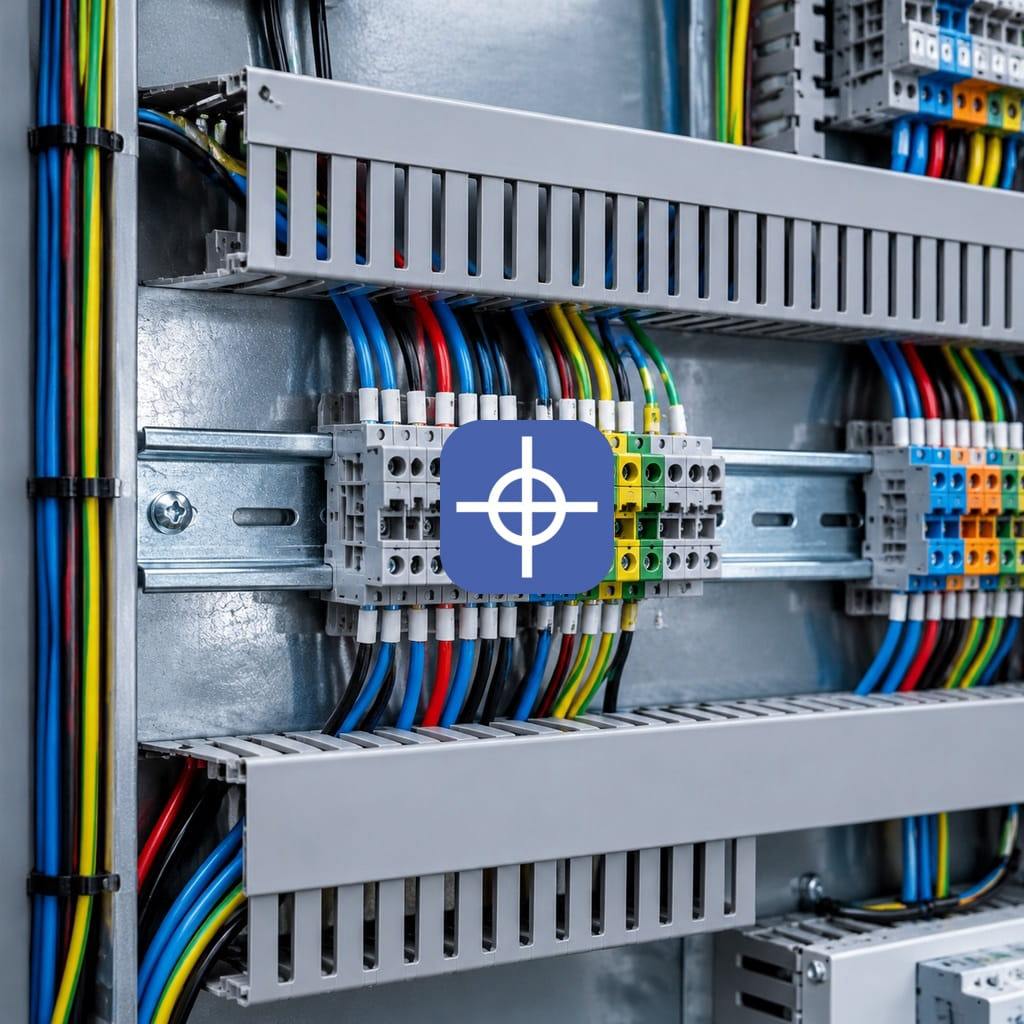
Duct and rail are among the core components used to build industrial electrical panels, control panels, and panels for CNC machines. Duct is used to route, separate, and protect wires and cables, while rail is the standard mounting location for equipment such as miniature circuit breakers, contactors, relays, terminals, power supplies, and control devices.
Using duct and rail correctly improves the panel’s organization, reduces wiring errors, makes maintenance easier, and increases the system’s safety.
What Is Panel Wiring Duct?
Panel wiring duct is a plastic or metal enclosure that the wires and cables inside a panel pass through. Ducts usually have a body and a removable cover, with slots built into the body to let wires exit at different points.
In a standard panel, wires shouldn’t run freely and haphazardly between components. Wires pass through the inside of the duct and only exit through a slot near the terminal or device they connect to.
Main Functions of Duct
- Organizing the wires and cables inside the panel
- Protecting wires from impact and contact with sharp metal edges
- Separating power, control, signal, and network wires
- Reducing the risk of short circuits and wiring mistakes
- Making troubleshooting, repair, and panel expansion easier
- Giving the electrical panel a professional, standardized appearance
- Reducing mechanical stress on equipment terminals
Duct Structure
Electrical panel ducts are usually made up of two main parts:
Duct body The body is mounted on the panel’s mounting plate, and wires sit inside it. Some ducts have pre-drilled holes for screwing in place, while some models are installed with industrial adhesive.
Duct cover The cover sits on top of the body and prevents wires from coming out or becoming disorganized. The cover should open easily but shouldn’t come loose from machine vibration once closed. High-quality ducts have a flexible, locking cover that doesn’t deform after repeated opening and closing.
Types of Electrical Panel Duct
Slotted Duct
The most common type of duct used in industrial electrical panels is slotted duct. Slots run along both sides of this duct, through which wires exit. This type suits panels with many components installed side by side, where wires need to exit the duct at different points.
Advantages:
- Easy wire exit at multiple points
- Suitable for control and command panels
- Organized, expandable wiring
- Easy access during maintenance
Disadvantages:
- Lower mechanical strength than closed duct
- Fingers can break on lower-quality models
- Less protection against dust
Plain (Non-Slotted) Duct
This type of duct has closed walls and is mostly used to route a wire or cable along one defined path. Non-slotted duct is generally used in panels where wires don’t need many exit points along their route.
Advantages:
- Better mechanical protection
- Simple, uniform appearance
- Suitable for power cables or straight runs
Disadvantages:
- Wires can only exit at the start, the end, or a cut point
- Less flexibility for wiring changes
Floor Duct
Floor duct is usually installed in a building’s floor, under office desks, or on surfaces. This type is mostly used for routing network, power, and telecom cables, and its use inside an electrical panel is more limited.
Wall Duct
Wall duct is used to route cable along a wall and is common in buildings, workshops, offices, and network systems. This model is usually wider and has fewer slots than electrical panel duct.
Metal Duct
Metal duct is used in environments where mechanical strength, heat resistance, or electromagnetic protection matters a great deal.
This type suits power cables, heavy industrial environments, or routes exposed to impact.
Duct Material
Most electrical panel ducts are made of PVC or heat-resistant thermoplastic materials.
A suitable duct should have the following characteristics:
- Adequate heat resistance
- Self-extinguishing property
- Good finger flexibility
- Resistance to cracking
- No deformation at the panel’s operating temperature
- No flame spread in the event of a short circuit
- A sturdy, openable cover
In industrial panels, it’s best to avoid ducts made from recycled or brittle materials, since their fingers break quickly during wiring or repair work.
Duct Dimensions
Ducts are made in various widths and heights. Common dimensions include:
- 25×25 mm
- 25×40 mm
- 40×40 mm
- 40×60 mm
- 60×60 mm
- 60×80 mm
- 80×80 mm
- 100×100 mm
The first and second numbers usually indicate the duct’s width and height, but it’s best to check the manufacturer’s dimensional drawing before purchasing.
Choosing the Right Duct Capacity
A duct shouldn’t be completely filled with wires. Leaving free space is essential for the following:
- Better air circulation
- Preventing pressure on the wires
- Allowing wires to be added later
- Preventing the duct cover from popping open
In practical design, it’s best to leave about 30–40% of the duct’s internal capacity empty.
Separating Wires Within the Duct
One of the most important principles for an electrical panel is separating the different wiring routes.
The following wires are best routed through separate ducts:
- Motor power cables and power input
- 24V control wires
- Encoder cables
- Industrial network cables
- Sensor wires
- Drive and inverter output
- Communication cables such as EtherCAT, Modbus, and Ethernet
Routing an encoder cable or weak signal lines next to an inverter output cable can cause noise, position errors, dropped communication, and unstable equipment behavior. In CNC machine panels, power and control ducts should generally be kept separate, and if crossing is unavoidable, cables should cross each other at close to a 90-degree angle.
What Is a Panel Mounting Rail?
A panel mounting rail is a standard metal profile that electrical equipment is mounted on. This rail is usually known by the following names:
- DIN Rail
- Miniature rail
- Panel rail
- Electrical equipment rail
The rail is screwed onto the panel’s mounting plate, and equipment with a rail-mount base is attached to it using a spring or clip mechanism.
Using a rail lets equipment be installed or replaced faster and more neatly, without needing separate drilling for each device.
The DIN Rail Standard
DIN stands for Deutsches Institut für Normung, meaning the German Institute for Standardization.
The dimensions and shape of most industrial equipment mounting rails are set by the IEC/EN 60715 standard. The most common rail used in electrical panels is the 35mm Top Hat type.
Types of Electrical Panel Rail
Omega Rail (Top Hat)
Omega rail is the most common rail used in electrical panels. Its cross-section resembles a hat or the Greek letter omega.
This rail is usually made in a 35mm width, and equipment such as the following is mounted on it:
- Miniature circuit breakers
- Contactors
- Relays
- Rail-mount terminals
- Power supplies
- Phase control relays
- Timers
- PLCs
- I/O modules
- Industrial network equipment
Omega rail is made in various thicknesses and heights. Thicker rail should be used for heavier equipment.
G-Shaped Rail
G rail has asymmetric edges and relatively high mechanical strength. This type of rail is used for some heavy industrial equipment and specific terminals.
G rail has less general-purpose use than omega rail.
C-Shaped Rail
C rail is mostly used to mount terminals, cable clamps, and certain specific equipment. Its shape resembles a C-channel, and it’s seen in older panels or specialized applications.
Perforated Rail
Perforated rail has pre-made holes or slots, making it easier to install on the panel plate.
Advantages:
- Fast installation
- Adjustable screw placement
- Less need for drilling the rail
Disadvantages:
- Slightly lower mechanical strength than the non-perforated model
- Higher risk of deformation under heavy equipment
Non-Perforated Rail
Non-perforated rail has a solid, uniform surface and greater strength. Installing it requires drilling the rail at the right spot or using special clamps.
Rail Material and Coating
Electrical panel rails are usually made of galvanized steel. The galvanized coating prevents the rail from rusting and corroding.
Common rail materials include:
- Galvanized steel
- Zinc-coated steel
- Aluminum
- Stainless steel
Aluminum rail is lightweight and suitable for standard environments, but its mechanical strength is lower than steel.
Stainless steel rail is more suitable for humid environments, the food industry, pharmaceuticals, petrochemicals, and corrosive environments.
How to Mount Equipment on the Rail
Most rail-mount devices have one fixed edge and one spring clip.
To mount a device:
- The device’s upper edge sits on the top of the rail;
- The lower part of the device is pressed toward the rail;
- The spring clip locks onto the rail’s lower edge;
- To remove the device, the lower clip is released with a screwdriver.
To prevent equipment from sliding along the rail, an end clamp should be used at the start and end of the row of equipment.
For terminal rows, using an end clamp matters even more, since terminals can shift on the rail while wires are being tightened.
How to Choose the Right Duct
The following should be checked when choosing a duct:
Wire volume The duct’s width and height should be selected based on the number of wires, their cross-section, and room for future expansion.
Spacing between equipment A duct shouldn’t be so large that it limits the space available for mounting equipment, and shouldn’t be so small that the wires end up under pressure.
Wire type For power cables, control cables, encoder cables, and network cables, it’s best to use separate routes.
Temperature inside the panel In panels with an inverter, servo drive, braking resistor, or high-power supply, the internal temperature can rise. The duct needs adequate heat tolerance.
Cover and finger quality The duct cover should close without excessive force and shouldn’t pop open from vibration. The duct’s fingers also shouldn’t break when bent or when wires pass through them.
How to Choose the Right Rail
The following matter when selecting a rail:
- Weight of the mounted equipment
- Width and type of the equipment’s rail-mount base
- Rail thickness
- Material and anti-corrosion coating
- Length of the equipment row
- Amount of machine vibration
- The panel’s environmental conditions
- Presence of suitable mounting holes
For servo drives, inverters, and heavy equipment, direct mounting on the panel plate is usually recommended, unless the equipment’s manufacturer approves DIN Rail mounting.
Important Tips for Installing Duct and Rail
Maintain proper spacing There should be enough space between the duct and the equipment for wire bending, ferrule installation, and screwdriver access. If the duct is placed too close to a device’s terminal, wires enter the terminal with an improper bend radius, and repairs become difficult.
Cutting duct correctly Duct should be cut with a suitable tool such as duct-cutting shears, a fine-toothed saw, or a dedicated cutting machine. Cut edges should be smoothed and any burrs removed. A sharp edge can damage wire insulation.
Cutting rail correctly Rail should be cut straight and square. After cutting, sharp edges should be dressed with a file or deburring tool.
Attaching the rail to the enclosure properly Rail should be mounted on the mounting plate with enough screws. Wide spacing between screws can cause the rail to bend or vibrate. On long equipment rows or where heavy equipment is mounted, the number of fixing points should be increased.
Grounding In some panels, DIN rail is connected to the panel’s metal plate and the grounding system. However, the rail shouldn’t be used as the only protective ground path without reviewing the equipment’s design. For sensitive equipment and metal enclosures, an independent, reliable ground connection should be considered.
Labeling Duct and rail, wires, and equipment should be numbered according to the panel’s drawings. Proper labeling reduces troubleshooting time and prevents mistakes during repairs.
Using Duct and Rail in a CNC Panel
In a CNC machine’s electrical panel, duct and rail play an important role in reducing noise and improving the system’s reliability.
Equipment such as the following is typically mounted on rail:
- Miniature circuit breakers
- Interposing relays
- Input and output terminals
- 24V power supply
- Phase control relay
- Rail-mount fuses
- PLC modules
- Network modules
- Safety relay
- Signal converters
Motor cables and servo drive/inverter output cables must be kept separate from encoder, network, and sensor cables. Cable shields should also be connected according to the manufacturer’s instructions and EMC principles.
Using a shared duct for all cables is one of the common causes of noise in CNC machines.
Trusted Duct and Rail Brands
Well-known global brands in electrical panel equipment and duct and rail accessories include:
- Schneider Electric
- Phoenix Contact
- Weidmüller
- ABB
- Siemens
- Legrand
- Hager
- OBO Bettermann
- Panduit
- HellermannTyton
- WAGO
- Rittal
Advantages of Using Duct and Rail Correctly
- Improves the panel’s organization and appearance
- Reduces assembly time
- Speeds up repair and troubleshooting
- Reduces the risk of wiring mistakes
- Allows quick equipment replacement
- Better protection for wires
- Increases panel safety
- Allows easy system expansion
- Reduces noise when cables are properly separated
- Reduces mechanical stress on equipment terminals
Disadvantages and Limitations of Duct and Rail
- Takes up part of the panel’s usable space
- Increases initial assembly cost
- Requires careful design before wiring
- Limits capacity if a small duct is chosen
- Risk of low-quality duct fingers breaking
- Risk of a thin rail bending under equipment weight
- Can create noise issues if unsuitable cables share a common duct
Common Mistakes in Selecting and Installing Duct and Rail
- Choosing a small duct and filling it completely
- Routing power and encoder cables through the same duct
- Mounting the duct too close to equipment terminals
- Using duct made from low-quality PVC
- Cutting duct with sharp, burred edges
- Installing rail with too few screws
- Using thin rail for heavy equipment
- Mounting terminals without an end clamp
- Leaving excess, coiled wire inside the duct
- Not allowing space for future expansion
- Placing an inverter output cable next to network cables
- Using the rail as the main ground path without an independent protective connection
- Placing too many wires under one terminal
- Missing wire numbers and equipment labels
Conclusion
Duct and rail are simple components that have a major effect on the quality of an electrical panel’s construction. Duct is responsible for routing, separating, and protecting wires, while rail is the standard base for mounting electrical and control equipment.
To achieve a safe, professional panel, duct dimensions should be chosen based on the number of wires and room for future expansion, power and signal cables should be kept separate, and the rail should be selected to suit the weight and type of equipment.
Using high-quality duct and rail, keeping proper clearances, removing sharp edges, installing end clamps, and numbering wires all improve the panel’s appearance while also reducing repair time and increasing the reliability of industrial equipment and CNC machines.
For industrial implementation, explore Radonix PC-based CNC controllers, control software and machine-specific HMI systems. Radonix PC-based CNC controller systems.