
Stepper vs Servo Motors in CNC Systems
Author: Radonix R&D Team
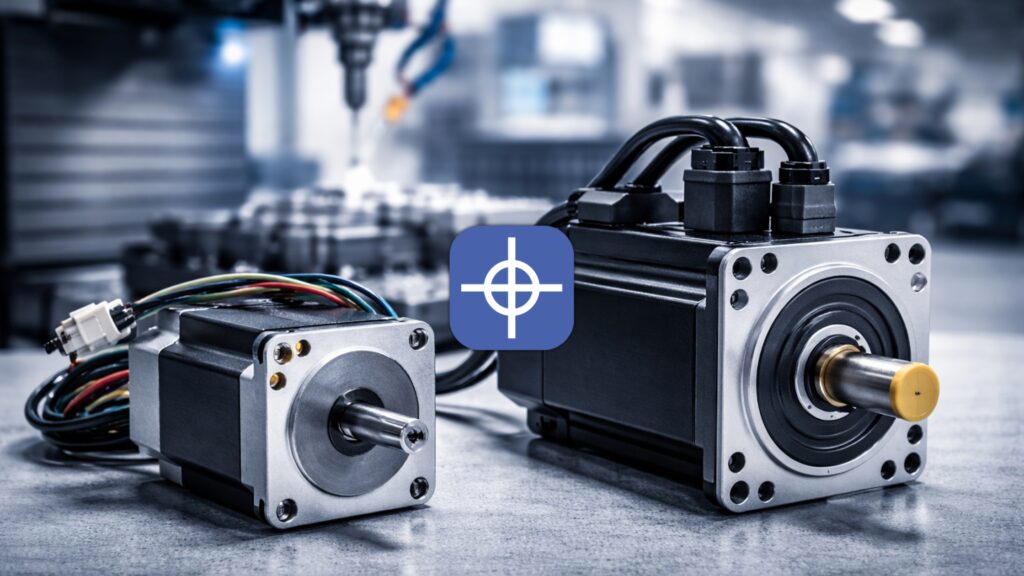
In CNC systems, the choice of motor directly affects precision, speed, efficiency, and overall machine performance. The two most common options are stepper motors and servo motors.
While both are used to drive CNC machine axes, they differ significantly in terms of control method, feedback, and performance capabilities. Selecting the right motor type is essential for achieving reliable and efficient operation.
Understanding Stepper and Servo Motor Technologies in CNC Systems
What is a Stepper Motor?
A stepper motor moves in discrete steps, meaning its rotation is divided into fixed increments. Each electrical pulse sent from the CNC controller corresponds to a specific movement.
Key Characteristics
- Open-loop control (no feedback)
- Simple and cost-effective
- High holding torque at low speeds
- Easy to implement
Advantages
- Lower cost
- Simple control system
- No need for feedback devices
Limitations
- Can lose steps under load
- Reduced performance at high speeds
- Lower efficiency
- Limited accuracy in demanding conditions
Stepper systems are commonly used in entry-level or light-duty CNC machines.
What is a Servo Motor?
A servo motor operates using closed-loop control, meaning it continuously receives feedback from an encoder to ensure accurate positioning.
Key Characteristics
- Closed-loop system with feedback
- High precision and accuracy
- Smooth motion across speed ranges
- High efficiency
Advantages
- No loss of position (error correction via feedback)
- Better performance at high speeds
- Higher torque-to-weight ratio
- Smooth and stable motion
Limitations
- Higher cost
- More complex setup and tuning
Servo motors are widely used in industrial CNC systems where precision and reliability are critical.
Key Differences Between Stepper and Servo Motors
Performance in CNC Applications
Stepper Motors
- Suitable for simple and low-cost machines
- May experience missed steps under high load
- Less reliable for continuous industrial operation
Servo Motors
- Provide stable and accurate motion
- Maintain performance under varying loads
- Ideal for high-speed and precision machining
In applications where accuracy, repeatability, and reliability are critical, servo systems are the preferred choice.
Why Feedback Matters in CNC Motion Control
The key difference lies in feedback.
- Stepper motors assume movement happens as commanded
- Servo motors verify movement through encoders and correct errors in real time
This makes servo systems significantly more reliable in demanding conditions.
Controllers developed by Radonix support advanced motion systems with feedback integration, enabling precise and stable control in both stepper and servo-based configurations.
Integration with CNC Controllers
Motor performance depends heavily on the CNC controller.
With Basic Controllers
- Limited control over motion profiles
- Reduced system efficiency
- Higher risk of instability
With Industrial Controllers
- Advanced motion algorithms
- Real-time feedback processing
- Smooth multi-axis synchronization
Radonix controllers are designed to fully utilize the capabilities of modern motion systems, ensuring optimal performance whether using stepper or servo motors.
When to Choose Stepper Motors
Stepper motors are suitable when:
- Budget is limited
- Application is simple
- Load conditions are predictable
- High precision is not critical
When to Choose Servo Motors
Servo motors are recommended when:
- High precision and repeatability are required
- Machine operates continuously
- High speeds are needed
- Load conditions vary
For industrial applications, servo systems combined with controllers like Radonix provide the most reliable and efficient solution.
Final Takeaway
Stepper and servo motors each have their place in CNC systems. Stepper motors offer simplicity and cost advantages, while servo motors deliver superior performance, accuracy, and reliability.
The right choice depends on the application, but for modern industrial environments, servo systems are generally the preferred option.
For expert guidance on selecting the right motion system for your CNC application, contact us or use the chatbot.
About Radonix
Radonix develops industrial CNC controllers designed to deliver precise, stable, and real-time motion control. With support for advanced motor systems and seamless integration, Radonix solutions are built for high-performance CNC applications.
For machine integration, compare Radonix CNC controller hardware for independent multi-axis motion, pulse/direction signals and industrial I/O. Radonix CNC controller hardware.