

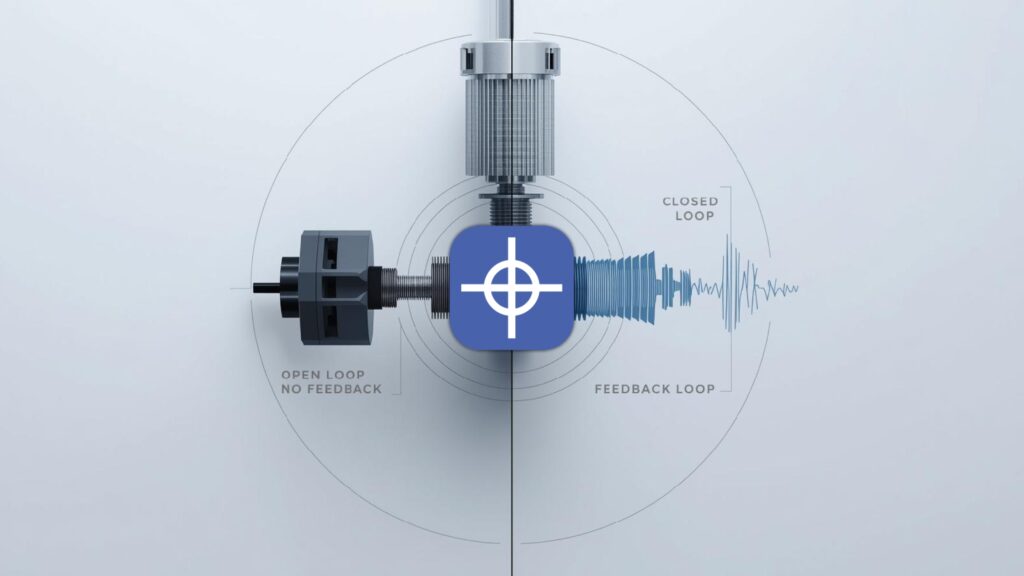
Open Loop vs Closed Loop Control Systems in Industrial Automation
Author: Nima Rad
In industrial automation and CNC systems, understanding Open loop vs Closed loop control is fundamental to making correct engineering decisions.
These two control philosophies directly affect the accuracy, stability, cost, and long-term reliability of machines. Choosing the wrong approach can lead to positioning errors, scrap, downtime, or unnecessary system complexity.
This article explains open-loop and closed-loop control systems from a practical industrial perspective, with clear examples from CNC, motion control, and process automation.
What Is an Open-Loop Control System?
An open-loop control system operates without feedback from the actual output. The controller sends a command and assumes the system executes it correctly.
There is no measurement of the real result.
Basic structure:
- Setpoint/command
- Controller or drive
- Actuator (motor, valve, heater)
- Process output
The system does not verify whether the output matches the command.
Key Characteristics of Open-Loop Control
- No feedback sensor
- Simple architecture
- Lower cost
- Faster commissioning
- Accuracy depends heavily on load, friction, voltage, and mechanical condition
Typical Open Loop Examples
- Stepper motor positioning without encoder feedback
- Timed control of pumps, fans, or heaters
- Conveyor belts with constant load
- Simple pneumatic cylinders driven by on/off valves
Open-loop control works best when the process is predictable, loads are stable, and small errors are acceptable.
What Is a Closed-Loop Control System?
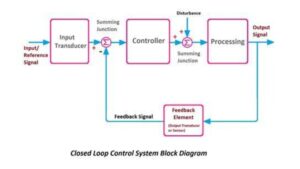
A closed-loop control system continuously measures the actual output and compares it to the desired value. Any difference (error) is used to automatically correct the control signal.
Basic structure:
- Setpoint
- Error calculation (setpoint – feedback)
- Controller (PID or advanced control)
- Drive/actuator
- Process output
- Sensor (encoder, pressure, temperature, flow, etc.)
Key Characteristics of Closed-Loop Control
- Uses real-time feedback
- Higher accuracy and repeatability
- Compensates for load changes and disturbances
- Higher cost and complexity
- Requires tuning and proper signal integrity
Typical Closed-Loop Examples
- Servo motor systems with encoder feedback
- Closed-loop stepper motors
- CNC axis position control
- Temperature control using thermocouples or RTDs
- Pressure and flow control systems
Closed-loop control is essential when precision, stability, and reliability are critical.
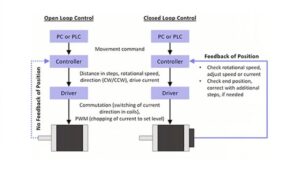
Open Loop vs Closed Loop: Practical Comparison
| Aspect | Open Loop | Closed Loop |
|---|---|---|
| Feedback sensor | No | Yes |
| Accuracy | Limited | High |
| Load compensation | None | Automatic |
| Complexity | Low | Higher |
| Cost | Lower | Higher |
| Fault detection | No | Yes |
| Sensitivity to disturbances | High | Low |
This comparison highlights why closed-loop systems dominate high-performance automation, while open-loop systems remain popular for cost-sensitive or simple applications.
CNC Motion Control: Where the Difference Matters Most
Open Loop CNC Axes
In open-loop CNC systems (commonly stepper-based), the controller sends pulses and assumes each pulse results in motion. If the motor stalls or skips steps:
- The system does not detect the error
- Position error accumulates
- Part accuracy is compromised
This approach is acceptable for:
- Light-duty machines
- Low cutting forces
- Short travel distances
- Non-critical tolerances
Closed Loop CNC Axes
Closed-loop CNC systems use encoders or linear scales to measure real-axis position. The controller continuously corrects errors caused by:
- Load changes
- Mechanical backlash
- Thermal expansion
- Wear over time
Benefits include:
- Higher contour accuracy
- Improved surface finish
- Protection against crashes and overloads
- Stable performance in long production runs
For industrial CNC machines, closed loop control is often the professional standard.
Common Misconception: Closed Loop Is Always Better
Closed-loop control is powerful, but it is not always the optimal choice.
Open-loop control may be preferable when:
- Loads are stable
- Speed and acceleration are moderate
- Small positioning errors are acceptable
- Budget constraints are critical
Closed-loop control is preferable when:
- Loads vary significantly
- High acceleration or dynamic response is required
- Precision and repeatability are critical
- Downtime and scrap are costly
Engineering judgment—not marketing—should drive the decision.
Industrial Applications Breakdown
Open Loop Applications
- Basic material handling
- Simple indexing systems
- Timed heating or cooling processes
- Low-cost automation cells
Closed Loop Applications
- CNC machining centers
- Robotics and multi-axis systems
- Tension control in roll-to-roll lines
- Precision dosing and flow control
- High-speed packaging and printing lines
Many modern machines use hybrid architectures, combining closed-loop control for critical axes and open-loop control for auxiliary functions.
Quick Selection Guide
Choose open-loop control if:
- The process is predictable
- Cost must be minimized
- Failure risk is low
Choose closed-loop control if:
- Precision matters
- Loads are variable
- Process stability is critical
- Diagnostics and fault detection are required
Final Takeaway
The difference between open loop vs closed loop control systems is not academic—it directly impacts machine performance, reliability, and operating cost.
Open-loop control offers simplicity and affordability. Closed-loop control delivers accuracy, adaptability, and professional-grade reliability. The best systems apply each approach where it makes the most sense.
Contact Radonix or use the chatbot in the bottom right corner to learn how linear encoders integrate with Radonix control systems.
For machine integration, compare Radonix CNC controller hardware for independent multi-axis motion, pulse/direction signals and industrial I/O. Radonix CNC controller hardware.