
Author: Radonix R&D Team – CNC Motion Control Specialists
Woodworking CNC machines require a high level of precision, smooth motion, and operational reliability to produce consistent results. Whether for cutting, carving, engraving, or nesting operations, the CNC controller plays a critical role in determining the final quality and efficiency of the process.
Selecting the right CNC controller for woodworking applications is essential to ensure clean cuts, high productivity, and long-term system stability.
The Role of CNC Controllers in Woodworking
In woodworking machines, the CNC controller is responsible for:
- Interpreting design files (G-code)
- Controlling multi-axis movement (X, Y, Z, and sometimes rotary axes)
- Managing spindle operation and speed
- Coordinating toolpaths for cutting and engraving
The controller directly influences:
- Surface finish quality
- Cutting accuracy
- Machine speed and efficiency
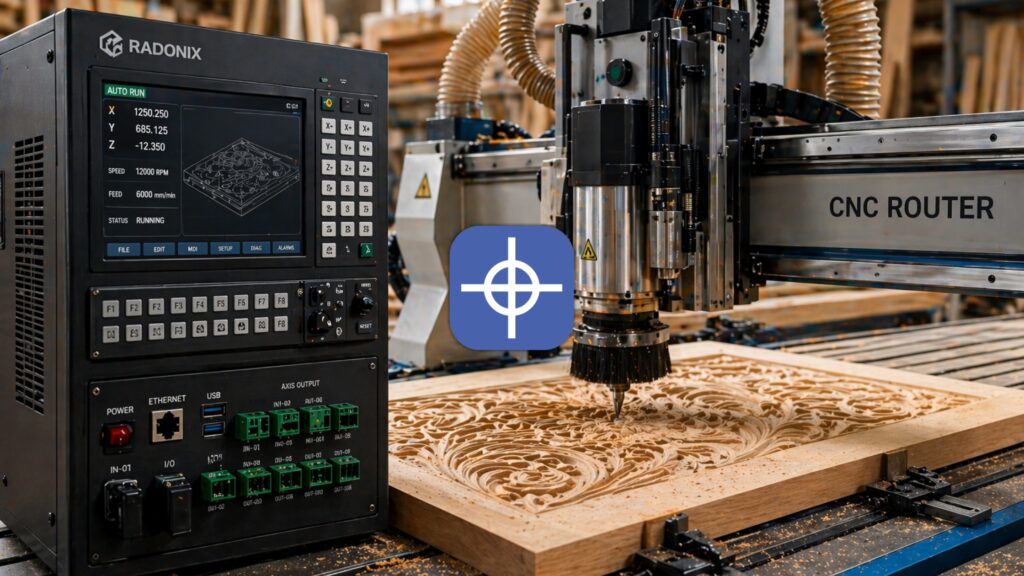
Industrial solutions like Radonix controllers are engineered to deliver stable, real-time motion control tailored for woodworking applications.
Key Requirements for Woodworking CNC Controllers
1. Smooth Motion Control
Wood materials are sensitive to vibration and irregular motion.
Why it matters:
- Prevents rough edges and surface defects
- Ensures clean carving and engraving
- Improves overall finish quality
Radonix controllers use real-time motion control to deliver smooth and continuous tool movement, reducing vibration and improving output quality.
2. High-Speed Processing
Woodworking operations often require high feed rates to maximize productivity.
Requirements:
- Fast trajectory planning
- Stable high-speed motion
- Accurate path following
Controllers developed by Radonix are optimized for high-speed applications while maintaining precision and stability.
3. Multi-Axis Coordination
Many woodworking machines operate with:
- 3-axis systems (standard routing)
- 4-axis or 5-axis systems (complex carving, furniture design)
Why it matters:
- Accurate synchronization ensures correct geometry
- Essential for complex designs and 3D carving
Radonix controllers support multi-axis systems with synchronized motion control.
4. Compatibility with Spindles and Tools
Woodworking machines use high-speed spindles and various cutting tools.
Controller requirements:
- Spindle speed control
- Toolpath accuracy
- Integration with tool change systems
Radonix controllers provide flexible integration with spindle systems and auxiliary components.
5. Reliability in Continuous Operation
Industrial woodworking environments often operate continuously.
Challenges:
- Dust-heavy environments
- Long operating hours
- Risk of overheating or instability
Industrial-grade solutions like Radonix are designed for stable operation under continuous workloads and harsh conditions.
6. I/O and Automation Integration
Modern woodworking machines require integration with:
- Sensors
- Safety systems
- Vacuum tables
- Automatic tool changers
Radonix controllers offer flexible I/O capabilities to support complex machine configurations and automation requirements.
Common Applications in Woodworking
CNC controllers are used across a wide range of woodworking processes:
- Furniture manufacturing
- Cabinet and panel cutting
- Decorative carving and engraving
- Door and window production
- MDF and plywood processing
In these applications, controller performance directly affects speed, precision, and repeatability.
Challenges in Woodworking CNC Systems
Woodworking introduces specific challenges:
- Material variability (soft vs hard wood)
- Dust and environmental conditions
- High-speed cutting requirements
- Complex toolpaths for design work
A well-designed CNC controller must handle these factors without compromising performance.
Radonix controllers are built to maintain stable motion and reliable operation even under these variable conditions.
Why Controller Choice Matters
Choosing the wrong controller can result in:
- Poor surface finish
- Inconsistent cutting accuracy
- Increased machine wear
- Reduced production efficiency
A high-quality controller ensures:
- Smooth motion
- Accurate toolpaths
- Reliable long-term operation
Industry Direction in Woodworking CNC
The woodworking industry is moving toward:
- Higher automation
- Faster production cycles
- More complex designs
- Integration with digital workflows
Modern CNC controllers must support these requirements with scalable, real-time, and reliable control systems.
Radonix follows this direction by developing controllers that support advanced motion control and integration capabilities.
Final Takeaway
CNC controllers are a critical component in woodworking machines, directly influencing quality, speed, and reliability. As production demands increase, the need for industrial-grade control systems becomes more important.
Selecting a controller designed for real-world woodworking conditions ensures consistent performance, reduced material waste, and long-term operational efficiency.
For expert guidance on selecting the right CNC controller for your woodworking machine, contact us or use the chatbot.
About Radonix
Radonix develops industrial CNC controllers focused on precision, stability, and seamless integration. Designed for modern manufacturing environments, Radonix solutions enable reliable and efficient operation across woodworking and other CNC applications.