
What is a CNC Controller, and How a CNC controller works?
Author: Radonix R&D Team
A CNC controller is the central intelligence of a CNC machine. It is the system that takes machining instructions and turns them into precise, coordinated motion of motors, spindles, and auxiliary devices.
While the mechanical structure of a CNC machine determines how rigid or powerful it is, the controller determines how accurately, safely, and consistently that machine behaves.
At Radonix, the focus is entirely on designing industrial CNC controllers—because control quality ultimately defines machining performance, repeatability, and long-term reliability.
What Does a CNC Controller Actually Do?
At its core, a CNC controller acts as both:
- Translator – converting machining instructions into motion commands
- Coordinator – synchronizing multiple axes, spindles, and I/O devices
It reads machining instructions, calculates how the tool should move through space, and ensures that all machine components act in perfect synchronization.
This process happens continuously and in real time.
The controller does not simply move from point to point. Instead, it:
- Generates smooth trajectories
- Manages acceleration and deceleration
- Controls jerk and motion blending
- Keeps multiple axes aligned down to fractions of a millisecond
This is what separates basic motion systems from true industrial CNC control.
From G-Code to Physical Motion
Most CNC jobs begin with a machining program, commonly written in G-code.
This program defines:
- Tool position
- Feed rate
- Spindle speed
- Motion type (linear, arc, complex curves)
When the CNC controller receives this program, it interprets the instructions and converts them into internal motion commands.
Straight lines, arcs, and complex curves are broken down into continuous motion segments. This step is known as interpolation, and it is one of the controller’s most critical responsibilities.
During interpolation, the controller calculates where each axis should be at every instant in time.
These calculations must be:
- Accurate
- Deterministic
- Time-consistent
Otherwise, the tool path will deviate from the intended geometry, affecting dimensional accuracy and surface finish.
Real-Time Axis Control and Synchronization
Once motion trajectories are calculated, the CNC controller sends commands to the machine’s drives and motors.
This communication occurs thousands of times per second.
Each axis receives:
- Precise position targets
- Velocity commands
- Acceleration profiles
At the same time, feedback from encoders is continuously monitored to confirm that motion is happening as expected.
If the controller detects a mismatch between commanded and actual position, it reacts immediately.
This closed-loop control behavior enables:
- Repeatable precision
- Smooth contouring
- Stability under dynamic load
- High-speed machining without drift
This is what allows industrial CNC systems to maintain consistent performance across long production cycles.
Monitoring, Diagnostics, and Continuous Feedback
A CNC controller is never passive. It constantly monitors:
- Axis positions
- Spindle status
- Sensor inputs
- Drive alarms
- Safety signals
This continuous monitoring allows the controller to:
- Adjust motion in real time
- Detect abnormal conditions early
- Prevent damage before it escalates
For example, if a drive reports a fault or a travel limit is reached, the controller can:
- Slow down feed rates
- Stop motion safely
- Trigger a controlled halt
- Log the event for diagnostics
This feedback loop is essential for both machining quality and operational safety.
Safety Is a Core Function of CNC Control
Safety is not an optional feature in a CNC controller. It is built into the control logic itself.
The controller enforces:
- Software travel limits
- Emergency stop logic
- Interlock conditions
- Motion inhibition under unsafe states
In industrial CNC controllers, safety-related decisions are handled in deterministic control layers.
This means reaction times are guaranteed and do not depend on:
- Screen refresh rates
- Operating system delays
- Operator interaction
Even under unexpected conditions, the machine remains protected.
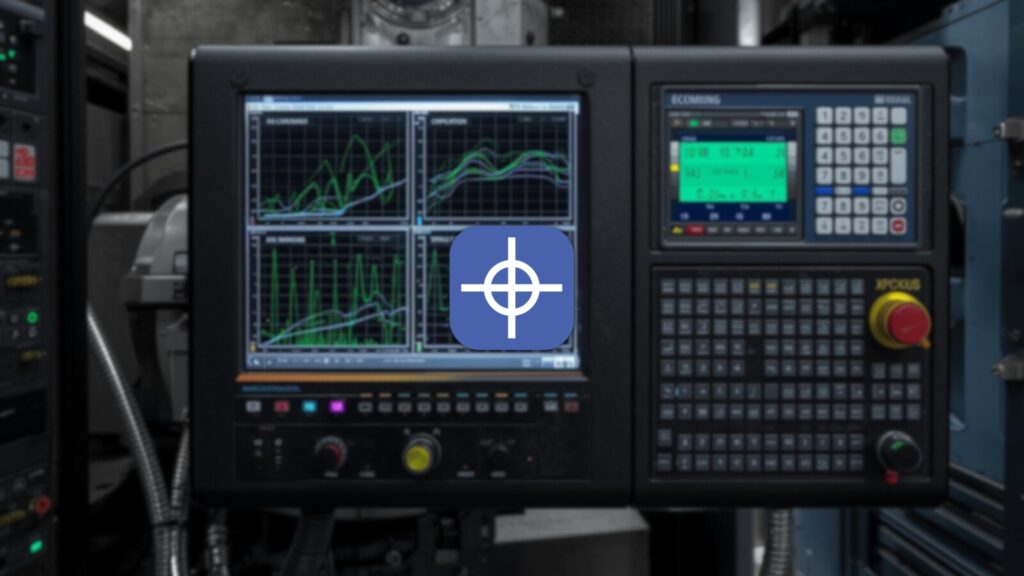
The Role of the CNC Interface
While the controller performs all real-time motion calculations internally, the interface is how operators interact with the system.
Through the interface, users can:
- Load programs
- Start and stop jobs
- Adjust feed overrides
- Monitor axis positions
- Respond to alarms
A well-designed CNC controller separates:
- Real-time motion execution
- System logic
- Operator interface activity
This architectural separation ensures that operator interaction never interferes with motion timing or precision.
Radonix controllers follow this principle to ensure usability never compromises control quality.
Why Deterministic Execution Matters in CNC Machines
Unlike general-purpose computers, CNC controllers must behave predictably at all times.
A delay of even a few milliseconds can affect:
- Surface finish
- Dimensional accuracy
- Tool engagement
- Machine safety
Deterministic execution ensures that motion calculations and control updates occur at fixed, guaranteed intervals.
This predictability enables:
- Identical part reproduction
- Stable long production runs
- Reliable automation integration
- Consistent machining quality
Without deterministic control, repeatability cannot be guaranteed.
How Radonix Designs Industrial CNC Controllers
Radonix designs CNC controllers with a clear architectural separation between:
- Real-time motion control
- System logic
- Operator interaction
This structure ensures:
- Stable multi-axis motion
- Strong safety enforcement
- Expandability across industries
- Compatibility with modern automation systems
By focusing exclusively on CNC control technology, Radonix builds systems that are:
- Reliable in high-load industrial environments
- Deterministic under all operating conditions
- Adaptable for future expansion
- Engineered for long-term operational stability
Conclusion: The CNC Controller Is the Heart of Every CNC Machine
A CNC controller is far more than a program reader.
It is the system that:
- Plans motion
- Synchronizes axes
- Enforces safety
- Monitors machine state
- Converts digital instructions into precise physical movement
Understanding how a CNC controller works is essential for anyone designing, operating, or investing in CNC machinery.
The quality of the controller directly determines:
- Machining accuracy
- Surface finish
- Reliability
- Safety
- Long-term performance
That is why the CNC controller remains the true heart of every CNC system.
Contact Radonix or use our chatbot in the bottom right corner to learn more about our industrial CNC controller solutions.