
Why Continuous CNC Lubrication Is Critical
Author: Mehdi Hasanzade
CNC lubrication is not a routine maintenance task; it is a core operating condition that directly affects accuracy, surface finish, thermal stability, and the service life of high‑value machine components. In CNC machines, motion systems operate under repeating loads, fine positioning requirements, and often contaminated environments.
Without continuous and controlled lubrication, even well‑designed machines rapidly lose performance.
At an engineering level, lubrication exists to create a stable film between moving surfaces. This film prevents metal‑to‑metal contact, reduces friction, controls heat generation, and maintains predictable motion behavior. When lubrication becomes intermittent or insufficient, precision degrades first—long before catastrophic failure appears.
How Lubrication Preserves Motion Accuracy
Formation of a Stable Lubrication Film
The primary function of CNC lubrication is the formation of a continuous lubricating film that separates rolling or sliding elements. This film:
- Reduces frictional resistance
- Minimizes wear on raceways and rolling elements
- Maintains smooth, repeatable motion
- Preserves positioning accuracy under load
In linear guide rails and carriages, inadequate lubrication increases rolling resistance and accelerates surface fatigue. Over time, this leads to loss of preload, higher servo effort, and measurable positioning error.
Preventing Stick–Slip and Motion Instability
At low feed rates or during finishing operations, insufficient lubrication can cause stick–slip behavior. This phenomenon results in jerky motion instead of smooth travel, leading to:
- Surface waviness and geometric errors
- Vibration and chatter
- Increased servo current and following error
- Reduced contour accuracy
Proper CNC lubrication stabilizes friction coefficients across the stroke, allowing controlled micro‑movements without oscillation.
Thermal Control and Dimensional Stability
Friction generates heat. Localized temperature rise in ball screws, linear guides, and spindle bearings causes uneven thermal expansion, resulting in:
- Thermal drift
- Loss of repeatability
- Axis squareness deviation
Lubrication reduces friction at the source and helps dissipate heat, supporting thermal equilibrium and dimensional consistency during long machining cycles.
CNC Components Most Sensitive to Continuous Lubrication
Linear Guide Rails and Carriages
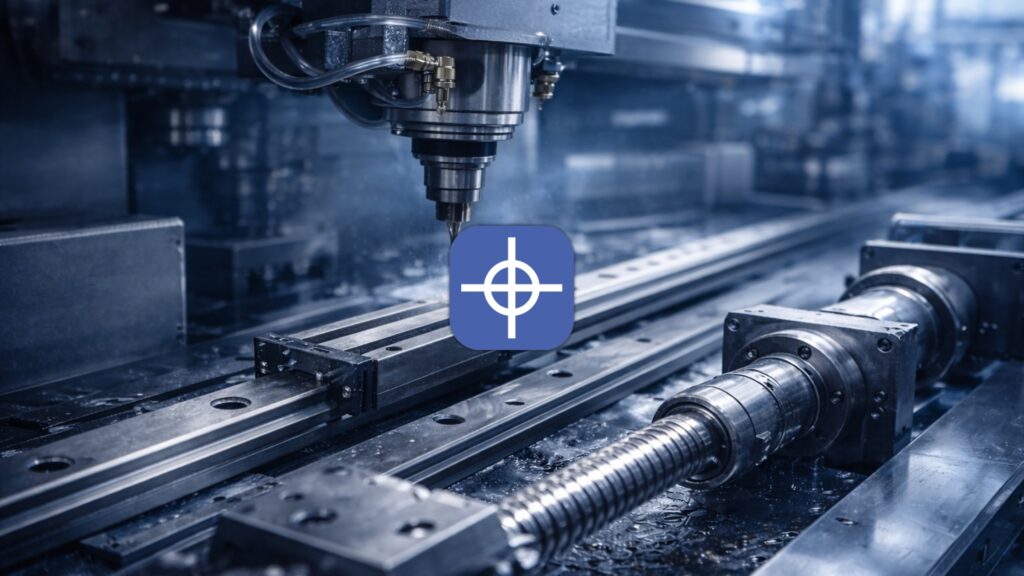
Linear guideways operate under cyclic loads with high contact pressures. They are also exposed to chips, dust, coolant mist, and fine abrasive particles. Continuous lubrication is essential to:
- Maintain rolling contact integrity
- Flush contaminants away from raceways
- Prevent corrosion in humid or coolant‑rich environments
Any interruption in lubrication directly translates into reduced guide life and declining axis accuracy.
Ball Screws
Ball screws convert rotary motion into precise linear movement. Inadequate lubrication increases friction between balls and raceways, causing:
- Accelerated wear and backlash growth
- Higher operating temperatures
- Reduced positioning repeatability
Over time, lubrication failure in ball screws leads to expensive replacement and prolonged machine downtime.
Spindle Bearings
Spindle bearings are extremely sensitive to lubricant type, cleanliness, and delivery method. At high speeds, incorrect or insufficient lubrication can quickly result in overheating, noise, and irreversible bearing damage. Continuous, clean lubrication is mandatory for stable spindle performance.
What Happens When CNC Lubrication Is Not Continuous
Short‑Term Effects
- Increased servo load and overcurrent alarms
- Audible noise from axes or spindle
- Declining surface finish quality
- Localized temperature rise
Medium‑ and Long‑Term Effects
- Accelerated wear of linear guides and ball screws
- Loss of preload and geometric accuracy
- Poor repeatability and contour errors
- Costly repairs and unplanned production stops
In most cases, lubrication issues manifest as quality problems long before mechanical failure becomes visible.
Common CNC Lubrication Methods and Why Continuity Matters
Manual Lubrication
Manual lubrication depends entirely on operator discipline. Injection intervals are often inconsistent, making this method unreliable for production environments.
One‑Shot or Central Manual Systems
Centralized systems improve lubricant distribution but still rely on human intervention. Missed cycles or incorrect timing can still cause lubrication gaps.
Automatic Central Lubrication Systems
Automatic systems provide the most reliable solution for CNC lubrication:
- Programmable injection intervals
- Metered lubricant distribution
- Integration with CNC or PLC alarms
- Monitoring of pressure and reservoir level
These systems ensure lubrication remains continuous regardless of shift changes or workload intensity.
Selecting the Right Lubricant (Principle‑Based)
Oil or Grease
- Linear guides and ball screws may use oil or grease depending on speed, contamination level, and delivery system
- Spindle bearings often require specialized grease or oil‑air systems
Viscosity and Operating Conditions
Lubricant viscosity must match operating speed, load, and temperature. Higher loads and temperatures typically require higher viscosity, while high‑speed applications favor lower viscosity.
Common Lubrication Mistakes
- Mixing incompatible oils or greases
- Using lubricants that emulsify with coolant
- Introducing contaminated lubricant into precision components
Each of these errors rapidly degrades lubrication effectiveness.
Practical Checklist for Reliable CNC Lubrication
Daily or Shift Checks
- Lubricant reservoir level
- Visible leaks in lubrication lines
- Lubrication‑related alarms
- Unusual axis noise or surface changes
Periodic Maintenance Checks
- Pump operation and priming
- Metering unit condition
- Verification of lubricant reaching end points
- Filter cleanliness
Tracking lubricant consumption trends and axis temperatures provides early warning of lubrication faults.
Rapid Troubleshooting Indicators
- Low lubrication alarm: Possible air in lines, leaks, blocked metering units
- Stick–slip motion: Inadequate film, wrong lubricant, surface contamination
- Surface quality loss: Insufficient lubrication or ingress of chips and dust
Early corrective action prevents permanent mechanical damage.
Conclusion
Continuous CNC lubrication is a system, not a task. When supported by the correct lubricant, automatic delivery, and consistent monitoring, it preserves machine accuracy, extends component life, and stabilizes production quality. Neglecting lubrication does not fail machines immediately—it silently erodes precision until recovery becomes expensive or impossible.
Contact Radonix or use the chatbot in the bottom right corner to learn how linear encoders integrate with Radonix control systems.
For industrial implementation, explore Radonix PC-based CNC controllers, control software and machine-specific HMI systems. Radonix PC-based CNC controller systems.