
From Monolithic Machines to Deterministic Modular CNC Design
Written by: Radonix R&D Team – CNC Control Systems & Motion Architecture
Modern CNC manufacturing is no longer defined by fixed, monolithic machines. Today’s production environments demand systems that are modular, scalable, and adaptable, capable of evolving alongside automation, software, and data-driven workflows.
At the center of this shift lies a critical requirement: a communication backbone that guarantees deterministic timing, ultra-low jitter, and precise multi-axis synchronization across distributed machine components.
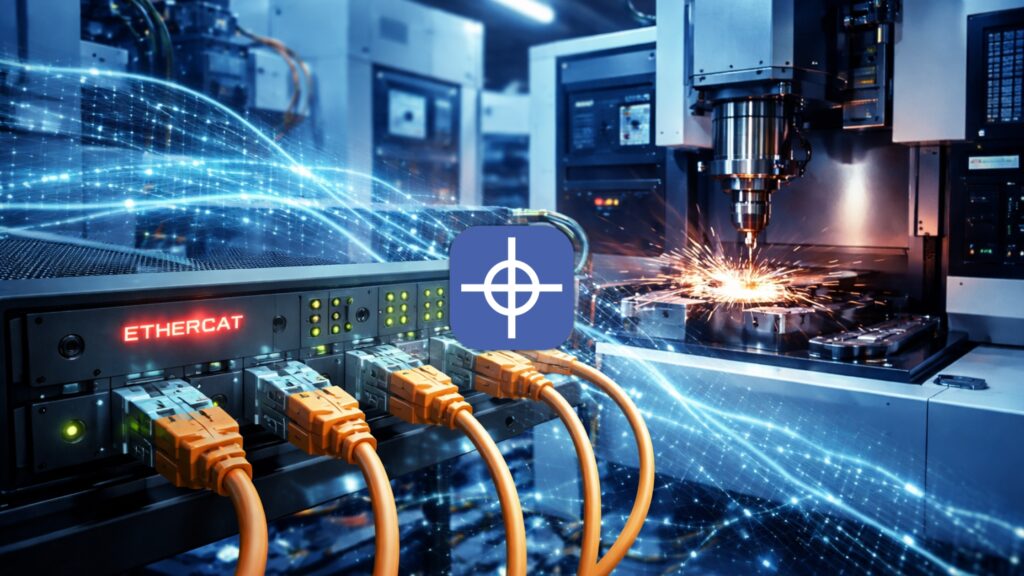
EtherCAT-Based CNC Systems, developed and maintained by the EtherCAT Technology Group, has emerged as the most reliable solution for real-time industrial motion control.
At Radonix, EtherCAT-Based CNC Systems is not treated as a simple protocol choice. It is the architectural foundation that enables modular CNC systems to scale without sacrificing precision, safety, or real-time performance.
This article explains why EtherCat-Based CNC Systems is essential for modern modular CNC architectures and how Radonix leverages it to deliver deterministic, future-ready control platforms aligned with real industrial requirements.
From Monolithic CNC to Modular Control Architectures
Traditional CNC machines were designed as tightly integrated, fixed-configuration systems. While effective for stable production lines, these architectures struggle to meet modern manufacturing needs such as rapid customization, flexible machine layouts, and scalable automation.
Modern CNC systems are increasingly built as collections of intelligent mechatronic modules, linear and rotary axes, spindles, tool changers, sensors, safety devices, and auxiliary units. Each module must operate independently while remaining perfectly synchronized with the rest of the machine.
At Radonix, CNC controllers are designed around this modular philosophy. However, modularity only succeeds when the underlying communication system can guarantee strict synchronization and predictable execution. This requirement is where EtherCat-Based CNC Systems becomes indispensable.
The Core Challenge: Determinism in Distributed CNC Systems
As CNC architectures become more distributed, maintaining precise coordination becomes significantly more complex. Standard Ethernet technologies offer bandwidth and flexibility, but they do not guarantee determinism. Even millisecond-level latency variation is unacceptable in CNC motion control, where microsecond-level timing directly affects:
- Surface finish and dimensional accuracy
- Tool life and cutting stability
- Machine safety and collision avoidance
Alternative approaches introduce critical limitations:
- Wireless industrial networks may offer convenience, but variable latency and packet delay make them unsuitable for inner motion-control loops.
- Proprietary real-time networks often limit interoperability and lock machine builders into closed ecosystems.
Radonix addresses these challenges by using EtherCAT as the deterministic backbone of its CNC platforms.
Why EtherCAT Fits Modular CNC Architectures
EtherCAT was engineered specifically for real-time industrial control. Its technical characteristics align directly with the requirements of modular CNC systems:
- Sub-millisecond cycle times that support high-speed, high-precision motion control
- Distributed clock synchronization with nanosecond-level accuracy across all nodes
- Processing-on-the-fly communication, minimizing latency as frames pass through devices
- Daisy-chain topology, simplifying wiring, expansion, and module replacement
For Radonix CNC controllers, this means additional axes, rotary tables, automation modules, or I/O units can be integrated without redesigning the core control architecture. Precise timing is preserved regardless of system size or complexity.
Modular CNC Design with Radonix
Radonix CNC systems are built around a clear separation of responsibilities to protect real-time behavior while enabling long-term scalability.
Deterministic Execution Layer
This EtherCAT-based core is responsible for motion execution, axis synchronization, safety limits, and real-time feedback. It is strictly deterministic and represents the non-negotiable foundation of the system.
Modular Mechatronic Layer
Each machine function—mechanical, electrical, and logical—is treated as an independent module. EtherCAT allows these modules to behave as a single, synchronized machine even when physically distributed across large systems.
High-Level Software & Integration Layer
Machine logic, automation workflows, diagnostics, and future intelligent services can evolve independently. This layer never interferes with real-time motion control, preserving safety and predictability.
This architecture enables Radonix controllers to meet current industrial demands while remaining ready for future expansion and integration.
Supporting Future Intelligence Without Risk
As data-driven optimization and AI-assisted planning become more common in manufacturing, CNC systems must absorb non-deterministic decision-making at higher levels—without allowing variability to reach the motion layer.
Radonix uses EtherCAT as a rigid execution boundary. Even if higher-level software introduces variability, the physical machine behavior remains synchronized, predictable, and safe. This separation protects machining accuracy while allowing innovation to progress responsibly.
Practical Benefits for Radonix Users
Using EtherCAT as the backbone of modular CNC systems delivers measurable advantages:
- Simplified machine expansion and reconfiguration
- Reduced wiring complexity and installation time
- Consistent motion accuracy under high system load
- Faster fault isolation and easier maintenance
- Long-term compatibility with evolving software architectures
For OEMs and system integrators, this translates into shorter development cycles and more adaptable machine platforms.
Limitations and Design Considerations
While EtherCAT provides unmatched determinism, practical considerations remain:
- Physical cabling requirements, limiting fully mobile architectures
- Legacy system integration, which may require gateways for older fieldbuses
- Cybersecurity considerations as CNC systems connect to broader IT networks
Radonix addresses these factors through controlled network segmentation, secure interfaces, and clearly defined data boundaries—ensuring that real-time control remains protected.
Conclusion
Modern modular CNC systems demand a balance of flexibility and precision that cannot be achieved without a deterministic communication backbone. EtherCat-Based CNC Systems resolves this challenge by combining real-time performance, precise synchronization, and scalable architecture in a single industrial solution.
At Radonix, EtherCat-Based CNC Systems is the foundation that enables modular CNC design today while preparing systems for tomorrow’s technologies. By separating flexible software innovation from rigid real-time execution, Radonix CNC controllers deliver stable, future-ready platforms aligned with modern manufacturing principles.
This is why EtherCAT is not just a protocol choice at Radonix—it is the backbone of modern modular CNC systems.
Contact Radonix or use the chatbot in the bottom right corner to learn how linear encoders integrate with Radonix control systems.