
From Monolithic to Modular: Why CNC Controllers Need a Lego-Style Architecture
Written by: Radonix Engineering & Control Systems Team
Abstract
Traditional CNC controllers are built as closed, monolithic systems where motion planning, kinematics, I/O, and hardware control are tightly bound into a single proprietary unit. While reliable, this design inherently limits flexibility, slows innovation, and increases long-term cost. Radonix introduces a fundamentally different approach: a Lego-style modular CNC controller architecture. By distributing intelligence across independent, interoperable modules, Radonix transforms the CNC controller from a fixed product into a scalable platform—one that evolves with the machine, the process, and the user’s needs.
Introduction: Why Radonix Reimagines CNC Control
Manufacturing requirements are advancing rapidly. Multi-axis machines, hybrid processes, adaptive machining, and sensor-driven control are increasingly standard. Yet most CNC controllers still operate as sealed black boxes, where even minor upgrades require replacing the entire controller or relying on vendor-locked solutions.
Radonix was created to break this cycle. Rather than layering incremental features onto a rigid architecture, Radonix reimagined the CNC controller from the ground up as a modular ecosystem. In this model, each function is independent, replaceable, and upgradeable—much like Lego bricks—allowing the control system to evolve without disruption.
The Limits of Monolithic CNC Controllers
Monolithic CNC controllers concentrate all logic into a single, tightly coupled system. While this simplifies initial deployment, it creates fundamental structural limitations:
- Any hardware change impacts the entire controller stack
- Innovation is constrained by centralized firmware release cycles
- Faults propagate system-wide instead of remaining localized
- Machines must be designed around controller limitations rather than application needs
Radonix does not attempt to optimize this model. Instead, it replaces it entirely with a modular architecture designed for long-term scalability and technical resilience.
The Radonix Lego Philosophy
At the core of Radonix lies a clear engineering principle:
A CNC controller should be modular by design, not modular by workaround.
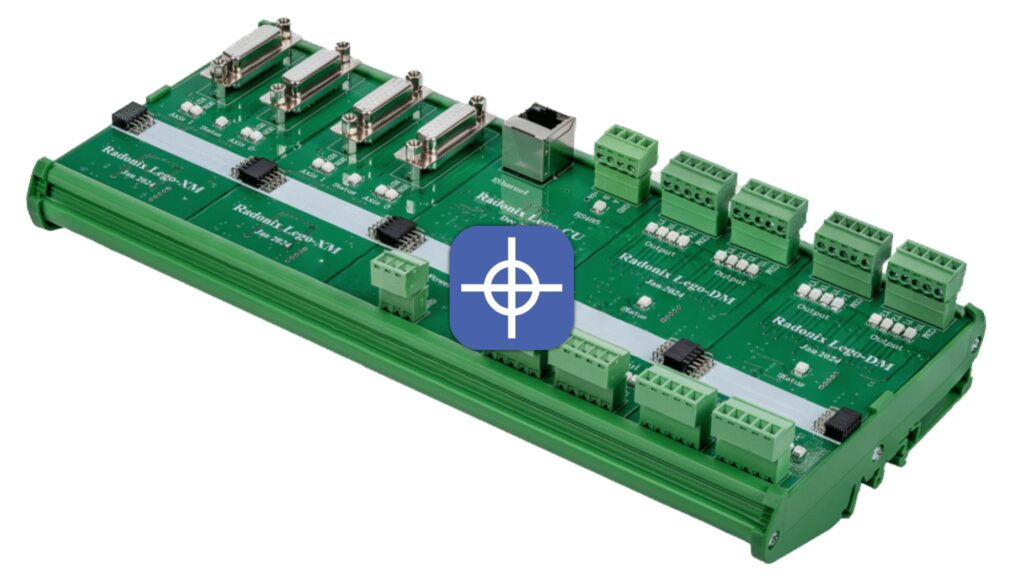
The Radonix Lego architecture decomposes CNC control into independent building blocks that communicate through a standardized, deterministic interface. Each block performs a specific function with high specialization and can be upgraded or replaced without affecting the rest of the system.
Inside the Radonix Lego Architecture
Radonix Planner Core
The Planner Core serves as the central intelligence of the system. It interprets G-code and high-level machining commands, generating optimized motion trajectories and synchronization rules across the machine.
Critically, the Planner Core is hardware-agnostic. It operates independently of motor type, axis count, or machine configuration. Whether controlling a three-axis router or an eleven-axis hybrid machine, the same planning logic applies.
This enables manufacturers and OEMs to reuse a single control logic across multiple machine platforms and product lines.
Radonix Lego Modules
Each physical function—axis control, spindle drive, I/O expansion, sensing, or safety—is implemented as an independent Radonix Lego module. Every module contains its own processing capability, feedback handling, and local safety logic.
Upon connection, modules automatically report their capabilities to the system, allowing the controller to self-configure during startup. Performance upgrades become straightforward: replacing or adding a module improves precision, torque, resolution, or functionality without rewriting software or redesigning the control cabinet.
Radonix Orchestrator Bus
The Orchestrator Bus is the deterministic communication backbone of the Radonix system. It ensures precise timing, synchronization, and fault isolation between all modules.
When a new Lego module is connected, Radonix detects it, validates compatibility, and integrates it automatically. Manual parameter configuration is eliminated, commissioning time is reduced, and system-level reliability is improved.
What This Means for Manufacturers and OEMs
A modular CNC controller fundamentally changes how machines are designed, maintained, and evolved:
- Machines scale naturally as axes or functions are added
- Maintenance is simplified through module-level replacement
- Downtime is reduced by isolating faults at the module level
- Control systems remain relevant over long machine lifecycles
Radonix enables OEMs to design machines around application requirements—not around controller constraints.
Designed for the Next Generation of CNC
The Radonix Lego architecture is inherently future-ready. Its distributed intelligence supports:
- Smart sensors and adaptive control strategies
- AI-assisted machining workflows
- Advanced kinematics and hybrid manufacturing systems
- Cloud-connected, data-driven production environments
Because intelligence is distributed rather than centralized, new capabilities can be introduced incrementally without destabilizing existing machine performance.
Engineering Reality: Modularity Done Right
Modularity introduces real engineering challenges, including synchronization, latency management, and safety coordination. Radonix addresses these challenges at the architectural level by combining deterministic communication, local fail-safe logic within each module, and robust system-wide coordination.
In Radonix, modularity is not an add-on feature. It is the core engineering principle that governs system behavior.
Conclusion: Why CNC’s Modular Future Is Radonix
The CNC industry is moving beyond fixed, closed controllers. As machines become more complex and manufacturing processes more adaptive, control systems must evolve accordingly.
Radonix Lego Controllers represent a shift from static hardware products to living control platforms—systems that grow with the machine, the process, and the business.
The future of CNC control is not a larger black box.
It is a modular, intelligent system—built brick by brick with Radonix.
Contact Radonix or use the chatbot in the bottom right corner to learn how linear encoders integrate with Radonix control systems.