
Protective Elements in Electrical Control Panels
Author: Nima Rad
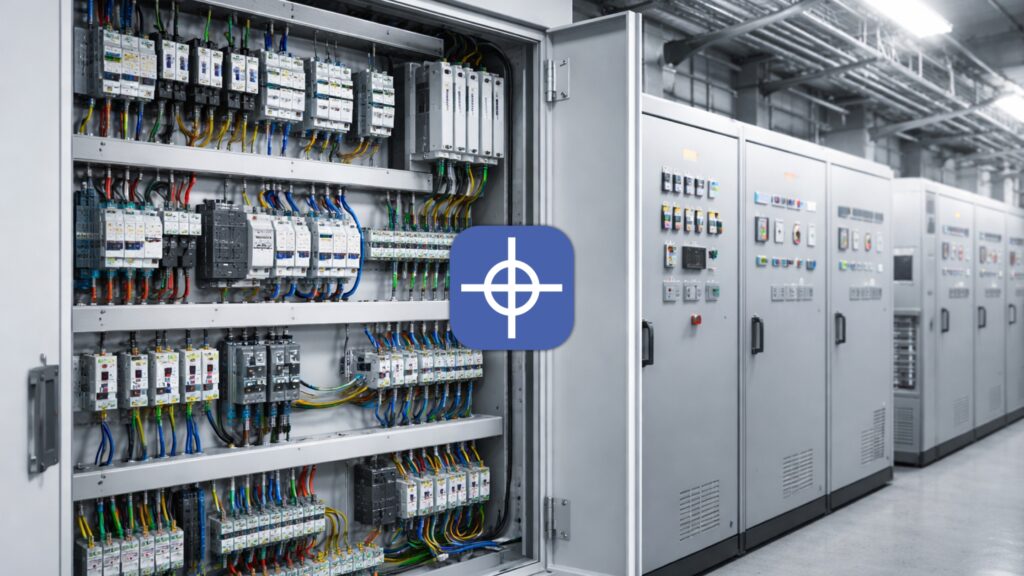
Electrical control panels are the backbone of industrial automation, machinery, and CNC systems.
A reliable panel is not defined only by neat wiring or correct component sizing; it is defined by how well it detects faults, limits damage, and protects people.
That protection is achieved through a coordinated set of devices and design practices—each covering a specific risk such as short circuit energy, motor overload, earth leakage shock hazards, transient overvoltage, electrical control panel noise, control power instability, heat buildup, and unsafe access.
This article translates and preserves the full technical intent of the original engineering notes while presenting them in a practical, evergreen structure suitable for panel builders, integrators, and maintenance teams.
1) Protection Against Short Circuit and Overcurrent (Short Circuit / Overcurrent)
Fuses (Fuse)
A fuse is a sacrificial element: when current rises beyond its designed limit, it opens the circuit by melting its element.
Key points:
- Advantages: fast operation, low cost, high reliability
- Disadvantages: once operated, it must be replaced
Common fuse types:
- gG/gL: general-purpose protection for cables and general loads
- aM: motor circuits; strong short-circuit protection but not full overload protection, so it is commonly used together with a thermal overload relay
- Fast-acting / time-delay: selected for loads with high inrush current, such as transformers and power supplies
Miniature Circuit Breaker (MCB)
MCBs provide combined protection:
- Thermal trip for overload
- Magnetic trip for short circuit
Trip curves (selection-critical):
- B curve: light loads and lighting
- C curve: general-purpose and light motor loads (very common in light industrial panels)
- D curve: very high inrush loads (transformers and heavy motors)
Critical selection note:
- Breaking capacity (e.g., 6 kA, 10 kA, etc.) must match the prospective short-circuit level of the supply network. This is not a minor spec—mismatch can become a safety risk.
MCCB and ACB (Molded Case / Air Circuit Breaker)
Where they are used:
- When currents are higher, breaking capacity requirements are greater, and more precise adjustment is needed.
Typical features:
- Adjustable thermal (long-time) settings
- Adjustable short-circuit settings
- In some configurations, earth fault protection
- Ability to add advanced protection units for better selectivity and coordination
2) Dedicated Motor Protection (Motor Protection)
Motors have specific failure modes—starting conditions, thermal loading, stall, and phase-related faults—so dedicated protection is essential.
MPCB / Motor Starter (Motor Protection Circuit Breaker)
Function:
- Protects motors against overload, stall/locked rotor, phase loss (in higher-end models), and short circuit (to a defined extent)
Advantages:
- Adjustable to motor-rated current
- Simple, compact, and industrial-grade
Thermal Overload Relay (Overload Relay)
Function:
- Provides overload protection for motors (typically installed with a contactor)
When it is essential:
- When using aM fuses, because aM does not fully cover overload conditions
Phase Sequence/Failure Relay
Function:
- Detects phase loss, incorrect phase sequence, voltage imbalance, and in some models under/over-voltage
Why it matters in the field:
- Many motor failures start from a loose phase, overheated terminal, or unbalanced supply. Phase monitoring is an early-warning layer that prevents costly burnout.
3) Earth Leakage and Electric Shock Protection (Earth Leakage / Shock)
Earth leakage protection supports two outcomes:
- Shock protection for people
- Fire risk reduction from larger leakage currents (design-dependent)
RCD/RCCB and RCBO
- RCCB / RCD: detects leakage current only (does not protect against overload/short circuit)
- RCBO: combines RCD + MCB (leakage + overcurrent protection)
Typical sensitivities:
- 30 mA: personal protection (commonly for sockets and general consumer circuits)
- 100 mA / 300 mA: often used for fire protection strategies and higher leakage thresholds (depends on design and selectivity plan)
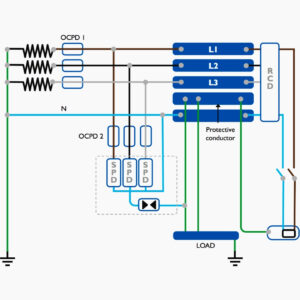
Coordination note (SPD + RCD):
- In coordinated designs, the placement of SPD relative to RCD and overcurrent protective devices (OCPD) matters, and the PE path plays a direct role in whether protection performs as intended.
Industrial note (drives/inverters/CNC panels):
- In panels with VFDs/inverters and electrical control panels, selecting the correct RCD type (for example, Type A / Type B, as required by the application) is crucial to avoid nuisance tripping or, more critically, a failure to trip under non-sinusoidal leakage conditions.
4) Overvoltage, Lightning, and Electrical Noise Protection (Surge / Transient / EMI)
Modern panels often include PLCs, servo drives, CNC controllers, and sensitive sensors. These electronics can be damaged or destabilized by transient surges and electromagnetic interference.
Surge Protective Device (SPD – Surge Protective Device)
Function:
- Absorbs and diverts fast transient overvoltages caused by indirect lightning events or switching of large loads.
SPD types (typical placement intent):
- Type 1: main building/service entrance (handles lightning impulse currents)
- Type 2: distribution panels (most common in industrial installations)
- Type 3: close to sensitive electronics (near PLCs and electronic modules)
Implementation note:
- SPD wiring must be short, correctly routed, and connected to a proper earthing system; otherwise it behaves like an unlatched seat belt—present but ineffective.
EMC/EMI Filter and Reactor/Choke
Function:
- Reduces electromagnetic noise and interference (critical for CNC, inverters, and servo systems)
Practical outcomes:
- Fewer unexplained PLC errors
- Less random resetting of electronics
- Reduced noise on sensor signals
5) Voltage and Control Power Protection (Control Power Protection)
Control circuits (often 24 VDC) require stable supply and noise control, because small disturbances can cause nuisance faults, resets, and intermittent behavior.
Switch-Mode Power Supply and Branch Protection
Typical good practice:
- Use DC fuses or DC-rated MCBs to protect 24 VDC branches
Flyback Diode (Flyback Diode)
Application:
- Across DC coils (contactors/solenoid valves)
Why it is critical:
- Protects outputs from back-EMF and reduces electrical noise in the control layer
Over/Under Voltage Relay (Over/Under Voltage Relay)
Function:
- Detects severe undervoltage or excessive overvoltage and issues a trip command to protect sensitive equipment
6) Thermal Protection and Fire Risk Inside the Panel
Heat and moisture are silent reliability killers. Managing temperature and condensation directly improves component life and reduces fault probability.
Thermostat + Panel Fan/Heater
Function:
- Prevents overheating and controls humidity/condensation inside the enclosure
Panel heater use case:
- Cold/humid environments where condensation causes corrosion, insulation breakdown, and micro short circuits
Temperature Sensor / Thermal Relay for Specific Equipment
Use case:
- Transformers, rectifiers, drives, and other heat-sensitive devices may require temperature sensors and alarm/trip logic depending on operating conditions
7) Earthing and Protective Earth (Earthing & Grounding)
Earthing is not just a component; it is the structural foundation of protection.
Key reality:
- Correct protective earth (PE) enables proper operation of RCDs and SPDs and reduces electric shock risk.
Implementation requirements:
- Mechanically secure bonding
- Good contact surfaces
- Short, low-impedance paths
A poor earthing system weakens every other protection layer.
8) Interlocks and Safety Protection (Safety)
Depending on application (machinery, CNC, plasma cutting), safety protection becomes a dedicated engineering topic.
Common safety elements in industrial panels:
- E-Stop pushbutton with correct safety circuit logic
- Safety Relay / Safety PLC
- Door interlock switch to prevent access while energized
- Safety contactor with contact monitoring/feedback
Electrical control panel protection prevents damage; safety systems prevent injury. Professional panels require both.
Conclusion
Protective elements in electrical control panels must be designed as a coordinated system. Correct selection, correct rating, correct placement, and correct earthing are what turn a panel from “assembled hardware” into a reliable industrial control system.
Contact Radonix or use the chatbot in the bottom right corner to learn how linear encoders integrate with Radonix control systems.
For industrial implementation, explore Radonix PC-based CNC controllers, control software and machine-specific HMI systems. Radonix PC-based CNC controller systems.