
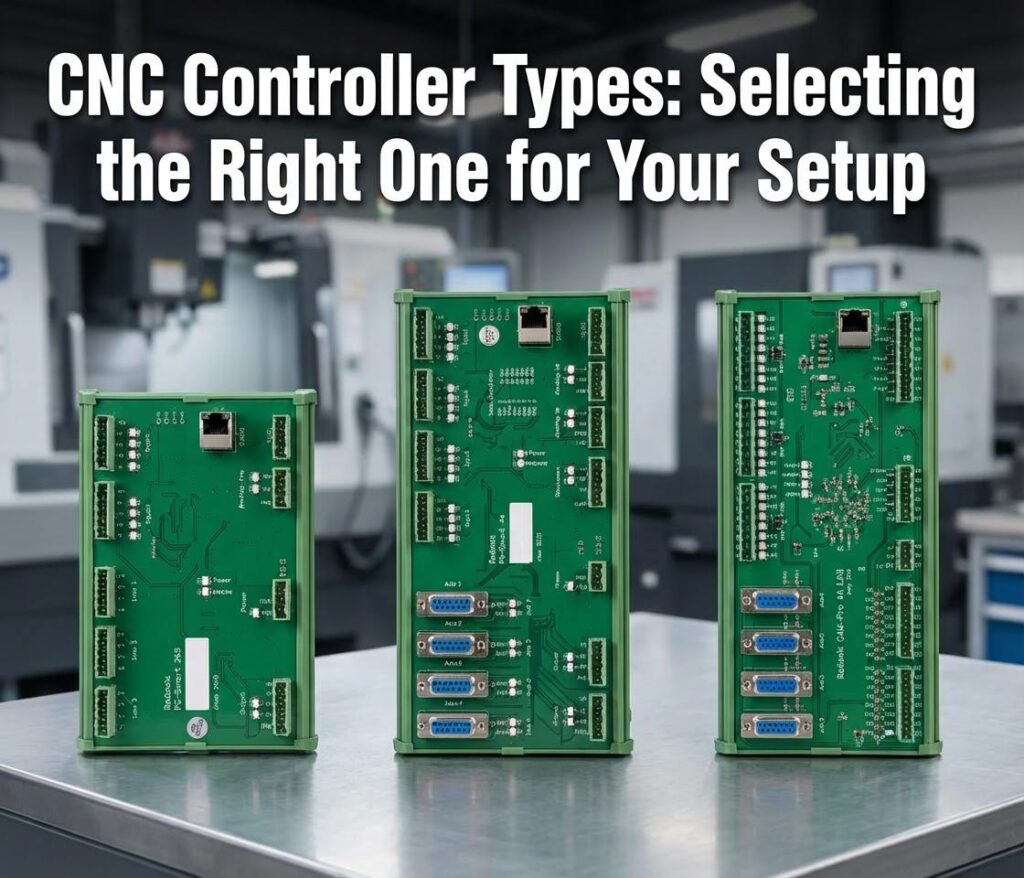
CNC Controller Types: Selecting the Right One for Your Machine
Written by: Radonix R & D Team.
Understanding CNC controller types is essential when configuring or upgrading a machining setup.
Each controller architecture differs in accuracy handling, motion speed, expandability, and long-term reliability. Selecting the right type directly impacts machining performance, downtime risk, and scalability.
For CNC engineers and industrial users, the goal is not simply to run a machine, but to achieve stable motion control, predictable output quality, and future-ready integration.
This guide provides a structured, technical overview to support informed controller selection.
Overview of Main CNC Controller Types in Modern Manufacturing
CNC controller types are commonly categorized by architecture and integration level, with each category serving different operational needs.
PC-Based Controllers
PC-based controllers rely on an industrial or standard PC for computation. They offer high flexibility through software environments and are often used in custom machines or retrofit projects where advanced processing, simulation, and parameter control are required.
Standalone Controllers
Standalone controllers are dedicated hardware units with integrated CPUs, I/O, and operator interfaces. These systems are designed for reliability in industrial environments and operate independently of external computers.
Embedded Controllers
Embedded controllers are tightly integrated into the machine’s electronics. Their compact design reduces wiring complexity and power consumption, making them suitable for space-constrained or OEM-built machines.
Motion Card-Based Controllers
Motion card-based controllers use PCI, PCIe, or USB motion cards connected to a host PC. This architecture is common in retrofit scenarios where precise motion control is required without replacing the entire system.
Each controller type aligns with different production priorities, from high-speed milling to precision engraving and plasma cutting.
Detailed Breakdown of CNC Controller Types and Their Features
Open-Loop and Closed-Loop Control
Open-loop controllers operate without positional feedback, typically using stepper motors. They are cost-effective and suitable for simple operations but are susceptible to lost steps under load.
Closed-loop controllers incorporate encoder feedback, allowing real-time position correction. These systems maintain accuracy under dynamic loads and are preferred for demanding or high-speed applications.
Hybrid systems combine both approaches to balance cost and performance.
Single-Axis and Multi-Axis Capability
Single-axis controllers handle linear motion in one direction and are used in basic cutting or feeding operations.
Multi-axis controllers (3 to 6+ axes) support complex interpolation, simultaneous motion, and rotary axis integration. These systems are essential for aerospace, automotive, and mold-making applications requiring complex geometries.
Integrated Versus Modular Architecture
Integrated controllers consolidate processing, motion control, and I/O into a single unit for ease of deployment.
Modular controllers allow individual components to be upgraded or replaced, supporting scalability and long-term system evolution, particularly in retrofit and custom-built machines.
Factors to Consider When Selecting CNC Controller Types
Choosing the correct CNC controller type requires evaluating both technical and operational requirements.
Machine Complexity
High-axis-count machines and complex toolpaths benefit from closed-loop or PC-based controllers with advanced interpolation and processing capability.
Budget Considerations
Entry-level motion card systems may start around 500 USD, while advanced integrated or closed-loop controllers can exceed 5,000 USD. Total cost of ownership should include upgrades, maintenance, and downtime risk.
Software Compatibility
Controller support for standard G-code, CAM platforms, and firmware updates is critical. PC-based systems typically offer broader compatibility.
Scalability and Future Expansion
Modular controllers allow additional axes, I/O, or communication protocols to be added as production requirements evolve.
User Interface and Usability
Clear HMIs reduce operator error and training time. Industrial controllers often provide touchscreens and dedicated control panels for shop-floor use.
Support and Lifecycle Management
Reliable technical support, documentation, and firmware updates are essential for long-term stability and performance.
How Radonix Supports Diverse CNC Controller Requirements
Radonix offers CNC controller solutions designed to support both retrofit projects and new machine builds. PC-based Radonix controllers integrate with Windows environments, enabling advanced simulation, multi-axis control, and parameter tuning for complex applications.
Standalone and embedded Radonix systems are engineered for industrial reliability, supporting high pulse rates up to 500 kHz for precise motion control. Closed-loop configurations incorporate encoder feedback and EtherCAT communication, enabling accurate multi-axis synchronization with low latency.
The modular design philosophy allows systems to scale from basic setups to advanced configurations across woodworking, metalworking, plasma cutting, and specialized industrial applications.
Pros and Cons of Common CNC Controller Types
| Controller Type | Advantages | Limitations |
|---|---|---|
| PC-Based | High flexibility, strong software support, cost-effective upgrades | Dependent on PC stability and operating system |
| Standalone | Industrial reliability, integrated HMI, independent operation | Higher initial cost, limited customization |
| Embedded | Compact design, energy efficient, reduced wiring | Limited expandability, service complexity |
| Motion Card-Based | Ideal for retrofits, precise control, affordable entry | Relies on host PC performance, possible latency |
This comparison highlights the trade-offs that influence controller selection in real production environments.
Step-by-Step Guide to Choosing the Right CNC Controller Type
- Define machine requirements, including axis count, materials, and accuracy targets.
- Select the appropriate control mechanism based on precision and load conditions.
- Verify compatibility with existing software, CAM workflows, and machine hardware.
- Evaluate scalability and long-term upgrade paths.
- Consider operator experience, interface clarity, and vendor support.
- Validate performance through simulation, testing, or pilot installations.
This structured approach reduces implementation risk and improves return on investment.
Conclusion
Selecting the correct CNC controller type is a strategic decision that affects machining accuracy, efficiency, and long-term system flexibility. By understanding controller architectures, control mechanisms, and scalability factors, manufacturers can align their choice with both current production needs and future growth objectives.
A well-matched controller ensures stable performance, reduced downtime, and consistent output quality across modern CNC applications.
Contact Radonix or use the chatbot in the bottom right corner to learn how linear encoders integrate with Radonix control systems.
For product evaluation, compare Radonix PC-based industrial CNC controllers, expansion hardware, software and machine-specific interfaces. Radonix industrial CNC controller range.