
Linear Encoder: High-Precision Position Feedback for Modern CNC Systems
Written by: Radonix R&D Team.
What Is a Linear Encoder?
A linear encoder is a high-accuracy sensor that measures straight-line motion along a machine axis.
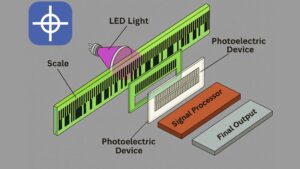
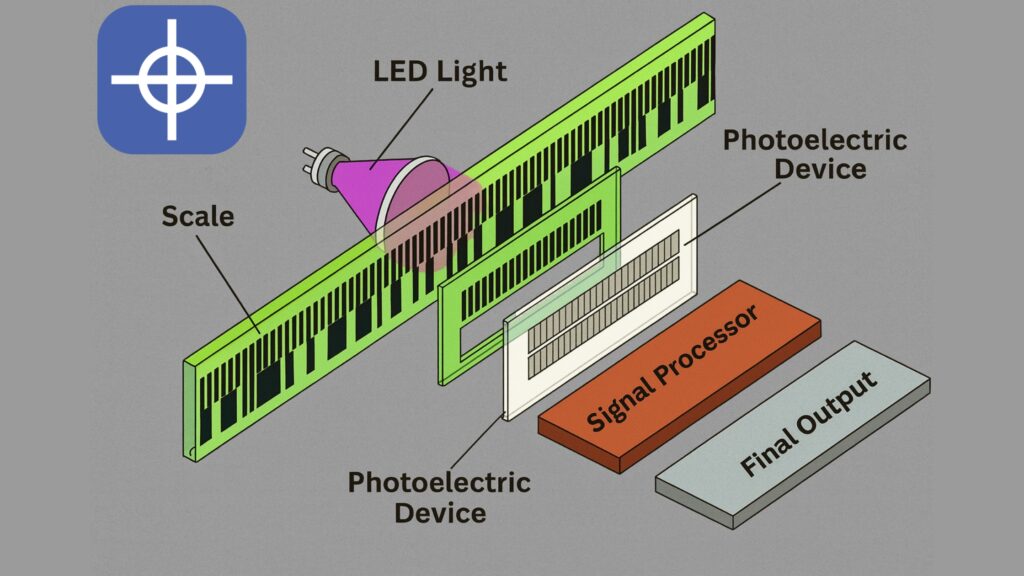
It works using two components: a scale, which contains coded patterns, and a readhead, which detects those patterns and converts them into electrical signals.
Because linear encoders measure actual axis movement, they are essential in CNC systems, automation, robotics, semiconductor tools, and metrology applications where precision and repeatability matter.
Linear encoders eliminate mechanical uncertainty such as backlash, thermal expansion, and screw wear, resulting in consistent, stable machining accuracy.

How Linear Encoders Work
Linear encoders operate by reading changes along the scale using optical, magnetic, inductive, capacitive, or eddy-current technologies. As the readhead moves along the axis, it detects variations and outputs digital or analogue signals.
Optical encoders use LED or laser light that interacts with transparent and opaque markings. Magnetic encoders use multi-pole magnetic strips and detect magnetic transitions. Inductive, capacitive, and eddy-current encoders provide alternatives for demanding environments.
Analogue outputs (sine/cosine) support fine interpolation, while digital outputs (A/B quadrature or index Z) provide clean, discrete positional data.
Types of Linear Encoders:
Linear encoders come in several designs, each with distinct strengths.
Optical Linear Encoders
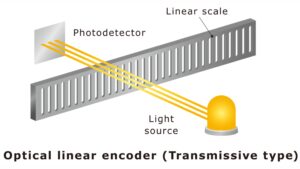
Optical encoders use light-based detection to achieve extremely high resolution, making them ideal for clean and controlled CNC environments. They are widely used in high-precision machining, semiconductor alignment, and metrology.
Magnetic Linear Encoders
Magnetic encoders rely on encoded magnetic strips and robust sensors. They perform reliably in dusty or oily industrial environments, making them suitable for automation lines, elevators, cranes, and robotics.
Alternative Technologies
Inductive encoders offer strong performance in contaminated environments. Capacitive encoders are cost-effective for low-precision measurement tools. Eddy-current encoders excel in specialised metallic environments.
Linear encoders may be open-type for maximum accuracy or sealed-type for protection in harsh industrial conditions.
Applications of Linear Encoders:
Linear encoders improve accuracy, stability, and performance in numerous fields.
Metrology & Precision Measurement
They are used in CMM machines, laser scanners, digital calipers, and tensile testing systems, offering reliable and repeatable dimensional accuracy.
CNC & Motion Control
Linear encoders deliver real-time closed-loop position feedback. This supports precise and stable tool control in milling, turning, PCB assembly, lithography systems, and high-end industrial printers.
Heavy-Duty Machinery
They provide stable motion control in elevators, cranes, grinders, and large linear platforms operating under vibration, temperature changes, and contamination.
Research & Engineering
Linear encoders support telescopes, optical devices, semiconductor R&D, and motor-driven precision stages, ensuring repeatable and high-accuracy motion for scientific applications.
Key Benefits and Limitations of Linear Encoders:
Benefits
- True position measurement: Eliminates mechanical errors from screws, couplings, or backlash.
- High repeatability: Essential for tight-tolerance machining.
- Reduced scrap: Improves part quality and process stability.
- Supports higher speeds: Enables fast cutting and positioning while maintaining accuracy.
Limitations
- Optical encoders need clean environments to avoid contamination.
- Magnetic encoders may be affected by strong magnetic fields.
- High-resolution models increase system cost.
- Installation requires careful alignment to reach optimal performance.
Linear Encoders in CNC Machines
Linear encoders are mounted on CNC axes (X, Y, and Z) with the scale fixed and the readhead moving with the axis. In closed-loop CNC systems, real-time encoder feedback allows the controller to correct positional errors instantly, neutralise backlash, and compensate for thermal expansion.
This capability improves surface finish, dimensional accuracy, and machining stability, especially during high-speed or multi-axis operations.
CNC Use Cases:
- Milling & Turning: Ensures precise tool-to-workpiece positioning.
- Robotic CNC Systems: Supports coordinated linear travel stages.
- Semiconductor Equipment: Enables nanometre-level alignment.
- CNC Retrofitting: Enhances older machines with modern accuracy.
Optical vs Magnetic Linear Encoders
Optical encoders use LED or laser-based detection and offer extremely fine resolution suitable for advanced machining and inspection systems. Magnetic encoders use multi-pole magnetic strips and allow larger air gaps, offering strong resistance to industrial contaminants such as dust, coolant, and oils.
Summary of Main Linear Encoder Applications:
- CNC machining centres requiring closed-loop accuracy.
- Precision metrology systems needing repeatable measurement.
- Automation platforms exposed to industrial contaminants.
- Scientific equipment demanding stable, precise linear movement.
Conclusion:
Linear encoders are fundamental components of modern CNC and automation systems. By measuring actual linear displacement rather than relying on mechanical estimates, they provide stable, repeatable, and highly accurate performance.
As encoder technology continues to advance, improvements in resolution, robustness, and integration will make them even more essential across precision engineering and high-end manufacturing.
Contact Radonix or use the chatbot in the bottom right corner to learn how linear encoders integrate with Radonix control systems.
For machine integration, compare Radonix CNC controller hardware for independent multi-axis motion, pulse/direction signals and industrial I/O. Radonix CNC controller hardware.