
Wire Diameter Calculation in Electrical Control Panels
Written by: Nima Rad, Content Specialist – Radonix
In electrical control panel design, what is commonly referred to as “wire diameter” must first be translated into conductor cross‑sectional area (mm²). Current‑carrying capacity, voltage drop, and short‑circuit withstand are all functions of cross‑section, not visual thickness. Only after selecting the correct cross‑section does it make sense, if required, to convert it into an equivalent conductor diameter.
This article presents a practical, standards‑based method for calculating wire size inside control panels, with specific attention to thermal conditions, bundling, and protection coordination.
1. Difference Between “Wire Diameter” and “Wire Size”
Standard wire sizing is expressed using nominal cross‑sectional area (1.5, 2.5, 4, 6, 10 mm², etc.).
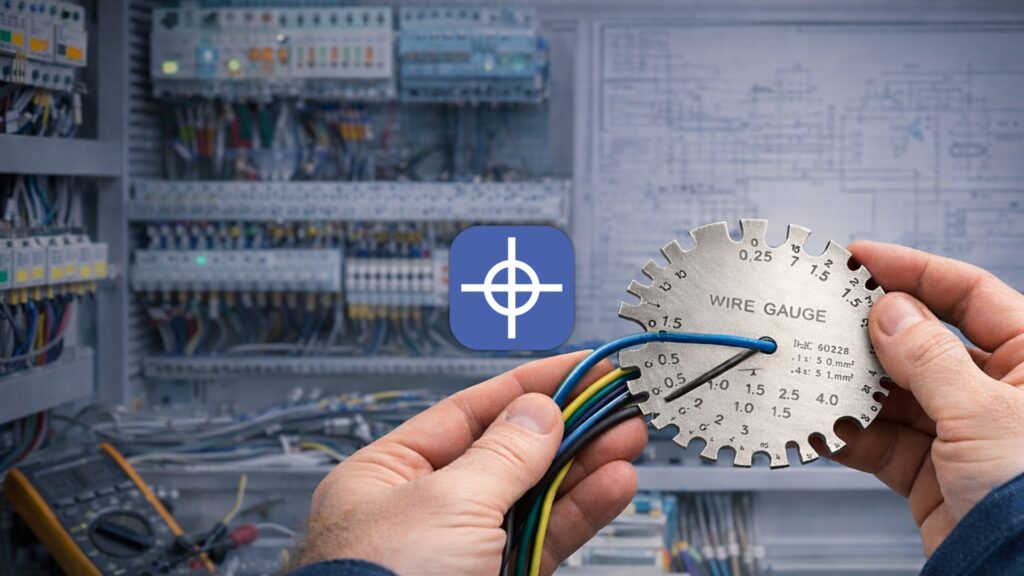
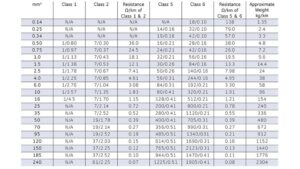
A true geometric diameter is only directly meaningful for solid conductors (IEC 60228 Class 1). For stranded or flexible conductors (Classes 2, 5, and 6), the actual diameter depends on strand count, strand diameter, and packing geometry. IEC 60228 defines conductor classes, construction, and maximum resistance values rather than physical outer diameter.
2. Required Input Data
Before selecting a wire cross‑section for a control panel, the following parameters must be known:
- Load power or current (kW or A) and load type (motor, resistive, non‑linear)
- System voltage and phase (single‑phase 230 V or three‑phase 400 V)
- Power factor (cosφ) and motor efficiency (η), where applicable
- Cable length (internal panel wiring is short; incoming/outgoing feeders may be long)
- Installation method: duct, conduit, tray, free air, internal panel wiring, bundled
- Ambient temperature inside the panel (usually higher than room temperature)
- Number of adjacent conductors and grouping factor
- Allowable voltage drop
- Short‑circuit conditions: fault current and protective device clearing time or I²t
3. Standard Cross‑Section Selection Procedure (Practical Method)
Step 1: Calculate Design Current (Ib)
Single‑phase:
Ib = P / (V × cosφ × η)
Three‑phase:
Ib = P / (√3 × V × cosφ × η)
For purely resistive loads, cosφ ≈ 1 and η ≈ 1.
Step 2: Select Protective Device Rating (In)
A common design rule:
In ≤ Ib
The selected conductor must safely carry at least In after applying all correction factors.
Step 3: Select Cross‑Section Based on Ampacity
Using IEC or NEC tables (or manufacturer data), determine the base current‑carrying capacity for the chosen installation method, then apply correction factors:
- Temperature correction factor (KT)
- Grouping/bundling factor (KG)
- Additional derating factors (thermal insulation, harmonic content, adjacent circuits)
Design condition:
Iz × KT × KG ≥ In
Control panel note: Even with short conductor lengths, derating inside panels is critical due to elevated temperature and dense bundling.
4. Voltage Drop Verification
For AC systems, voltage drop depends on conductor resistance and reactance.
Single‑phase:
ΔV = 2 × I × L × (R × cosφ + X × sinφ)
Three‑phase:
ΔV = √3 × I × L × (R × cosφ + X × sinφ)
Typical design guidance (IEC‑based practice):
- ~3% for lighting circuits
- ~5% for general loads
Conductor resistance values may be taken from IEC 60228 or manufacturer datasheets. Example copper conductor resistance at 20°C:
- 2.5 mm² → 7.41 Ω/km
- 4 mm² → 4.61 Ω/km
- 6 mm² → 3.08 Ω/km
- 10 mm² → 1.83 Ω/km
Temperature correction for resistance:
Rθ = R20 × [1 + α × (θ − 20)]
5. Short‑Circuit Withstand Verification
To ensure the conductor survives a short‑circuit until the protective device clears, the adiabatic equation is used:
S = I × √t / K
Where:
- S = conductor cross‑section (mm²)
- I = short‑circuit current (A)
- t = disconnection time (s)
- K = material and insulation constant
This check is often decisive for internal panel feeders, even when voltage drop is negligible.
6. Converting Cross‑Section to Equivalent Diameter
For solid round conductors only:
d = √(4S / π)
If S is in mm², d is in mm.
Common equivalents:
- 1.5 mm² → 1.38 mm
- 2.5 mm² → 1.78 mm
- 4 mm² → 2.26 mm
- 6 mm² → 2.76 mm
- 10 mm² → 3.57 mm
- 16 mm² → 4.51 mm
For stranded conductors, the actual bundle diameter is larger and must be obtained from IEC 60228 tables or manufacturer data.

7. Numerical Example (Three‑Phase, Practical Case)
Assume a 15 kW three‑phase motor, 400 V, cosφ = 0.85, η = 0.9, cable length = 45 m.
- Design current:
Ib = 15000 / (√3 × 400 × 0.85 × 0.9)
- Cross‑section selection:
Select candidate cross‑section from tables, apply temperature and grouping factors, and verify:
Iz × KT × KG ≥ In
- Voltage drop check (resistance‑only approximation):
For 6 mm² copper, R20 ≈ 3.08 Ω/km.
Convert to Ω/m and apply three‑phase voltage drop formula with L = 45 m.
- Short‑circuit check:
Apply the adiabatic equation using system fault current and protective device clearing time.
8. Control‑Panel‑Specific Design Notes
- Conductor length is short, but thermal conditions and bundling dominate
- For control and signal wiring, current is low; noise immunity and terminal compatibility are often more critical than voltage drop
- For internal power wiring between breakers, contactors, and terminals, mechanical termination limits and short‑circuit withstand may govern size selection
- Always consider upsizing when:
- Panel temperature is high
- Future expansion is expected
- Conductors are densely packed
Correct wire sizing inside control panels is not guesswork—it is the result of coordinated thermal, electrical, and protection design based on standards and real operating conditions.
Contact Radonix or use the chatbot in the bottom right corner to learn how linear encoders integrate with Radonix control systems.