
Why the Difference Between ECM and EDM Changes CNC Output Quality?
Written by: Radonix Automation Technical Team
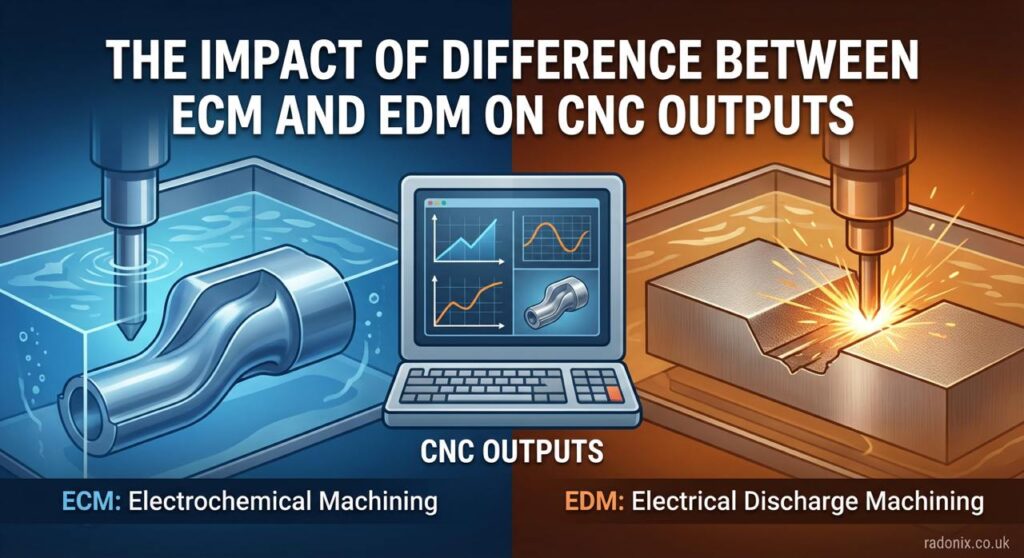
ECM (Electrochemical Machining) and EDM (Electrical Discharge Machining) are non-traditional CNC processes used where conventional cutting reaches its limits.
While both are suitable for hard and complex materials, their material removal physics differ fundamentally—and that difference between ECM and EDM directly defines CNC output quality.
Key CNC output factors affected by process selection include:
- Surface integrity and roughness
- Dimensional accuracy and tolerance stability
- Metallurgical condition and residual stress
- Post-processing requirements
- Long-term fatigue and corrosion behavior
Selecting ECM or EDM purely based on geometry—without considering these output effects—often leads to parts that meet dimensional specs but fail in service.
Core Machining Principle: ECM vs EDM
Electrochemical Machining (ECM)
ECM removes material through anodic dissolution:
- Workpiece: anode
- Tool: cathode (no physical contact)
- Electrolyte: conductive salt solution (commonly NaCl or NaNO₃)
- Power supply: low-voltage DC
Typical operating ranges:
- Voltage: ~5–25 V
- Current density: ~10–100 A/cm²
- Inter-electrode gap: ~0.05–0.5 mm
Material removal follows Faraday’s laws, meaning removal rate is proportional to current and time. Because no melting occurs, ECM introduces no thermal damage and no tool wear.
Electrical Discharge Machining (EDM)
EDM removes material through controlled thermal erosion:
- Electrical discharges across a dielectric gap
- Dielectric fluids: hydrocarbon oil or deionized water
- Localized melting and vaporization
Typical operating ranges:
- Discharge temperature: ~8,000–12,000 °C (localized)
- Spark gap: ~0.01–0.05 mm
- Pulse duration: ~1–100 µs
EDM enables machining of very hard materials and complex internal geometry but introduces thermal effects that must be managed.
Surface Quality and Integrity in CNC Outputs
ECM surface characteristics
Because ECM is heat-free, surface integrity is inherently high:
- No recast (white) layer
- No microcracking from thermal shock
- Minimal burr formation
- Uniform surface chemistry
Typical surface roughness:
- Ra ≈ 0.1–0.8 µm (process-dependent)
These properties make ECM suitable for fatigue-critical, sealing, and corrosion-sensitive components.
EDM surface characteristics
EDM surfaces are thermally affected:
- Recast layer thickness: ~5–50 µm (parameter-dependent)
- Potential microcracks from rapid cooling
- Tensile residual stresses near surface
Typical surface roughness:
- Roughing EDM: Ra ≈ 1.5–3.2 µm
- Finishing EDM: Ra ≈ 0.1–0.8 µm
Post-processing (polishing, layer removal, stress relief) is often required for high-reliability applications.
Dimensional Accuracy and Tolerances: Where Each Process Wins
Dimensional accuracy is governed by gap stability and energy distribution, which differ significantly between ECM and EDM.
Quantitative comparison
| Parameter | ECM | EDM | Practical Impact on CNC Outputs |
|---|---|---|---|
| Typical tolerance range | ±0.01–0.05 mm | ±0.005–0.025 mm | EDM favors micro-features; ECM suits consistent profiles |
| Repeatability | High (no tool wear) | Moderate (electrode wear) | ECM reduces batch variability |
| Machining gap | ~0.05–0.5 mm | ~0.01–0.05 mm | EDM supports sharper internal geometry |
| Overcut tendency | Higher (electrolyte flow) | Lower (pulse-controlled) | ECM needs edge optimization |
| Material hardness influence | Minimal | None | EDM effective beyond ~60 HRC |
Practical interpretation
ECM delivers stable, repeatable dimensions in continuous production, but sharp edges require careful electrolyte and tool design. EDM achieves tighter local tolerances and fine features, especially in hardened materials, but dimensional accuracy degrades as electrode wear accumulates.
Metallurgical and Structural Effects on Machined Parts
ECM metallurgical outcome
- No heat-affected zone (HAZ)
- No phase transformation
- Near-zero residual thermal stress
- Base material hardness preserved
These characteristics make ECM highly suitable for aerospace, energy, and medical components where long-term structural integrity matters.
EDM metallurgical outcome
- HAZ depth: ~10–100 µm (application-dependent)
- Possible martensitic transformation in steels
- Tensile residual stresses up to several hundred MPa
- Altered surface chemistry from dielectric interaction
Without post-treatment, these effects can reduce fatigue life and corrosion resistance.
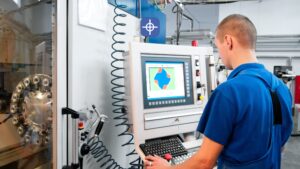
CNC Control Influence on ECM and EDM Output Stability
Process physics alone do not define output quality—control stability is equally critical.
For ECM, CNC control directly affects:
- Gap stability to prevent stray dissolution
- Current density uniformity
- Electrolyte flow balance and flushing
For EDM, CNC control directly affects:
- Discharge stability (arc vs spark control)
- Adaptive gap regulation under debris load
- Electrode wear compensation
Advanced CNC control architectures improve consistency, reduce scrap, and stabilize tolerances across both processes.
Application-Driven Process Selection
Aerospace and energy
ECM is preferred where fatigue life, surface integrity, and flow performance are critical.
Tooling and mold manufacturing
EDM dominates due to its ability to machine hardened steels and complex cavities with high geometric precision.
Medical components
ECM is commonly selected where surface integrity and metallurgical cleanliness directly affect biocompatibility.
Conclusion
The difference between ECM and EDM fundamentally shapes CNC output quality. ECM preserves surface integrity and material structure, while EDM enables extreme geometric freedom at the cost of thermal side effects.
Selecting the correct process—and controlling it correctly—is essential not just for meeting dimensional targets, but for ensuring long-term performance of precision-machined components.
Contact Radonix or use the chatbot in the bottom right corner to learn how linear encoders integrate with Radonix control systems.