
Understanding RTCP in CNC: Why Rotation Tool Center Point Matters in 5-Axis Machining
Written by: Radonix R & D Team.
What Is RTCP in CNC?
RTCP, or Rotation Tool Center Point, is a CNC function that ensures the tool tip stays exactly on the programmed toolpath even when rotary axes move.
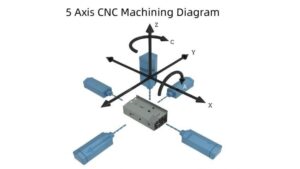
In 5-axis machining, axes such as A, B, or C rotate while linear axes X, Y, and Z move simultaneously. Without compensation, the tool tip deviates from the intended path. RTCP corrects this by continuously recalculating the tool tip position based on machine kinematics.
Why 5-Axis Machines Need RTCP
In 3-axis machining, the tool moves only in X, Y, and Z, making toolpath calculation straightforward. In 5-axis machining, rotary axes change the spatial relationship between the tool and the workpiece. Even slight angular adjustments shift the tool tip. RTCP compensates these nonlinear errors, ensuring the programmed geometry matches the real cut.
How RTCP Works in Simple Terms
When CAM defines a toolpath based on the workpiece coordinate system, it provides the tool vector and TCP position. With RTCP off, CAM must calculate every rotary transformation and linear correction. With RTCP on, the controller performs these calculations itself. It adjusts X, Y, Z, and rotary angles automatically, keeps the tool tip aligned, and reduces the need for complex reposting when tool lengths or pivot offsets change.
What RTCP Actually Does
RTCP performs three critical functions:
- Keeps the tool tip exactly on the programmed path during rotary motion
- Compensates angular changes to maintain a stable workpiece coordinate relationship
- Simplifies post-processing by removing the need for manual kinematic conversions
Benefits of RTCP in 5-Axis Machining
Improved Dimensional Accuracy and Surface Quality
RTCP minimizes nonlinear errors and maintains a consistent tool load on complex free-form surfaces.
Higher Productivity and Faster Setup
Tool length modifications and fixture adjustments can be handled in the controller without regenerating toolpaths.
Easier Programming and More Flexibility
The programmer focuses on geometry and tool vectors instead of machine-specific kinematics.
Enabling Advanced Simultaneous 5-Axis Strategies
RTCP stabilizes feed rates, reduces vibration, and ensures smooth motion during continuous multi-axis machining.
RTCP from a Kinematics Perspective
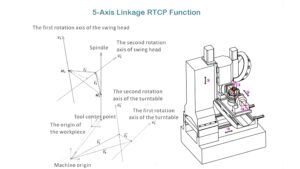
To function properly, the controller must understand:
- Machine configuration (Head-Table, Table-Table, Head-Head)
- Axis order and pivot points
- Coordinate transformations between workpiece and machine systems
During each G-code block, the controller reads the tool vector and TCP position, applies rotary transformations, and calculates the corrected axis positions required to maintain the programmed path.
How RTCP Is Activated on Different Controllers
Different CNC brands use different activation commands:
Heidenhain
Uses TCPM, PLANE SPATIAL, and dedicated 5-axis settings.
Siemens
Uses transformations like TRAORI for 3D tool tip compensation.
Beckhoff / TwinCAT
Employs commands such as #TRAFO ON or #RTCP ON.
Industrial 5-Axis Routers and Machining Centers
Often list RTCP as an optional feature; not all 5-axis machines include it.
Calibration and Setup of RTCP
Accurate kinematics are essential. Calibration includes:
- Measuring pivot lengths and offsets
- Running standard RTCP verification paths
- Using probes, test spheres, or reference artifacts
Improper calibration can introduce errors rather than prevent them.
Industrial Applications of RTCP
RTCP is widely used where precision and complex geometries matter:
- Aerospace turbine blades and impellers
- Mold and die components
- Medical implants and orthopedic parts
- Wood, stone, and composite machining for 3D shapes
With vs Without RTCP
Without RTCP
- Difficult programming
- Sensitive to tool length changes
- Limited to positioning (3+2) machining
- Higher risk of dimensional errors
With RTCP
- True simultaneous 5-axis machining
- Better surface finish
- More flexibility and higher reliability
- Reduced dependency on machine-specific CAM settings
Common RTCP Issues and Challenges
- Incorrect kinematic definitions
- Poor calibration
- Mismatch between CAM assumptions and controller settings
- Axis dynamic limitations affecting contour accuracy
Conclusion
RTCP is a core technology that makes true 5-axis machining possible. By stabilizing the tool tip, compensating for machine motion, and simplifying programming, it improves accuracy, surface quality, and productivity. For best results, RTCP requires accurate kinematic models, proper calibration, and alignment between CAM and CNC settings.
Contact Radonix or use the chatbot in the bottom right corner to learn how linear encoders integrate with Radonix control systems.