
Understanding Precision Electric Motors: Types, Performance, and Industrial Applications
Written by: Radonix R & D Team.
Modern automation relies on motors that deliver not only power but also accuracy, repeatability, and reliability.
Precision electric motors fill this role across CNC machines, robotics, medical equipment, semiconductor tools, and high‑performance industrial systems. Unlike conventional AC or DC motors, precision electric motors are engineered for controlled motion, minimal error, and consistent torque across a wide range of speeds.
This guide breaks down the core types of precision electric motors, how they operate, where they are used, and what advantages or limitations each offers. It also reflects real industrial search trends such as stepper vs servo motor, industrial servo motors, BLDC motor advantages, and linear motor applications.
What Makes a Motor “Precision”?
Precision electric motors are designed to provide fine motion control, stable positioning, and highly repeatable performance. Their key attributes include:
- Accurate speed or position control
- Low vibration and reduced noise
- Long service life with minimal maintenance
- High efficiency and torque consistency
Compared to standard motors, precision electric motors often incorporate feedback sensors, permanent magnets, optimized electromagnetics, and advanced drive electronics.
They are used in CNC axes, robotic joints, automated inspection systems, semiconductor tools, medical pumps, and laboratory instruments where even millimeters—or microns—matter.
Types of Precision Electric Motors
Stepper Motors
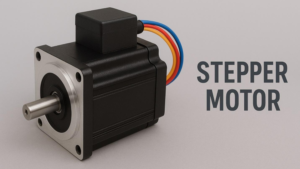
Stepper motors are among the most widely used precision electric motors thanks to their affordability and simplicity.
How They Work
A stepper motor rotates in fixed increments (steps). Each pulse sent to the driver causes the shaft to move a precise angle—commonly 1.8° per step (200 steps/rev). They operate in an open loop, meaning no feedback is required to control position.
Applications
- 3D printers
- Small CNC routers
- Robotics prototypes
- Medical devices
- Camera positioning systems
Advantages
- Very easy to control
- High low‑speed torque
- Cost‑effective for precision positioning
- Good repeatability
Limitations
- Torque drops sharply at high RPMs
- Can lose steps under heavy load
- Generates heat while holding a position
- Less suitable for fast or high‑load applications
Step‑based motion and low cost make them ideal for stepper motor applications, but not for high‑speed industrial automation.
Servo Motors
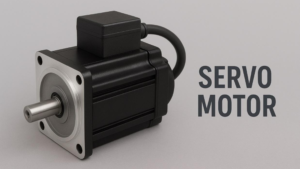
Servo motors deliver high performance, high responsiveness, and high precision. They combine a motor (often brushless), an encoder, and a closed-loop controller.
How They Work
A servo motor continuously receives position feedback from its encoder. The controller compares actual vs. commanded position and corrects any error instantly. This makes servos ideal for robotics, CNC machining, and fast dynamic systems.
Industrial Applications
- CNC machine axes
- Robotic manipulators (robotics servo motors)
- Packaging and printing machines
- Automotive assembly systems
Advantages
- Accurate positioning with no lost motion
- High torque at both low and high speeds
- Smooth, low‑vibration operation
- Excellent energy efficiency
Limitations
- Higher cost than steppers
- Requires tuning (PID/tracking parameters)
- More complex installation
This category also includes industrial servo motors and precision servo motors, widely used in automation.
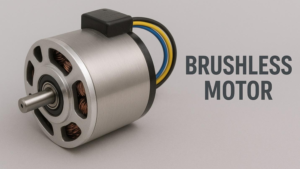
Brushless DC Motors (BLDC)
BLDC motors offer high efficiency, low noise, and an excellent power‑to‑weight ratio. They rely on electronic commutation instead of brushes, making them durable and low maintenance.
How They Work
An electronic controller energizes stator windings in sequence, causing the rotor’s permanent magnets to rotate. Sensors (often Hall sensors) or sensorless algorithms determine rotor position.
Typical Uses
- Electric vehicles
- Industrial fans and blowers
- Robotics platforms
- Power tools
- HVAC compressors
BLDC Motor Advantages
- Very high efficiency (up to ~90%)
- High-speed capability
- Durable with minimal-wear components
- Low electrical noise
- Compact size with high torque density
Limitations
- Requires a dedicated controller
- Higher cost than brushed motors
- Sensitive to heat in compact designs
BLDC motors are a middle ground between servo systems and low‑cost steppers, often used where long duty cycles and efficiency are priorities.
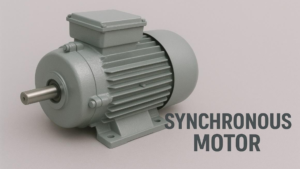
Precision Synchronous Motors
Precision synchronous motors rotate in perfect synchrony with the frequency of their input power or drive signal.
Operating Principle
The rotor—usually containing permanent magnets—locks to the rotating magnetic field. When paired with a servo drive and encoder, this becomes a high‑end industrial servo system.
Applications
- CNC machining centers
- High‑speed pumps and compressors
- Direct drive rotary tables (direct drive torque motor)
- Industrial automation lines
Advantages
- Extremely stable speed
- Very high efficiency
- Excellent torque characteristics
- Suitable for heavy‑duty industrial loads
Limitations
- Not self‑starting without drive assistance
- Higher cost due to magnets and control electronics
Their stability and dynamic performance make them essential in precision manufacturing.
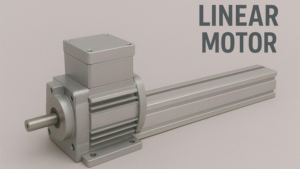
Linear Motors
Linear motors generate motion in a straight line rather than rotation. They are essentially “unrolled” motors.
How They Work
A moving magnetic assembly travels along a track containing stator windings. There is no screw, belt, or mechanical transmission—no backlash, no elastic deformation.
Linear Motor Applications
- Semiconductor lithography machines
- High‑accuracy CNC stages
- Robotics and automated pick‑and‑place systems
- Medical imaging tables
- High‑speed printing and packaging equipment
Advantages
- Zero mechanical backlash
- Ultra‑high precision (micron and sub‑micron control)
- Extremely fast acceleration
- Very smooth motion
Limitations
- High cost due to magnets and precision mechanics
- Requires careful installation and alignment
- Sensitive to metallic debris
Linear motors define the highest class of precision in industrial motion control.
Leading Global Manufacturers
Several world‑class brands dominate the precision motor industry:
- Yaskawa – Servo motor leader (Sigma‑series)
- Mitsubishi Electric – High‑reliability industrial servo solutions
- Siemens – SIMOTICS motors for CNC and robotics
- ABB/Baldor – Heavy‑duty motors for industrial automation
- Nidec – Major producer of BLDC and micro motors
- Kollmorgen – Famous for direct drive torque motors
- Oriental Motor – Specialist in stepper and small servo systems
- Maxon – Premium micro motors used in aerospace and medical
- Faulhaber – High‑precision miniature drives
These companies set global standards for performance, durability, and precision.
Summary & Choosing the Right Precision Motor
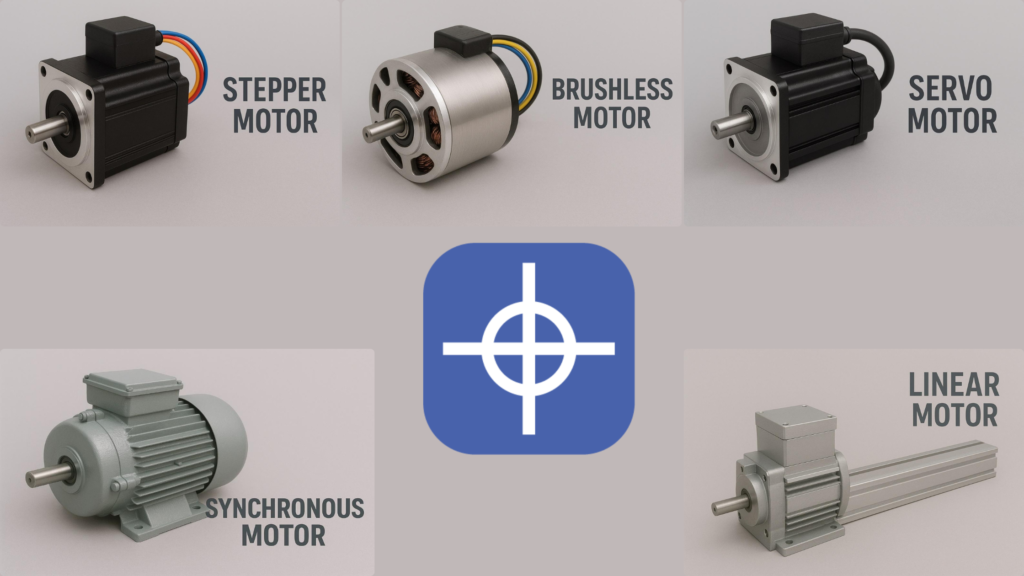
Each motor type excels in different scenarios:
- Stepper motors – Best for low‑cost, moderate‑precision positioning
- Servo motors – High accuracy, high speed, no missed steps
- BLDC motors – Efficient, long‑life, ideal for continuous operation
- Precision synchronous motors – High torque, stable speed, industrial power
- Linear motors – Ultimate accuracy and speed for advanced automation
Selecting the right motor depends on your priorities: precision, speed, torque, cost, maintenance, or energy efficiency. Understanding these categories helps engineers design motion systems that are reliable, scalable, and optimized for their specific applications.
Contact Radonix or use the chatbot in the bottom right corner to learn how linear encoders integrate with Radonix control systems.