

What Is a Potentiometer?
Author: Nima Rad
A potentiometer is a three-terminal variable resistor commonly used to divide voltage or manually adjust an analog parameter such as speed, gain, brightness, threshold levels, or reference voltage.
In industrial electronics and CNC-related systems, potentiometers are widely used for manual tuning, calibration, and analog input control.
When all three terminals are used, the potentiometer operates as a voltage divider. When only two terminals are used (the wiper and one end), it behaves like a rheostat, acting as a variable series resistor.
Internal Structure and Working Principle
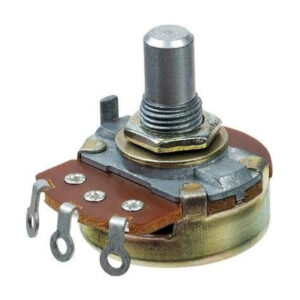
A typical potentiometer consists of three main components:
- Resistive track: The fixed resistance element, made from carbon, cermet, conductive plastic, or wirewound material.
- Wiper: A movable contact that slides or rotates along the resistive track.
- Three terminals:
- Terminal A: One end of the resistive track
- Terminal B: The opposite end of the track
- Terminal W: The wiper (output)
As the shaft is rotated or the slider is moved, the wiper changes its position along the resistive path, altering the resistance ratio and therefore the output voltage.
Circuit Model and Key Formulas
Voltage Divider Configuration
When the potentiometer is connected between Vin and GND and the output is taken from the wiper:
- Total resistance = R
- Wiper position ratio = x (from 0 to 1)
Then:
- Resistance from wiper to ground = xR
- Resistance from Vin to wiper = (1 − x)R
If the load impedance is high, the output voltage follows:
Vout ≈ x × Vin
Rheostat Configuration
When the wiper is tied to one end terminal, the potentiometer functions as a variable series resistor. This mode is not suitable for high-current applications unless a power-rated or wirewound type is used.
Types of Potentiometers by Mechanical Design
Rotary Potentiometer
The most common type. Available in single-turn and multi-turn versions and used extensively on control panels and industrial equipment.
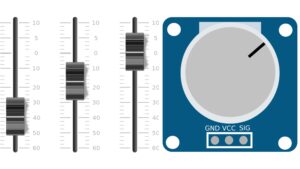
Linear (Slider) Potentiometer
Uses linear motion instead of rotation. Common in mixers, operator panels, and manual control interfaces.
Trim Potentiometer
Small, board-mounted devices designed for calibration and fine adjustment during setup or maintenance.
Multi-Turn Potentiometer
Provides higher resolution adjustment, typically requiring 5, 10, or more turns for full-scale change. Preferred for precision calibration.
Types by Resistive Technology
Carbon
Low cost and widely available, but prone to wear, noise, and limited accuracy.
Cermet
Offers improved stability and accuracy. Common in industrial and calibration-focused applications.
Conductive Plastic
Smooth operation, low noise, and long mechanical life. Suitable for high-quality control applications.
Wirewound
Designed for higher power handling and stability. May introduce small step changes due to the winding structure.
Resistance Taper Characteristics
- Linear taper: Resistance changes proportionally with rotation or movement.
- Logarithmic taper: Used primarily for audio and human-perception-based controls.
- Reverse logarithmic taper: Less common and application-specific.
Taper naming conventions vary by manufacturer, so datasheets should always be verified.
Key Technical Specifications When Selecting a Potentiometer
- Nominal resistance value (e.g., 1kΩ, 10kΩ, 100kΩ)
- Resistance tolerance
- Power rating
- Maximum operating voltage
- Mechanical life (number of cycles)
- Contact noise and signal stability
- Operating temperature range
- Shaft type, torque, and mounting style
Standard Wiring and Practical Tips
Identifying the Terminals
- Measure resistance between the two outer terminals to confirm the nominal value.
- Measure between the wiper and each outer terminal while rotating to identify direction.
Direction Control
If clockwise rotation produces decreasing output, simply swap the two outer terminals.
Industrial Reliability Tips
- Avoid long, unshielded wiper connections in noisy environments.
- Use RC filtering or buffering for ADC inputs.
- Implement fail-safe logic when potentiometer failure could cause unsafe behavior.
Common Industrial and CNC Applications
- Analog speed control for drives with 0–5V or 0–10V inputs
- Gain and threshold tuning in control circuits
- Sensor calibration and reference voltage adjustment
- Manual override controls on CNC and automation panels
In modern automation systems, potentiometers are often replaced by encoders or digital potentiometers where repeatability and durability are critical.
What Is a Digital Potentiometer?
A digital potentiometer is an integrated circuit that emulates a mechanical potentiometer using internal resistor networks and electronic switches. The resistance value is adjusted via digital interfaces such as I2C or SPI.
Advantages
- No mechanical wear
- Software-controlled adjustment
- Ideal for automated calibration
Limitations
- Limited voltage and current handling
- Resolution constraints
- Potential switching noise in sensitive circuits
Common Failures and Practical Solutions
- Noisy or unstable output: Caused by contamination or track wear → replace with higher-quality type
- Intermittent signal loss: Often due to damaged wiper or resistive track → replacement required
- Thermal damage: Result of excessive current → redesign using proper voltage division or power-rated components
Step-by-Step Testing with a Multimeter
- Set the multimeter to resistance mode.
- Measure between the two outer terminals to verify nominal resistance.
- Measure between the wiper and one outer terminal while rotating.
- Look for smooth, continuous resistance change without jumps.
Abrupt changes usually indicate internal wear or failure.
Quick Selection Guide
- For microcontroller ADC inputs: ~10kΩ is commonly used.
- For precision calibration: multi-turn cermet types.
- For high power or current: wirewound rheostats instead of standard potentiometers.
- For automated systems: digital potentiometers or encoders.
Contact Radonix or use the chatbot in the bottom right corner to learn how linear encoders integrate with Radonix control systems.