
Pneumatic Cylinder in CNC Workholding and Automation
Written by: Radonix R&D Team.
A pneumatic cylinder is one of the most widely used actuators in CNC automation. By converting compressed air into controlled linear motion, the pneumatic cylinder in CNC machines handles workholding, tool clamping, door actuation, and part ejection with high speed and very simple mechanics.
In this guide, we walk through the structure, main types, working principle, CNC applications, advantages, limits, installation, and maintenance—so designers and machine builders can specify cylinders confidently.
Why the Pneumatic Cylinder Matters in CNC
In CNC machining, the machine must repeat the same motion thousands of times while keeping the workpiece stable and operators safe. A pneumatic cylinder offers:
- Fast motion for clamping, unclamping, and part transfer.
- Clean operation compared with oil‑based hydraulics.
- Simple integration with standard valves and sensors.
When combined with a well‑designed fixture, a pneumatic cylinder in CNC workholding can easily increase throughput by 30–50% compared with manual vises, because loading and unloading become repeatable and largely automated.

Internal Structure of a Pneumatic Cylinder
Although compact from the outside, the internal structure is carefully engineered for reliability.
- Cylinder barrel – A precision tube in steel or aluminium that contains the compressed air.
- Piston – The moving element that separates the two air chambers.
- Piston rod – Transfers force from the piston to the external mechanism or gripper.
- End caps – Close the cylinder ends and provide ports for air inlet and outlet.
- Seals and wear bands – Prevent leakage and keep the piston centred.
- Cushions and stops – Slow the piston at stroke limits to avoid impact.
- Guides or bearings – In guided cylinders, these prevent rod side‑load and improve accuracy.
In CNC machines, compact or guided cylinders are common because they fit into tight spaces around the spindle, table, or guarding while keeping motion accurate.
Main Types of Pneumatic Cylinders Used in CNC
Different tasks on a CNC require different cylinder designs.
1. Single‑acting cylinders
Compressed air drives the piston in one direction, while a mechanical spring returns it. They are used for simple clamp or eject motions where force is needed in only one direction.
2. Double‑acting cylinders
Air is supplied alternately to both sides of the piston, creating force in extension and retraction. This is the default choice in CNC for vises, tool changers, and doors because speed and position are controlled in both directions.
3. Rodless cylinders
The piston moves inside the barrel, and a magnetic or mechanical coupling carries the force outside. These are useful when long strokes are required, but there is no room for a projecting rod, for example, on sliding covers or chip guards.
4. Compact and guided cylinders
Short‑body cylinders with relatively large piston areas, often combined with guide rods. They deliver high clamping force in a very small envelope and resist side‑loads from heavy workpieces.
5. Rotary pneumatic actuators
Instead of linear motion, these deliver controlled rotation for tasks such as indexing a small table or opening and closing swing clamps.
Selecting among these types depends on the required stroke, force, space envelope, and how the cylinder integrates with the CNC table or guarding.
Working Principle: From Compressed Air to Linear Motion
The working principle of a pneumatic cylinder is straightforward but powerful:
- A compressor supplies air at typically 4–10 bar to a manifold and air preparation unit.
- A directional valve opens, allowing air into one port of the cylinder.
- Pressure acts on the piston area, creating a force F = P × A and driving the piston and rod.
- Air on the opposite side is exhausted through the valve.
- To reverse direction, the valve switches, and the pressure/exhaust paths are swapped.
In CNC workholding, this sequence is often controlled by the CNC controller or PLC: a simple M‑code can open the valve, clamp the part, read back position sensors and then allow the machining cycle to start.
Typical CNC Applications of Pneumatic Cylinders
A correctly sized pneumatic cylinder in CNC machines can automate several repetitive tasks:
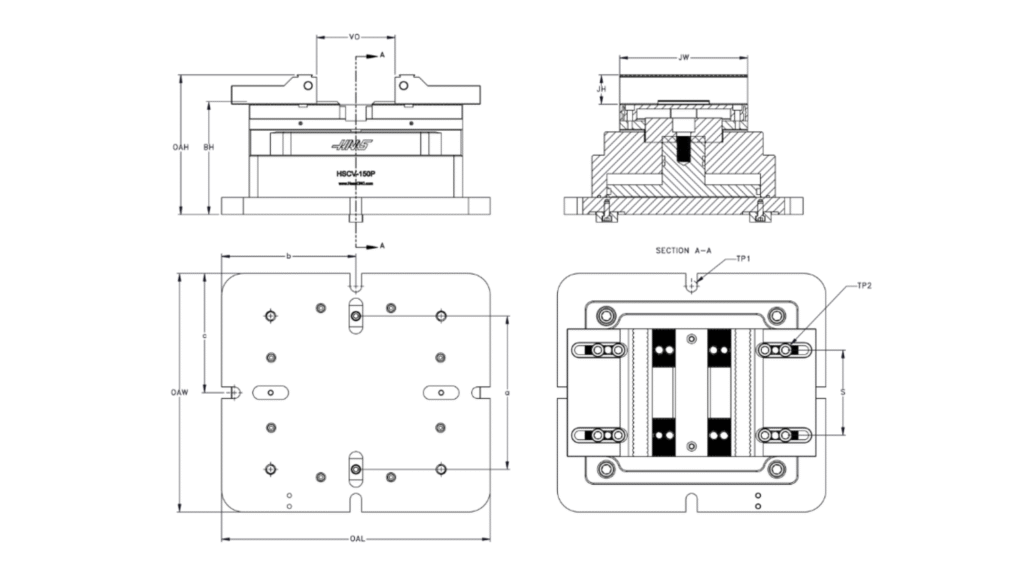
- Workholding and vises – Clamp plates, castings or bar stock with repeatable force on milling and drilling centres.
- Automatic tool changers (ATC) – Drive the drawbar, gripper fingers or carousel locking mechanisms.
- Doors and guards – Open and close safety doors with controlled speed and interlock feedback.
- Part ejection and transfer – Push finished parts onto a conveyor or into collection bins.
- Ancillary mechanisms – Actuate chip deflectors, air knives, probes or cleaning brushes.
Using cylinders for these motions frees the main axes and spindle from non‑cutting tasks, improving overall equipment effectiveness.
Advantages and Limitations
Pneumatic cylinders offer a very attractive trade‑off for many CNC builders.
Key advantages
- High-speed response, suitable for short clamp/unclamp cycles.
- Low component cost and simple installation.
- Clean and safe—no oil leakage near precision guides or electronics.
- Wide range of sizes, strokes, and mounting styles.
- Easy integration with standard valves, regulators, and position sensors.
Main limitations
- Force is limited by available pressure and piston area; hydraulics are preferred for very high clamping forces.
- The compressibility of air can introduce small position variations if the pressure is unstable.
- The system depends on reliable compressed‑air quality; moisture or contamination quickly wears seals and valves.
For most CNC workholding, door actuation, and light automation, these limitations are acceptable and easy to manage with good air preparation and safety margins on force.
Step‑by‑Step Installation on a CNC Machine
- Define the function – Clamp, eject, move a door, etc., and calculate required stroke and force.
- Choose mounting and orientation – Align the pneumatic cylinder with the direction of motion to avoid side‑load.
- Prepare the structure – Machine-precise mounting surfaces or use rigid brackets on the CNC frame or fixture plate.
- Install the cylinder – Bolt in place with the recommended torque and add mechanical stops if needed.
- Connect air lines – Route hoses from the valve manifold, keeping them short and protected from chips and hot coolant.
- Add regulators and flow controls – Set pressure for the required force and use flow controls to tune extend/retract speed.
- Wire sensors – If using magnetic or mechanical switches, connect them to the CNC or PLC for clamp‑confirmation signals.
- Test the motion – Run multiple cycles at low speed, check for leaks, misalignment or unexpected contact, then bring up to full speed.
Maintenance and Troubleshooting
A well‑maintained pneumatic cylinder in CNC service can run for millions of cycles.
- Inspect regularly for air leaks, unusual noise or reduced speed.
- Keep filters, regulators and lubricators serviced so only clean, dry air reaches the cylinder.
- Check rod alignment and mounting bolts after crashes or fixture changes.
- Replace worn seals when you see oil mist, internal leakage or erratic end positions.
Common problems such as slow motion, sticking or oscillation are often traced to low pressure, contaminated valves, or side‑loads on the rod rather than the cylinder itself.
Conclusion
For many CNC applications, the pneumatic cylinder remains the simplest and most economical way to convert compressed air into reliable, high‑speed motion. By understanding its internal structure, main types, working principle and correct installation, machine builders can design workholding and automation that is fast, repeatable and easy to maintain.
With robust controller integration and good air preparation, a pneumatic cylinder in CNC machines delivers exactly what competitive shops need: safe operation, consistent clamping and shorter non‑cutting time per part.
Contact Radonix or use the chatbot in the bottom right corner to learn how linear encoders integrate with Radonix control systems.