
Selecting Between Linear Encoder Vs Potentiometer
Written by: Mehdi Hassanzadeh, Content Specialist – Radonix
When choosing between a linear encoder (linear scale) and a potentiometer, the first step is to clearly define the intended application: precise CNC axis position feedback, simple displacement measurement, or manual control and adjustment. In CNC and automation systems, these two sensors belong to fundamentally different classes in terms of accuracy, stability, service life, and signal type.
Definition and Operating Principle of Linear Encoder vs Potentiometer:
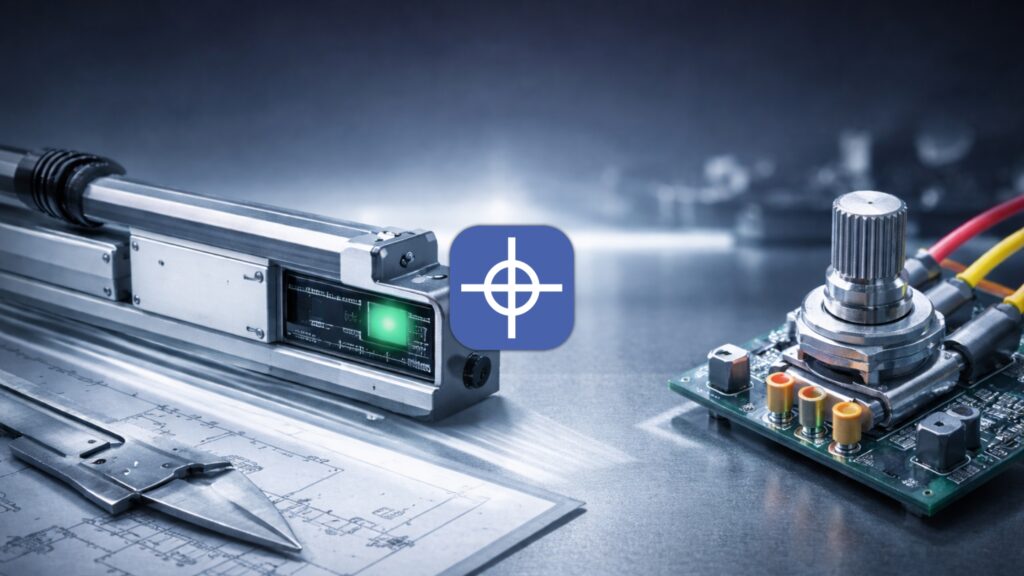
Linear Encoder (Linear Scale)
A sensor designed for direct measurement of linear position.
Typical outputs:
- Incremental signals (A/B/Z quadrature)
- Absolute protocols (BiSS, EnDat, SSI, depending on brand and model)
Linear encoders are inherently designed for high accuracy and repeatability and are standard components in machine tools.
Potentiometer
A variable resistor with a mechanical wiper that changes resistance or voltage as it moves.
Typical outputs:
- Analog voltage such as 0–10 V or 0–5 V
- Variable resistance
Potentiometers are mainly used for simple, low-accuracy measurements or manual control applications.
Direct Comparison for Fast Selection: Linear Encoder Vs Potentiometer
To support a quick yet technically sound decision, the following comparison highlights the most relevant engineering criteria used in CNC and automation systems.
Accuracy and Resolution
Accuracy and resolution define whether a sensor is suitable for precision CNC motion control or only coarse position indication.
- Linear encoder: Micron-level or sub-micron resolution (model-dependent), making it suitable for precision machining and closed-loop CNC control.
- Potentiometer: Effective resolution is limited by electrical noise, wiper quality, and ADC resolution, which makes it unsuitable for high-accuracy positioning.
Repeatability and Long-Term Stability
Long-term stability is critical in production machines where consistent results are required over thousands of cycles.
- Linear encoder: Excellent repeatability with minimal drift, making it suitable for continuous operation and production environments.
- Potentiometer: Performance degrades over time due to wiper wear, dust, oxidation, and vibration, leading to signal instability.
Service Life and Reliability
- Linear encoder: Non-contact (in many technologies) or highly controlled contact; long operational life.
- Potentiometer: Mechanical contact component with limited cycle life; sensitive to vibration and contamination.
Sensitivity to Industrial Environment
- Linear encoder: Industrial-grade models with sealing and protection standards are available; resistant to dust and coolant.
- Potentiometer: More sensitive to dust, moisture, oil, and vibration; higher risk of noise and failure.
Dynamic Response and Noise Immunity
- Linear encoder: Mostly digital outputs; higher noise immunity with proper cabling.
- Potentiometer: Analog output; sensitive to electrical noise, grounding, shielding, and ADC quality.
Cost and Installation Complexity
- Linear encoder: Higher cost and more demanding installation (alignment, read-head gap, mechanical protection).
- Potentiometer: Lower cost and simpler installation, especially for short strokes or simple mechanisms.
Practical Result for CNC Applications
For CNC Axis Position Feedback
If the goal is accurate position feedback for CNC axes (X/Y/Z), a linear encoder is almost always the better choice because:
- It measures the actual axis position, reducing the influence of ballscrew pitch error, backlash, compliance, and elastic deformation.
- It is more suitable for closed-loop control with high accuracy and repeatability.
- In machine tools, linear encoders are commonly used to improve accuracy, not just repeatability.
For Simple and Low-Cost Displacement Measurement
A potentiometer can be an acceptable option when:
- Position accuracy requirements are coarse (millimeter-level).
- The application is non-machining related, such as positioning a mechanical arm, valve, or low-speed mechanism.
- Cost is a critical factor and potential wear or failure is acceptable.
The Most Important Constraint: Controller Input Capability
Before making any selection, verify the controller’s supported inputs.
Linear Encoder Inputs
- Incremental A/B/Z (TTL or HTL)
- Absolute protocols such as SSI or BiSS
- Requires encoder inputs or dedicated modules on the CNC controller or servo drive
Potentiometer Inputs
- Analog voltage inputs (0–10 V or 0–5 V)
- Resistive inputs are rare in CNC controllers
- Requires a high-quality ADC, proper filtering, and careful grounding and shielding
If the controller only accepts encoder signals, a potentiometer is not a practical option without additional converters. Conversely, if only analog inputs are available, a digital linear encoder may require an interface module.
Recommended Selection Scenarios
Based on practical CNC and automation experience, the following scenarios summarize when each sensor type is the more appropriate choice.
Choose a Linear Encoder if:
- Target accuracy is better than 0.05 mm, especially in the micron range
- The machine operates continuously in a production environment
- Industrial conditions involve vibration or dust and long-term stability is critical
- Compensation of ballscrew, pitch, and thermal errors is required
- Surface finish quality and tight tolerances matter
Choose a Potentiometer if:
- Accuracy requirements are in the range of approximately 0.2–1 mm
- Stroke length is short and the mechanism is simple
- Minimum cost is a priority
- Periodic maintenance or replacement is acceptable
- Electrical noise and vibration are limited or well controlled
Important Note for CNC Systems: A Linear Encoder Is Not Always Mandatory
In many CNC systems, the primary feedback comes from the motor’s rotary encoder, and acceptable performance can be achieved without a linear encoder. However:
- Motor encoders measure motor position, not the true table or axis position.
- Linear encoders are added when true axis accuracy is required, compensating for ballscrew errors, thermal effects, load variations, backlash, and structural deflection.
Decision Summary
- For CNC axes and industrial-level accuracy, linear encoders are the more appropriate and standard choice in most projects.
- For simple, low-cost displacement measurement, potentiometers are only recommended when high accuracy, long-term durability, and noise immunity are not primary concerns.
Contact Radonix or use the chatbot in the bottom right corner to learn how linear encoders integrate with Radonix control systems.