
Electronic Gearbox in CNC Systems (Electronic Gearing)
Written by: Radonix R&D Team.
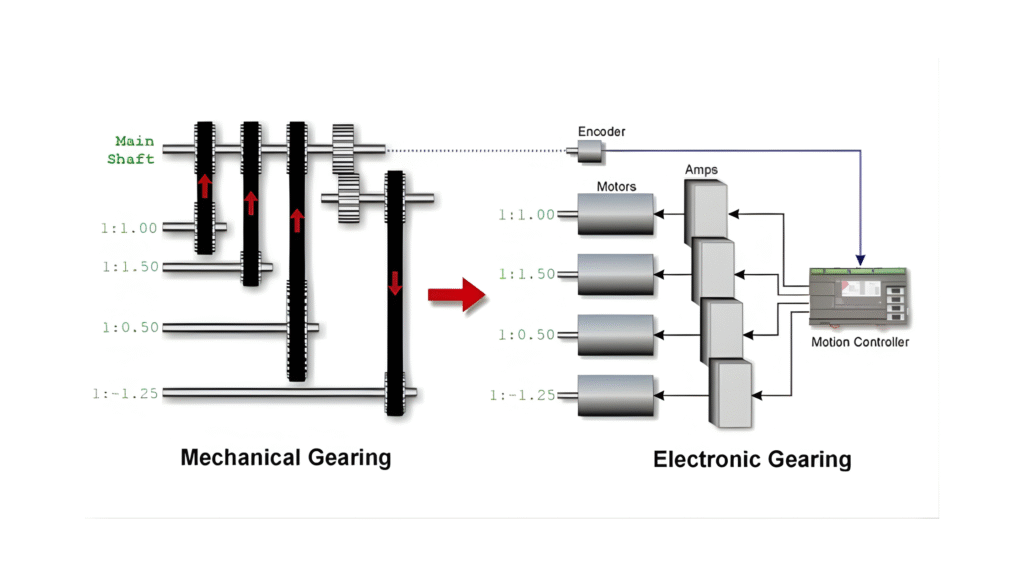
Electronic Gearing — often called an Electronic Gearbox — is a digital method of replicating the behavior of a mechanical gearbox.
Instead of relying on physical gears, a servo drive mathematically applies a programmable gear ratio between an external reference signal (master) and the driven servo axis (slave).
This allows precise, flexible synchronization without mechanical backlash or maintenance.
In CNC automation, electronic gearing is used wherever axes must follow a reference motion with high accuracy, stable torque, and configurable speed relationships.
How an Electronic Gearbox Works
At the core of the system, a master device (external encoder, pulse generator, or another servo axis) provides real‑time motion signals. The servo drive receives these signals and multiplies them by a programmable ratio:
Slave Speed = Master Speed × (Numerator / Denominator)
This ratio can be changed during operation, enabling dynamic adjustments without stopping the machine. For example, with a 2:1 gear ratio, the slave axis rotates twice as fast as the master.
Electronic gearing maintains full motor torque because all adjustments happen inside the drive’s control algorithms, not through mechanical reduction.
Parameter Setup
Configuring an electronic gearbox typically includes:
- Gear Ratio (GEARI / GEARO): Defines the numerator and denominator of the gear relationship.
- Mode Selection (GEARMODE): Specifies the type of master input, such as quadrature encoder or step/direction.
- EXTPOS: Sets whether the axis follows the master in position mode or velocity mode.
- Encoder Input Resolution (ENCIN): Matches the drive to the master’s encoder counts.
- Phase Adjustment: Aligns the slave axis to the master without changing the ratio.
These parameters ensure the servo drive receives clean motion reference data and synchronizes accurately in real time.
Servo Drive and Motor Fundamentals
Electronic gearing relies fully on servo system architecture. A standard CNC servo system includes:
- Servo Motor: High‑precision motor designed for rapid response and stable torque output.
- Servo Drive: Executes control algorithms and processes master input signals.
- Encoder: Provides continuous feedback so the drive can correct position and speed.
Mechanical gearboxes traditionally adjust torque and speed, but bring backlash, wear, and maintenance costs. Electronic gearing replaces mechanical constraints with programmable digital control.
Definition and Function of Electronic Gearing
Electronic gearing synchronizes a slave axis to a master axis through a digital ratio. The master may be:
- External quadrature encoder (A/B signals)
- Pulse generator (step/direction)
- Servo axis output
- Sine‑wave encoder
The ratio is defined in fractional form and can be non‑integer without accumulating error. Drive‑level feed‑forward, PID control, and phase offset settings improve accuracy and eliminate tracking delays.
Common Configuration Parameters
| Parameter | Description | Typical Values |
|---|---|---|
| GEARMODE | Input signal type | 0: Quadrature 0–24V, 3: 0–5V |
| EXTPOS | Follow position or velocity | 0: Position, 4: Velocity |
| GEARI / GEARO | Gear ratio numerator/denominator | 300 / 73 (~4.1:1) |
| ENCIN | Master encoder resolution | 1024–65536 |
| PRBASE | Position resolution base | 16 or 20 bits |
Advantages and Disadvantages
Advantages
- Zero Backlash: No mechanical play or accuracy loss.
- Flexible Ratios: Change gear ratios instantly during operation.
- Multi‑Slave Capability: One master can synchronize multiple axes.
- Lower Long‑Term Cost: No mechanical wear or lubrication needs.
Disadvantages
- Requires Precise Tuning: High servo gains needed for fast following.
- Noise Sensitivity: Poor cabling or grounding may cause signal errors.
- Input Frequency Limits: Excessively high master speeds may exceed drive capability.
Advanced Applications in CNC
Electronic gearing enables high‑level motion scenarios such as:
- Tension Control: Adjusting the ratio based on real‑time tension feedback in winding systems.
- Multi‑Axis Synchronization: Coordinating up to 16 slave axes to one master.
- Manual Pulse Following (MPG): High‑resolution manual jog control.
- Chain Synchronization: A slave axis can act as the next axis’s master for cascading motion.
These functions enhance machine precision, reduce setup time, and support complex automated processes.
Common Issues and Technical Solutions
Typical challenges include:
- Following Error: Caused by slow servo response; solved by increasing servo gains or applying velocity feed‑forward.
- Master Signal Loss: Usually wiring or parameter errors; verifying GEARMODE and encoder connections resolves it.
- Overshoot at High Ratios: Lowering ratios or applying position filtering stabilizes motion.
Proper tuning ensures consistent, accurate synchronization under varying CNC loads.
Electronic vs. Mechanical Gearbox Comparison
| Aspect | Electronic Gearbox | Mechanical Gearbox |
|---|---|---|
| Accuracy | High, no backlash | Medium, subject to play |
| Flexibility | Ratio changes during operation | Requires hardware changes |
| Cost | Lower in the long term | Higher due to wear and service |
| Usage | Digital sync, tension control, automation | High‑torque transmission |
| Challenges | Servo tuning, noise sensitivity | Inertia mismatch, mechanical wear |
Recent Developments in Servo & Electronic Gearing
Modern CNC servo systems incorporate:
- High‑resolution encoders providing ultra‑smooth motion.
- Fast digital processors enable real‑time synchronization.
- Communication protocols such as EtherCAT for deterministic timing.
- Regenerative drives that recover braking energy.
- Compact servo motor designs for applications with limited space.
These innovations improve precision, reduce power consumption, and align with Industry 4.0 requirements.
Conclusion
Electronic gearing is a powerful digital replacement for mechanical gearboxes in CNC automation. It delivers high precision, configurable ratios, zero backlash, and reduced long‑term costs. When paired with correct tuning and industrial‑grade servo hardware, it enables smooth synchronization across complex multi‑axis systems.
Radonix Automation continues to support manufacturers with advanced motion‑control engineering and reliable CNC solutions designed for high‑performance automation.
Contact Radonix or use the chatbot in the bottom right corner to learn how linear encoders integrate with Radonix control systems.