
Understanding the CNC Spindle: Structure, Types, Applications & Maintenance Essentials
Written by: Radonix R&D Team.
The CNC spindle is one of the most critical components in machining systems. Accuracy, surface quality, tool life, productivity, and overall machine reliability depend heavily on spindle performance.
As the rotational unit responsible for driving the cutting tool—or in some machines, the workpiece—the spindle delivers controlled speed, torque, and stability essential for modern CNC operations.
What a CNC Spindle Does
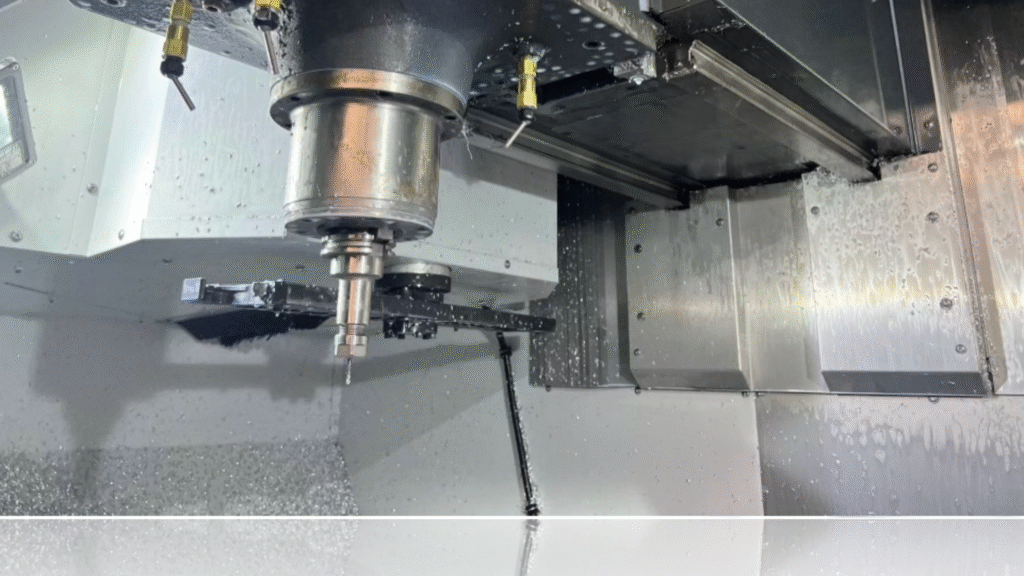
In milling, engraving, woodworking, stone machining, and metalworking systems, the spindle serves as the primary rotational axis for the cutting tool. In turning machines, it rotates the workpiece itself.
Core spindle functions:
- Delivering stable, controlled rotational speed
- Providing adequate torque based on cutting loads
- Holding tools or workpieces securely
- Minimizing vibration during cutting
- Ensuring high precision and consistent surface finish
Internal Structure & Key Components
A CNC spindle is a precisely engineered assembly consisting of multiple high‑accuracy subsystems working together.
Spindle Housing
The housing is typically made from aluminum or alloy steel and contains the bearings, stator, cooling channels, and mounting interfaces. Its rigidity directly affects machining accuracy.
Spindle Shaft
The shaft is the main rotating axis. It is precision‑ground and dynamically balanced to reduce vibration and withstand cutting forces.
Bearing Assembly
High‑precision angular‑contact bearings support radial and axial loads. Their quality, lubrication, and alignment define spindle smoothness, speed capability, and lifespan.
Motor Unit
The spindle motor includes the stator (fixed) and rotor (mounted on the shaft). Powered by a VFD/inverter, its specifications—rated power, RPM, voltage, current—determine machining capabilities.
Cooling System
Cooling is essential for maintaining thermal stability.
Air‑Cooled
- Uses internal fans and heat‑sink fins
- Easy installation and minimal equipment
- Louder than water‑cooled designs
Water‑Cooled
- Circulates coolant through internal channels
- Stable temperature during long duty cycles
- Ideal for industrial CNC machines
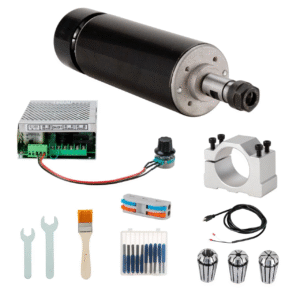
Tool Holder / Collet System
Most general‑purpose spindles use ER collets (ER11–ER32). High‑end machining centers may include ATC systems with specialized tool holders.
Types of CNC Spindles
Spindles can be categorized based on cooling, power transmission, or application.
Based on Cooling
Air‑Cooled
Suitable for moderate duty cycles and simple installations.
Water‑Cooled
Best for continuous heavy machining with lower noise and controlled temperature.
Based on Power Transmission
Direct‑Drive Spindles
Rotor mounted directly on the spindle shaft for minimal vibration and high precision.
Belt‑Driven Spindles
Driven by an external motor via belts, allowing flexible gear ratios.
Gear‑Driven Spindles
Use a gearbox for extremely high torque at low speeds—ideal for heavy metal cutting.
Based on Application
CNC Wood & MDF Spindles
High RPM (18,000–24,000) for routing, carving, and panel cutting.
CNC Stone Spindles
Reinforced, high‑torque units for granite and marble machining.
High‑Speed Precision Spindles
Used for PCB drilling, micro‑engraving, and fine mold work (30,000–60,000 RPM).
Machining Center Spindles
High rigidity and accuracy with ATC support for steel and aluminum machining.
Key Parameters When Choosing a CNC Spindle
The correct spindle selection depends on workload, material, and machine capability.
Rated Power
Light tasks: 0.8–2.2 kW
Heavy machining: 3–9+ kW
RPM Range
Soft materials require high RPM; metals require low RPM with high torque.
Torque
Critical for heavy cuts, metal machining, and maintaining RPM under load.
Tool Holder Type
ER collet size affects tool diameter, rigidity, and precision.
Voltage & Electrical Requirements
Single‑phase or three‑phase must match inverter output.
Cooling Method
Choose based on duty cycle, ambient temperature, and machining duration.
Industrial Applications of CNC Spindles
CNC spindles appear in a wide range of industries and automation systems.
CNC Wood & MDF Machines
Used for cabinet manufacturing, 3D carving, panel cutting, and decorative work.
CNC Metalworking Machines
Ideal for milling, drilling, tapping, surfacing, and mold production.
CNC Stone Machines
Used in countertop production, monuments, and architectural components.
Special‑Purpose Machines
Complex drilling rigs, assembly lines, and customized automation systems.
Installation & Operating Guidelines
Proper installation ensures accuracy, safety, and spindle longevity.
Mechanical Installation
Ensure rigid mounting with fully aligned, stress‑free brackets.
Tool Alignment
Use balanced, undamaged tools and ensure perfect tool‑to‑spindle alignment.
VFD Configuration
Match frequency, current limits, and acceleration/deceleration settings with spindle specifications.
Cooling System Maintenance
Water‑cooled spindles require clean coolant and functional pumps; air‑cooled spindles must have unobstructed fans.
Maintenance & Periodic Inspection
Consistency in maintenance greatly extends spindle life.
Warm‑Up Routine
Run at mid‑speed for a few minutes at the start of each shift.
Sound & Vibration Monitoring
Unusual noise or vibration indicates bearing wear or imbalance and must be addressed immediately.
Temperature Checks
Overheating signals cooling failure or overload conditions.
Cooling System Inspection
Check coolant levels, hose condition, and fan cleanliness.
Tool Holder Care
Clean collets, nuts, and taper seats regularly. Avoid damaged tools and ensure correct tightening torque.
Conclusion
The CNC spindle is the core of machining performance. Understanding its structure, cooling methods, transmission types, and maintenance requirements helps achieve higher accuracy, improved surface quality, longer tool life, and reduced downtime. With correct selection, installation, and preventive care, a CNC spindle delivers years of stable, high‑precision operation.
Contact Radonix or use the chatbot in the bottom right corner to learn how linear encoders integrate with Radonix control systems.