
What Is a CNC Interface? The Role of Interfaces in Modern CNC Control Systems
Written by: Radonix R&D Team.
When professionals discuss CNC systems, the conversation often centers on servo performance, axis accuracy, interpolation quality, or spindle power. However, one of the most critical—and frequently underestimated—components of any CNC system is the interface.
The CNC interface is where human decision-making meets deterministic machine execution. Its structure directly impacts productivity, safety, training time, and operational confidence.
At Radonix, the interface is not treated as a visual add-on. It is engineered as a functional layer of the CNC control architecture, designed according to real industrial workflows and machine categories.
What Is a CNC Interface?
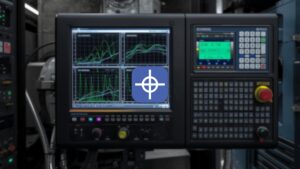
A CNC interface is the visual and interactive layer of the CNC controller that enables operators to:
- Load and manage machining jobs
- Monitor real-time machine status
- Adjust feeds and speeds
- Respond to alarms and faults
- Control machine operations safely
In practical terms, the interface defines how the operator communicates with the CNC controller.
While the CNC controller performs real-time motion calculations, trajectory planning, safety monitoring, and I/O management internally, the interface translates this technical complexity into structured information that operators can interpret and act upon with confidence.
A well-designed interface does not simplify the system by removing capability. It simplifies interaction by organizing complexity.
Interface vs. Controller: Not the Same Thing
A common misconception in CNC discussions is treating the interface and the controller as the same entity. They are tightly integrated, but their responsibilities are fundamentally different:
- The controller manages motion control, safety logic, timing precision, and execution layers
- The interface manages visualization, communication, and operator interaction
A powerful controller paired with a poorly designed interface can result in:
- Increased operator errors
- Slower setup times
- Misinterpretation of machine states
- Reduced confidence in system reliability
Interface design is therefore not cosmetic. It is a systems-engineering decision that directly influences real-world machine performance.
What Makes a Good CNC Interface?
A high-performance CNC interface must balance clarity, control authority, and operational safety.
Clarity
Operators must instantly understand:
- Current machine position
- Active process state
- Upcoming machine actions
Overloaded dashboards, hidden states, or unclear status indicators increase cognitive load and elevate the risk of mistakes—especially under production pressure.
Context Awareness
An effective interface presents only what is relevant to the active workflow.
A woodworking CNC operator does not require metal-specific offset structures. A laser cutting operator does not need stone machining parameters.
Context-aware design reduces distractions and accelerates decision-making.
Fast and Safe Interaction
Critical functions such as feed override, hold, pause, or emergency stop must be:
- Immediately accessible
- Clearly visible
- Designed to prevent accidental activation
In industrial environments, speed of access must never compromise safety.
Why One Interface Does Not Fit All
CNC machines serve fundamentally different industries, each with unique operational logic, risk profiles, and production priorities. A single generic interface rarely performs optimally across all applications.
For example:
- Woodworking prioritizes fast job flow and simplified sequencing
- Stone processing requires strong multi-axis visualization and safety emphasis
- Metal machining demands precision offset control and detailed parameter access
- Laser cutting depends on synchronization visibility and timing feedback
- Plasma cutting requires robust fault handling and clear state communication
Because of these operational differences, interface architecture must reflect real production workflows—not abstract software structures.
At Radonix, industry-specific interfaces are developed on top of a shared deterministic CNC core. This enables workflow specialization without compromising motion integrity or control stability.
The Interface as a Safety Layer
Although primary safety logic resides within the controller, the interface plays a decisive role in preventing unsafe actions.
A properly engineered CNC interface:
- Makes hazardous states clearly visible
- Requires confirmation for critical operations
- Provides structured alarm explanations
- Guides operators through safe recovery procedures
Poorly designed interfaces either hide critical information or overwhelm users with excessive data. Both conditions increase the probability of incorrect actions during time-sensitive situations.
Safety in CNC systems is not only about hardware redundancy—it is also about human-centered information design.
Interfaces and Productivity
In daily operation, small interface design decisions compound over time:
- Reduced navigation steps accelerate job setup
- Clear alarm presentation minimizes downtime
- Logical screen hierarchy shortens operator training cycles
Over months of production, a well-designed CNC interface can significantly improve throughput without any modification to motors, drives, or mechanical components.
Interface quality directly influences operational efficiency.
Radonix Approach to CNC Interfaces
Radonix develops CNC interfaces based on structured engineering principles rather than aesthetic trends.
1. Task-Oriented Design
Screens are structured around operator workflows—setup, execution, monitoring, and recovery—not around internal software modules.
2. Industry Awareness
Each interface reflects the practical needs of its target application—wood, stone, metal, laser, or plasma—ensuring relevance and operational clarity.
3. Separation from Real-Time Control
The interface layer remains isolated from deterministic motion and safety execution layers. Heavy interaction, visualization tasks, or user navigation never interfere with motion precision or real-time reliability.
This separation ensures stability under industrial loads while maintaining intuitive usability.
Interfaces as the Foundation for Future CNC Systems
As CNC control systems evolve toward modular architectures and intelligent feedback integration, the role of the interface becomes even more critical.
Advanced features such as:
- Diagnostic analytics
- Adaptive machining feedback
- Predictive maintenance indicators
- AI-assisted parameter suggestions
must be presented in a structured and interpretable manner.
Technology without clear visualization creates operator hesitation. A strong interface enables advanced control systems to remain usable, safe, and trustworthy.
Conclusion
A CNC interface is far more than a screen. It is the operational bridge between human intent and machine execution.
Its design affects:
- Safety
- Efficiency
- Learning curve
- Operator confidence
- Long-term productivity
Radonix treats CNC interfaces as a core engineering component, developing industry-specific, task-oriented systems that complement a deterministic CNC control architecture.
In modern CNC environments, controller performance is essential—but without a structured, intelligent interface, its full capability cannot be realized.
For objective consultation on selecting or designing the right CNC interface architecture for your machine, contact Radonix or use the chatbot in the bottom right corner to connect directly with our engineering team.