
Understanding the CNC Ball Screw in Motion Systems
Written by: Radonix R&D Team.
In CNC machines, precision defines performance. Every movement must be accurate, repeatable, and efficient — and that’s where the ball screw becomes indispensable.
A ball screw converts rotary motion into linear motion using rolling balls, achieving high-speed precision with minimal friction.
Unlike conventional lead screws that rely on sliding contact and lose energy through heat and wear, ball screws utilize rolling contact, reaching efficiencies above 90%.
This efficiency allows smoother axis movements, reduced backlash, and enhanced dimensional accuracy in machining operations.
The ball screw’s influence extends far beyond movement; it determines the reliability, longevity, and energy efficiency of the entire CNC system.
Whether it’s cutting, milling, engraving, or positioning, the ball screw ensures controlled motion and repeatable results that define modern automation standards.
Structure and Working Principle
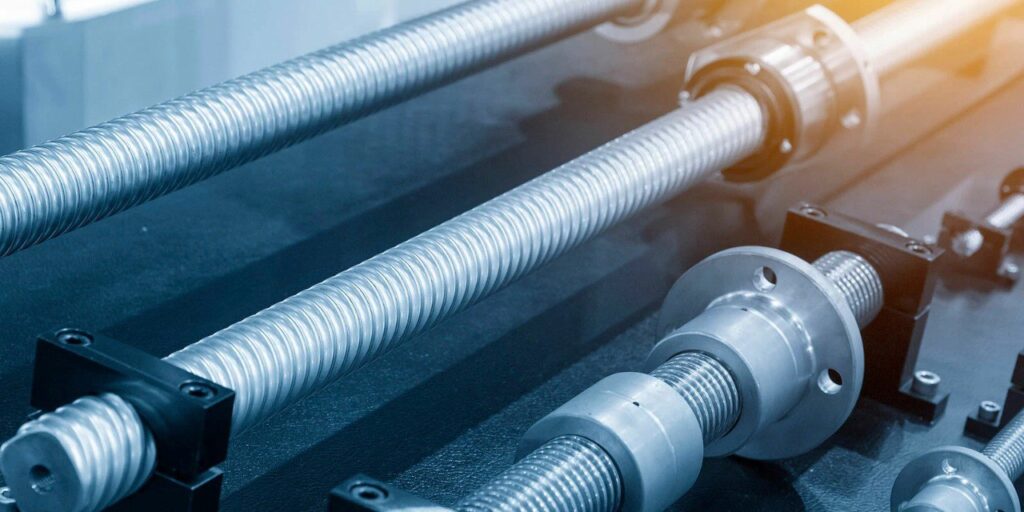
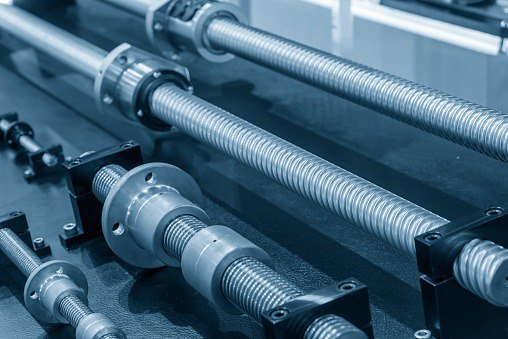
A typical ball screw consists of three main components — the screw shaft, ball nut, and balls. The helical grooves on both the shaft and nut create a continuous track for the balls to circulate.
When the shaft rotates, the balls roll between the two surfaces, converting rotary motion into precise linear movement. This mechanism drastically reduces friction compared to sliding systems.
The main components include:
- Ball Screw Shaft: A precision-ground cylindrical shaft with helical grooves.
- Ball Nut: Houses corresponding grooves and integrated ball return channels.
- Ball Return System: Recirculates the balls through the nut for continuous operation.
- End Seals: Protect against contamination and lubricant leakage.
- Load Balls: Bear the mechanical load and transmit motion.
- Spacer Balls: Separate load balls, ensuring smooth motion with reduced noise and vibration.
This unique construction ensures minimal backlash and maximum repeatability, vital for the accuracy of CNC motion systems.
By applying controlled preload, even microscopic clearances can be eliminated, giving CNC machines unmatched stability.
Types of Ball Screws and Their Applications
Different designs meet different industrial demands:
- Positioning Ball Screw (Type P): Designed for precision positioning tasks, such as in measuring devices or semiconductor machinery.
- Transmission Ball Screw (Type T): Used for high-speed power transmission where load movement is frequent.
- Single-Start Ball Screw: Features a single helical groove; ideal for steady, controlled motion.
- Multiple-Start Ball Screw: Includes multiple grooves for faster linear movement and higher load capacity.
These variations give designers flexibility to balance speed, torque, and precision according to specific CNC requirements.
Advantages of Ball Screws
The benefits of integrating ball screws into CNC machines include:
- High Precision and Repeatability: Ensures exact movements during repetitive machining cycles.
- Low Friction and Smooth Motion: Rolling contact reduces wear and heat.
- High Load-Bearing Capacity: Withstands heavy operational stresses.
- Elimination of Backlash: Preloading improves accuracy in both directions.
- Long Service Life: With proper lubrication, ball screws operate efficiently for thousands of cycles.
- Quiet and Stable Performance: Ideal for high-end automation environments.
Disadvantages and Considerations
While the advantages dominate, some considerations must be addressed:
- Higher Cost: Precision manufacturing increases the initial investment.
- Contamination Sensitivity: Dust or chips can damage grooves and reduce accuracy.
- Maintenance Requirements: Regular lubrication and cleaning are essential.
- Lack of Self-Locking Ability: Reverse motion may occur under gravity when the motor stops in vertical systems.
Proper engineering controls — such as protective covers, lubricators, and braking systems — can easily overcome these limitations.
Real-World Applications
Ball screws are found in nearly all motion-critical systems, including:
- CNC milling, turning, and cutting machines.
- Industrial robots and automated assembly lines.
- Medical, optical, and semiconductor manufacturing.
- Measuring equipment, positioning stages, and 3D printers.
Their efficiency and accuracy make them the backbone of modern motion control technology.
Maintenance and Reliability
For lasting performance, maintenance plays a vital role:
- Use the correct lubricant — grease or light industrial oil — as recommended by the manufacturer.
- Install protective bellows or covers to keep out chips and dust.
- Inspect the grooves, nuts, and bearings periodically for wear.
- Adjust preload regularly to maintain consistent backlash-free performance.
Following these steps ensures the ball screw delivers long-lasting precision and stability under heavy industrial use.
Conclusion
The ball screw is the unsung hero of CNC precision. By transforming rotational energy into highly efficient linear motion, it drives the heart of automation systems with smoothness, accuracy, and reliability.
Choosing the right ball screw, installing it with precision, and maintaining it correctly can dramatically enhance the overall efficiency and lifespan of a CNC machine.
Radonix Automation continues to innovate motion control systems with advanced CNC controllers, ensuring every component — from the ball screw to the servo system — performs at its peak.
Contact us or use the chatbot in the bottom-right corner to learn more about our high-precision automation solutions for next-generation manufacturing.