
Understanding Ball Bearings Types in CNC Machines: Types, Performance & Selection Guide
Written by: Radonix R & D Team.
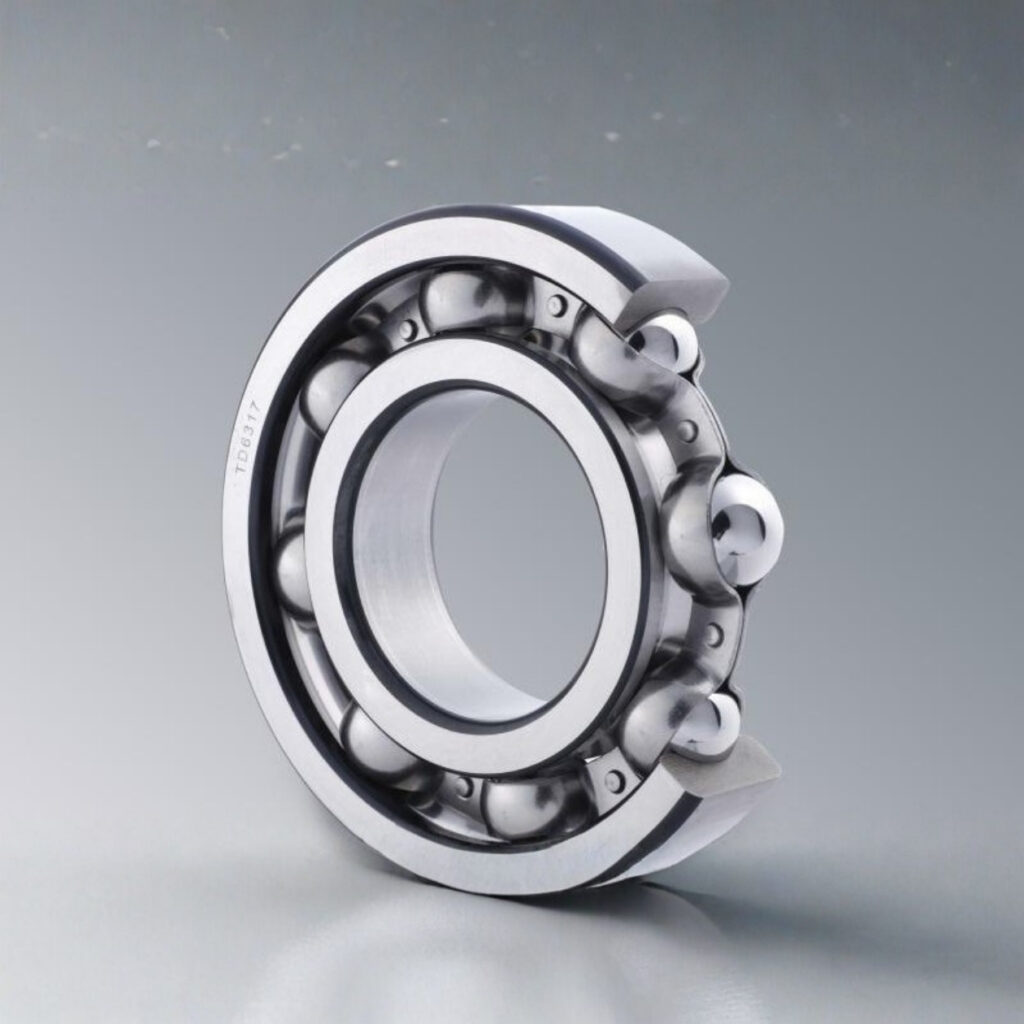
Ball bearing types are foundational components in all rotating and linear motion systems.
In CNC machinery—where precision, high speed, and long-term stability are essential—bearings directly influence accuracy, spindle performance, axis motion quality, noise level, energy efficiency, and machine lifespan.
1A correct bearing choice dramatically improves both machining performance and long-term reliability.
How Ball Bearing Types Work
A standard ball bearing reduces friction by enabling rolling contact instead of sliding contact. The inner ring rotates with the shaft, the outer ring remains fixed to the housing, and the balls roll between them.
Three main performance factors define how a bearing behaves:
- Radial load capacity (forces perpendicular to the shaft)
- Axial load capacity (forces along the shaft)
- Maximum permissible speed
These parameters determine whether a bearing can handle CNC spindle speeds, axis motion loads, or the combined forces generated during cutting.
Types of Bearings & Their CNC Applications
Deep Groove Ball Bearing
- Most common bearing type
- Handles radial loads and light axial loads
- High allowable speeds
- Used in CNC: general spindles, motors, and cooling fans
Angular Contact Bearing
- Designed for combined axial and radial loads
- Can be mounted in matched pairs (back-to-back or face-to-face)
- High stiffness and high precision
- Used in CNC: high‑speed spindles, precision axes
Self-Aligning Bearing
- Compensates for shaft misalignment
- Suitable for medium speeds and loads
- Used in CNC: long shafts, motors with minor misalignment risks
Cylindrical Roller Bearing
- Very high radial load capacity
- High-speed capability
- Used in CNC: heavy-duty industrial axes
Tapered Roller Bearing
- Supports heavy combined loads
- Suitable for shock loads
- Used in CNC: machine beds, table axes, load‑bearing structures
Thrust Bearing
- Handles pure axial loads
- Moderate speed capability
- Used in CNC: ball screw support, thrust mechanisms
Linear Bearing
- Supports high-precision linear motion
- Extremely low friction
- Used in CNC: X, Y, and Z guide rails
Bearing Comparison Table
| Bearing Type | Radial Load | Axial Load | Speed | Precision | CNC Use |
|---|---|---|---|---|---|
| Deep Groove | Medium | Low | Very High | Medium | Motors, general spindles |
| Angular Contact | High | High | High | Very High | High-speed spindles |
| Self-Aligning | Low–Medium | Low | High | Medium | Long shafts, motors |
| Cylindrical Roller | Very High | Low | High | Medium | Heavy-duty axes |
| Tapered Roller | High | Very High | Medium | Medium | CNC tables, load axes |
| Thrust Bearing | Low | Very High | Low–Medium | Medium | Ball screw support |
| Linear Bearing | — | — | — | Very High | CNC linear axes |
Role of Bearings in CNC Machine Structure
Spindle Assembly
High-speed CNC spindles demand:
- Low friction
- High stiffness
- Precisely matched bearing pairs
Ideal bearing: angular contact bearings with preload.
Axis Motion (X/Y/Z)
Accuracy and zero backlash are essential.
Ideal bearing: linear bearings combined with precision guide rails.
Ball Screws
Require smooth axial force transmission.
Ideal bearing: thrust bearings or duplex angular contact bearings.
Servo Motors
Need low noise, smooth operation, and high rotational accuracy.
Ideal bearing: high-speed deep groove ball bearings.
Key Factors When Choosing Bearings for CNC
- Load type (radial, axial, or combined)
- Required rotational speed
- Precision class and motion accuracy
- Noise and vibration tolerance
- Lubrication method and maintenance schedule
- Preload requirements for stiffness and backlash elimination
- Material of balls and cages (steel vs. ceramic)
Ceramic hybrid bearings are essential for extremely high-speed spindles.
Advantages & Disadvantages of Ball Bearing Types
Advantages
- Very low friction → reduces heat and increases efficiency
- High precision → ideal for CNC spindles and axes
- Easy maintenance and lower cost compared to roller bearings
- Supports very high speeds (20,000–40,000 RPM)
- Low noise, beneficial for servo systems
- Available in extensive size and material options
Disadvantages
- Lower radial load capacity than roller bearings
- Sensitive to shock and impact (risk of ball indentation)
- Lower axial load capability compared to tapered roller bearings
- Not suitable for very dirty environments without proper sealing
- Not ideal for extreme heavy loads
Comparison: Ball Bearing Types vs. Other Bearing Types
| Bearing Type | Friction | Load Capacity | Speed | Sensitivity | Cost | Typical Use |
|---|---|---|---|---|---|---|
| Ball Bearing | Very Low | Medium | Very High | Medium | Low | CNC, motors, spindles |
| Roller Bearing | Low | Very High | Medium | Low | Medium | Heavy-duty axes |
| Sliding Bearing | Medium | High | Low–Medium | Low | Low | Heavy machinery |
| Hydrodynamic | Very Low at high speed | Very High | High | High | High | Turbines, large rotors |
| Magnetic | Near Zero | Medium | Exceptionally High | Very High | Very High | Scientific & medical devices |
Ball bearing types remain the top choice for CNC machines due to their precision, low friction, and high-speed capabilities.
Conclusion
Ball bearing types are the backbone of precision motion in CNC systems. From spindle assemblies to linear axes and servo motors, the correct bearing selection enhances accuracy, minimizes vibration, reduces downtime, and extends machine life. Understanding bearing types, load characteristics, lubrication needs, and performance limits ensures reliable CNC operation and optimal machining quality.
Contact Radonix or use the chatbot in the bottom right corner to learn how linear encoders integrate with Radonix control systems.
For industrial implementation, explore Radonix PC-based CNC controllers, control software and machine-specific HMI systems. Radonix PC-based CNC controller systems.