
Author: Mehdi Hasanzade | Radonix Automation Company
Precise motion control in servo systems, CNC machines, PLC-based automation, and MCU/DSP platforms relies fundamentally on PID control. While advanced strategies such as feedforward, resonance suppression, and trajectory shaping improve performance, PID remains the mathematical backbone of industrial motion loops.
This article presents complete PID motion control equations used in industrial servo and CNC systems, including continuous, Laplace-domain, digital, filtered-derivative, and anti-windup implementations
What PID Means in Motion Control
In motion control, the controller continuously evaluates:
- Current position or velocity
- Target reference (setpoint)
- The difference between them (error)
Error definition:
e(t) = r(t) − y(t)
The controller output (torque, current, or voltage command) is calculated to minimize this error.
Proportional Term (P) – Immediate Reaction
The proportional component responds to present error:
uP(t) = Kp · e(t)
Higher Kp → stronger corrective action.
Excessive Kp → oscillation risk.
In motion systems, Kp behaves similarly to stiffness: increasing Kp makes the axis hold position more aggressively.
Integral Term (I) – Eliminating Steady-State Error
Integral action accumulates error over time:
uI(t) = Ki · ∫ e(t) dt
It compensates for:
- Friction
- Constant load
- Backlash
- Calibration offsets
- Torque limits
Risk: Windup occurs if actuator saturation prevents output growth while integral continues accumulating.
Derivative Term (D) – Predictive Damping
Derivative reacts to the rate of change of error:
uD(t) = Kd · d e(t) / dt
Advantages:
- Reduces overshoot
- Increases damping
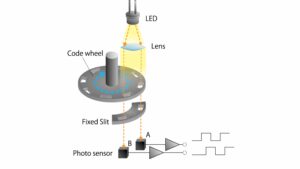
Limitation: Sensitive to encoder noise; therefore filtered derivative is required in industrial systems.
Full Continuous-Time PID Equation
u(t) = Kp·e(t) + Ki∫e(t)dt + Kd·d e(t)/dt
PID in Laplace Domain (Analysis and Design)
Controller transfer function:
C(s) = Kp + Ki/s + Kd·s
Alternative time-constant form:
C(s) = Kp · (1 + 1/(Ti·s) + Td·s)
Where:
Ki = Kp/Ti
Kd = Kp·Td
Filtered Derivative (Industrial Servo Implementation)
Pure derivative amplifies noise. Practical implementation:
CD(s) = (Kd·s) / (1 + s/ωf)
Where:
ωf = derivative cutoff frequency (rad/s)
Higher ωf → sharper response but more noise sensitivity.
Digital (Discrete) PID for PLC / MCU / CNC
Sampling time: Ts
Position Form
u[k] = Kp·e[k] + Ki·Ts·Σe[k] + Kd·(e[k] − e[k−1]) / Ts
Incremental Form
Δu[k] = Kp·(e[k] − e[k−1]) + Ki·Ts·e[k] + (Kd/Ts)·(e[k] − 2e[k−1] + e[k−2])
Anti-Windup in Motion Control
If actuator saturates:
u = sat(u_raw)
Integral must be limited.
Clamping Method
Stop integrating when saturation increases error.
Back-Calculation Method (Continuous)
dI/dt = Ki·e(t) + Kaw·(u − u_raw)
Back-Calculation (Discrete)
I[k] = I[k−1] + Ki·Ts·e[k] + Kaw·Ts·(u[k] − u_raw[k])
PID for Axis Position Control (Mechanical Model)
Mechanical axis dynamics:
τ = J·ω_dot + B·ω
Where:
J = inertia
B = viscous friction
And since:
ω = dx/dt
The system becomes second order. Therefore cascaded loops are preferred in servo drives:
- Current/Torque loop (fastest)
- Velocity loop
- Position loop (slowest)
Practical PID Tuning Notes
- Use derivative on measurement to avoid derivative kick
- Always implement anti-windup
- Reduce Ki if overshoot persists
- Increase damping before aggressively increasing Kp
- Combine PID with feedforward and resonance filters for optimal CNC performance
Key Formula Checklist
Continuous PID:
u(t) = Kp·e(t) + Ki∫e(t)dt + Kd·d e(t)/dt
Laplace Form:
C(s) = Kp + Ki/s + Kd·s
Filtered Derivative:
CD(s) = (Kd·s) / (1 + s/ωf)
Incremental Digital Form:
Δu[k] = Kp·(e[k] − e[k−1]) + Ki·Ts·e[k] + (Kd/Ts)·(e[k] − 2e[k−1] + e[k−2])
Anti-Windup Back-Calculation:
I[k] = I[k−1] + Ki·Ts·e[k] + Kaw·Ts·(u[k] − u_raw[k])
Modern industrial motion control requires deterministic execution, numerical stability in discrete implementation, and proper encoder noise filtering. PID remains the structural foundation of servo loops, but its effectiveness depends on architecture, filtering, and saturation management.
For advanced servo architecture or industrial CNC motion integration, contact Radonix or use the chatbot in the bottom right corner.
For machine integration, compare Radonix CNC controller hardware for independent multi-axis motion, pulse/direction signals and industrial I/O. Radonix CNC controller hardware.