
How to Reduce Servo Motor Noise in Industrial CNC Systems
Written by: Nima Rad – Radonix
Servo motor noise in CNC and industrial motion systems is not a random phenomenon. When a servo system is properly installed and tuned, it should follow position and velocity commands accurately, without excessive vibration, whining, knocking, humming, or abnormal temperature rise.
In practice, servo motor noise typically originates from three primary sources:
- Mechanical / Vibrational: structural resonance, backlash, misalignment, bearing wear, insufficient rigidity
- Control / Tuning: excessive gain, improper filtering, aggressive trajectory, unstable loop interaction
- Electrical / Drive-Level: PWM switching frequency, EMI noise, grounding issues, encoder feedback noise
Correctly identifying the origin of the noise is the most important step. Applying tuning changes to a mechanical problem—or mechanical fixes to a control issue—often makes the system worse.
1. First Identify Which Type of Noise You Have
A) High-Pitched Whistle or Squeal (High Frequency)
Often caused by PWM switching frequency of the drive or high-frequency micro-oscillations in the control loop. This type of sound typically remains constant and may change slightly with load.
B) Knocking or Impact During Direction Change
Usually related to mechanical backlash, loose couplings, aggressive acceleration or jerk settings, or excessive position gain.
C) Humming or Growling at a Specific Speed
Strong indication of mechanical resonance in the structure, coupling, ballscrew, belt system, or motor–load inertia interaction.
D) Noise Combined with Heating and Noticeable Vibration
Commonly indicates mechanical overload, bearing damage, shaft misalignment, or unstable control oscillation.
Accurate diagnosis prevents unnecessary parameter adjustments.
2. Mechanical Actions (Highest Impact, Lowest Risk)
Mechanical integrity must always be verified before aggressive tuning.
2.1 Alignment and Coupling
- Verify shaft alignment between motor and load using dial indicators or professional alignment tools.
- Misalignment results in vibration, noise, and premature bearing failure.
- If a rigid coupling is used in a slightly misaligned system, consider a flexible coupling (Bellows, Oldham, Spider) rated for required torque and speed.
- Balance rotating elements such as pulleys or flywheels, especially at high RPM.
2.2 Backlash and Preload
- Backlash in gearbox, worm drive, or ballscrew causes knocking during direction reversal.
- Proper ballscrew preload or low-backlash gearboxes significantly reduce reversal noise.
- Even minor looseness in the structure can become amplified in servo systems due to active correction.
2.3 Structural Rigidity
- Avoid mounting motors on thin plates without reinforcement ribs.
- Ensure correct bolt torque and full surface contact.
- Increasing structural stiffness often reduces resonance more effectively than software filtering.
2.4 Bearings and Lubrication
- Continuous whining or grinding may indicate worn or dry bearings.
- Excessive belt tension increases noise and radial load.
- Bearing issues cannot be corrected through tuning.
3. Control and Tuning Adjustments (Critical for Reducing Whine and Vibration)
Low-noise tuning requires: stability, sufficient damping, and avoidance of resonance excitation.
3.1 Recognize Signs of Excessive Gain
- Audible whining during holding position
- Micro-vibration on machine frame
- Elevated motor current at standstill
- Oscillating or high Following Error
If present, Position or Speed gain is likely too high or filtering is insufficient.
3.2 Reducing Holding Noise
Noise frequently occurs when the axis is stationary.
- Gradually reduce Position gain in small increments.
- If required, slightly reduce Speed gain.
- Increase Deadband / In-position band to prevent correction of microscopic errors.
- Adjust Torque limit during standstill if available.
- Temporarily disable or reduce Friction compensation if improperly tuned.
3.3 Resonance Suppression (Most Critical Section)
If noise intensifies at a specific speed:
- Apply a Notch Filter at the resonance frequency.
- Use a Low-pass filter in the Velocity or Torque loop to suppress high-frequency excitation.
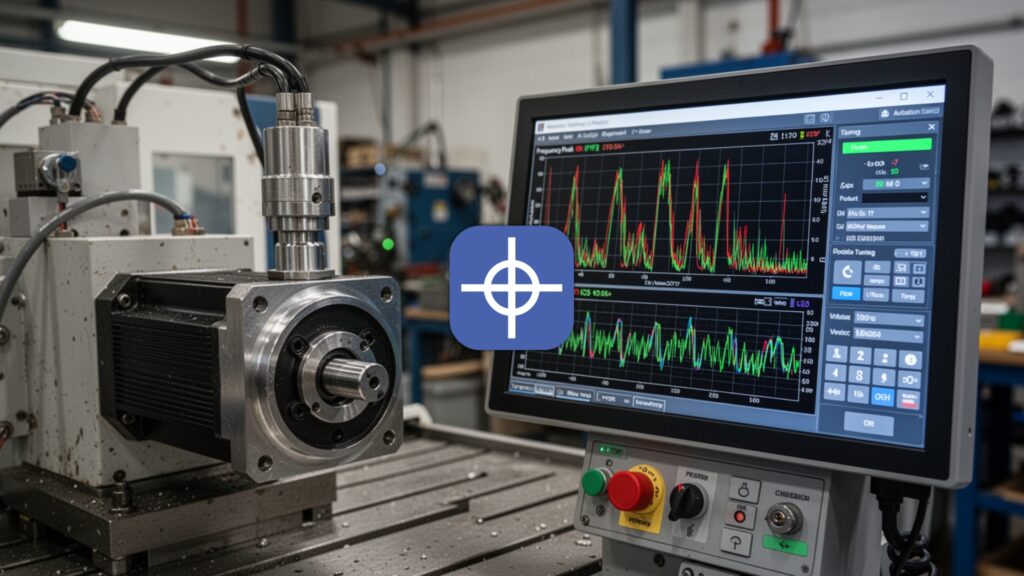
- Enable built-in Resonance suppression or Vibration damping features when available.
Practical resonance identification:
- Run the axis at varying speeds without heavy load.
- Identify the speed where vibration peaks.
- Use FFT analysis if available.
3.4 Trajectory Optimization
Noise can originate from aggressive motion profiles.
- Enable S-curve motion profile to control jerk.
- Reduce acceleration and jerk by approximately 10–20% to evaluate improvement.
- Properly tune Velocity and Acceleration Feedforward to minimize corrective spikes.
3.5 Loop Optimization Order
- Keep Current/Torque loop near factory default.
- Stabilize Speed loop first.
- Increase Position loop cautiously.
4. Electrical and Drive-Level Actions
4.1 PWM / Carrier Frequency
Increasing PWM frequency can shift audible noise above human hearing range.
Considerations:
- Higher PWM increases switching losses and drive heat.
- Always monitor motor and drive temperature after changes.
4.2 Cable Routing and Shielding
- Route motor and encoder cables separately from power lines.
- Connect encoder shield according to manufacturer guidelines.
- Avoid ground loops.
- Use EMC filters or ferrite cores where necessary.
4.3 Encoder Feedback Noise
- Inspect encoder connectors and cable integrity.
- Verify shield termination.
- Use encoder noise filtering if supported by the drive.
5. Quick Reference: Symptom → Cause → Action
- Continuous high-pitched whine → Low PWM or micro-oscillation → Increase PWM, reduce gain slightly, apply filtering
- Noise at specific speed → Mechanical resonance → Apply notch filter, increase stiffness, reduce acceleration
- Knocking on reversal → Backlash or high jerk → Fix backlash, enable S-curve, reduce jerk
- Vibration at standstill → Excessive gain or narrow deadband → Reduce gain, widen band, check encoder
- Noise with heating → Overload or misalignment → Inspect mechanics, lubrication, torque limits
6. Step-by-Step Checklist (Low Risk to High Impact)
- Inspect alignment, coupling, rigidity, bearings.
- Test with reduced acceleration and S-curve.
- Slightly reduce Speed gain, then Position gain.
- Apply notch or damping filter.
- Tune Feedforward.
- Adjust PWM frequency and monitor temperature.
- Verify grounding, shielding, cable routing.
7. Resonance Reduction Filters in Detail
7.1 Notch / Band-Stop Filter
Purpose: Remove excitation at a specific resonance frequency.
Parameters:
- f0 (Hz): Center frequency of resonance
- Q: Bandwidth (higher Q = narrower notch)
- Depth: Attenuation magnitude
Tuning guidance:
- Use narrow bandwidth when possible to preserve stiffness.
- Excessive depth and width degrade system response.
7.2 Low-Pass Filter
Purpose: Reduce high-frequency noise and prevent excitation of higher structural modes.
Parameters:
- Cutoff frequency (fc)
- Order (1st / 2nd)
Caution:
- Excessively low cutoff reduces servo bandwidth and increases following error.
- Second-order filters provide better attenuation but introduce more phase lag.
7.3 Damping / Vibration Suppression Filter
Used in two-mass systems (motor–load).
Advantages:
- Effective for broader resonance bands.
Trade-off:
- May soften dynamic response slightly.
7.4 Lead-Lag / Phase Compensation
Purpose: Improve phase margin and allow slightly higher gain without oscillation.
Does not eliminate resonance directly; improves stability around it.
7.5 Command Shaping Filters
S-Curve / Jerk Limiter
Reduces acceleration shock and prevents excitation of structural modes.
Input Smoothing / Moving Average
Smooths step commands to reduce resonance excitation.
7.6 Adaptive Notch
Automatically tracks shifting resonance frequency due to load or temperature change.
Should be used cautiously to avoid phase instability.
Practical Selection Based on Problem Type
- Strong resonance at specific frequency → Start with Notch
- Broad two-mass resonance → Damping + light Notch
- High-frequency hiss → Mild Low-pass
- Impact noise on direction change → S-curve / Jerk limiter
- Instability at higher gain → Phase compensation with filtering
Conclusion
Reducing servo motor noise requires a systematic engineering approach. Mechanical integrity must be verified first. Control tuning must prioritize stability and damping. Electrical and PWM adjustments should be applied carefully while monitoring thermal performance.
In industrial CNC systems, the quietest servo system is not simply the softest—it is the most stable, correctly aligned, properly filtered, and thermally safe system. A structured process ensures reduced acoustic noise without sacrificing precision, reliability, or dynamic performance.
Contact Radonix or use the chatbot in the bottom right corner to troubleshoot servo motor noise and stabilize your CNC motion system.
For machine integration, compare Radonix CNC controller hardware for independent multi-axis motion, pulse/direction signals and industrial I/O. Radonix CNC controller hardware.