
Author: Nima Rad | Radonix Automation Company
In industrial environments, the term IP or IP Rating refers to the Ingress Protection level of an enclosure. It defines how effectively a device housing — such as a sensor, electrical panel, drive, connector, or industrial lighting unit — prevents the entry of solid objects and water.
Understanding IP ratings is essential for selecting reliable equipment, avoiding premature failure, and ensuring long‑term operational safety in real production environments.
1. What Does IP Mean in Industry?
IP stands for Ingress Protection. It is a standardized coding system that classifies the degree of protection provided by an enclosure against:
- Solid objects (including dust)
- Accidental contact with hazardous internal components
- Water under defined test conditions
These ratings are defined under internationally recognized enclosure protection standards.
In practical industrial terms, IP tells you how resistant an enclosure is to environmental exposure — not how durable the internal electronics are, and not how resistant the material is to chemicals or UV.
2. What Exactly Does an IP Rating Cover?
An IP rating addresses:
- Protection against solid object ingress and dust
- Protection against water under specified exposure conditions (splashing, jets, immersion, high‑pressure washing, etc.)
However, IP does not guarantee:
- Chemical resistance
- Corrosion resistance
- UV resistance
- Gasket aging performance
- Oil vapor exposure tolerance
- Internal pressure resistance
- Mechanical impact resistance
Mechanical impact resistance is typically defined separately using the IK rating (IEC/EN 62262).
This distinction is critical in industrial applications where environmental stress extends beyond water and dust exposure.
3. How to Read an IP Code Correctly
The general format is:
IP + First Digit (Solids) + Second Digit (Water) + Optional Letters
Examples:
- IP54 → Limited dust protection + Protection against water splashes
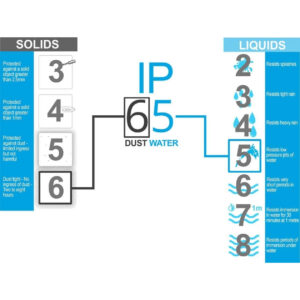
- IP65 → Dust‑tight + Protection against water jets
- IPX7 → Solid protection not declared (X) + Short‑term immersion
- IP69K / IPX9 → High‑pressure hot water washdown (depending on standard)
The letter X does not mean zero protection. It means that the parameter was not tested or declared.
First Digit (0–6): Protection Against Solid Objects and Dust
Common industrial levels:
- 0 → No protection
- 1 → Objects approximately 50 mm
- 2 → Finger / 12.5 mm objects
- 3 → Tools / 2.5 mm objects
- 4 → Wires / 1 mm particles
- 5 → Dust‑protected (not fully sealed, but harmful dust cannot enter)
- 6 → Dust‑tight (complete protection against dust ingress)
Second Digit (0–9 or 9K): Protection Against Water
Common industrial levels:
- 4 → Splashing water from any direction
- 5 → Water jets (nozzle)
- 6 → More powerful water jets
- 7 → Temporary immersion (depth/time defined by standard test conditions)
- 8 → Continuous or deeper immersion (manufacturer must specify depth/time)
- 9 / X9 → High‑pressure, high‑temperature water jets (referenced in IEC 60529 as IPX9)
Important Clarification: IP Ratings Are Not Automatically Cumulative
A frequent misconception in industry is assuming that a higher water rating automatically includes lower ones.
For example:
If a device is rated IPX7, it does not automatically mean it passed IPX5 or IPX6 (water jet tests).
If a product passes multiple tests, manufacturers often specify this explicitly, such as:
IPX5/IPX7
Always verify the test coverage in technical documentation.
IP69K vs IPX9 — Understanding the Difference
- IPX9 is defined under IEC 60529 and refers to high‑pressure hot water testing.
- IP69K is defined under ISO 20653, commonly used in automotive and heavy washdown environments.
In industries such as food processing, pharmaceuticals, truck equipment, and concrete machinery — where hot, high‑pressure washdown is routine — look for:
- IP69K or IPX9 certification
- Suitable enclosure materials
- Gasket compatibility with cleaning chemicals
IP rating alone does not address chemical compatibility.
Optional Letters in IP Markings
Some products include additional letters depending on standard and application:
- A / B / C / D → Protection level against access to hazardous parts (back of hand, finger, tool, wire)
- F → Oil resistance (in specific industrial applications)
- H → High‑voltage equipment
- M / S → Water test performed while moving or stationary
- W → Weather conditions
These suffixes are less common but can be important in specialized environments.
4. How to Select the Correct IP Rating in Industry (Practical Guide)
Rather than assuming “higher is always better,” define the actual exposure scenario.
Dust Conditions
- Wood, stone, cement, or plastic processing workshops → Typically minimum IP5X, often IP6X
- Clean electrical room or enclosed cabinet → IP20–IP4X may be sufficient
Water Exposure
- Splashing or rain → IPX4–IPX5
- Hose cleaning → IPX5–IPX6
- Risk of immersion (floor drains, flooding, tank environments) → IPX7–IPX8
- Hygienic high‑pressure washdown → IP69K / IPX9
Real‑World Failure Points
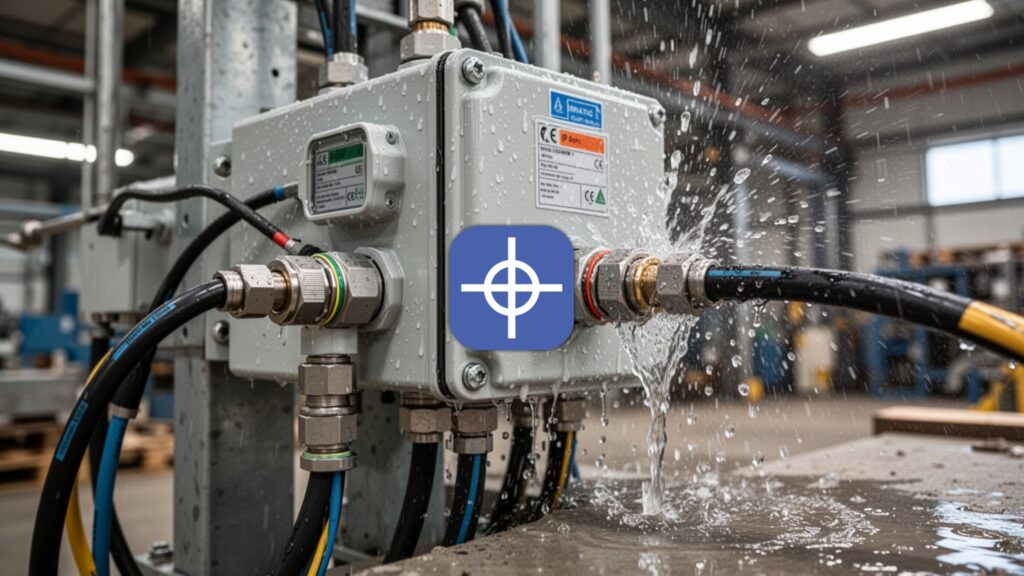
Ingress failures rarely occur through solid metal enclosure walls.
They typically occur at:
- Cable glands
- Connectors
- Panel doors
- HMI windows
- Screw points
- Vent openings
The effective IP rating of a system equals its weakest component.
An inadequate cable gland can compromise an IP65 enclosure.
IP vs IK — Critical Distinction
- IP → Protection against dust and water ingress
- IK → Protection against mechanical impact (IEC/EN 62262)
Example:
An enclosure may be rated IP66, yet remain vulnerable to mechanical impact in harsh industrial environments.
For rugged applications, evaluate both IP and IK ratings.
5. Common Industrial Examples
- Control panel inside dry indoor facility → IP20 to IP54 depending on dust level
- Panel near dusty production line → IP54/IP55 or higher
- Outdoor installation (rain and dust exposure) → IP65 and above
- Sensors or connectors near washdown area → IP67/IP68 or IP69K
- Hygienic food or pharmaceutical environments → Typically IP69K + stainless steel housing + chemical‑resistant gasket materials
Conclusion
IP ratings are not marketing labels — they are engineering specifications that must align with the real operating environment.
Selecting the correct IP rating requires understanding:
- The actual exposure conditions
- The difference between dust and water protection
- The non‑cumulative nature of water tests
- The limitations of IP regarding chemicals and impact
In industrial automation, correct enclosure selection directly affects reliability, maintenance cycles, and long‑term operational safety.
A properly selected IP rating reduces failure risk, protects investment, and ensures equipment performs as intended under real‑world conditions.
For industrial implementation, explore Radonix PC-based CNC controllers, control software and machine-specific HMI systems. Radonix PC-based CNC controller systems.