

Written by: Nima Rad – Radonix Automation Company
A servo drive or motor is considered properly tuned when it follows position and velocity commands quickly and accurately, without vibration, excessive noise, abnormal temperature rise, or exceeding allowable Following Error limits. In industrial CNC systems, tuning is fundamentally about stabilizing and optimizing nested control loops (current/torque → velocity → position) step by step, then refining performance using feedforward terms and filters.
1. Critical Prerequisites Before Tuning
Ignoring these prerequisites will result in unstable or non-repeatable tuning, regardless of parameter values:
Mechanical integrity and stiffness
Backlash in couplings or pulleys, loose motor mounting, damaged bearings, loose belts, dry ball screws, or poor alignment all introduce mechanical resonance and hunting. These issues cannot be compensated reliably through software tuning alone.
Correct feedback sensors and encoder wiring
Encoder noise, signal dropouts, or improper grounding often appear identical to poor tuning, causing random vibration and sudden following errors.
Safety preparation
Initial tuning must be performed with reduced speed and acceleration, torque limits enabled, and an emergency stop readily available.
2. Servo Control Architecture (What Is Actually Tuned)
Nearly all industrial servo systems are based on three nested control loops:
- Current / Torque Loop: The fastest loop, typically factory-tuned or adjusted automatically by the drive.
- Velocity Loop: The primary contributor to dynamic stability and damping.
- Position Loop: Determines positional stiffness and tracking accuracy.
Understanding this hierarchy is essential, as instability in an inner loop cannot be corrected by adjusting an outer loop.
3. Key Tuning Parameters (Conceptual Mapping)
Parameter names vary between manufacturers, but their functional roles are consistent:
- Gain / Kp: Higher values increase response speed but raise the risk of oscillation and audible noise.
- Ki (Integral): Eliminates steady-state error; excessive values cause overshoot, oscillation, and motor heating.
- Kd / Damping / Derivative: Increases damping and reduces overshoot; excessive values amplify noise and produce rough motion.
- Feedforward (Velocity / Acceleration FF): Reduces following error during rapid motion without increasing loop gain.
- Notch / Anti-resonance / Low-pass Filters: Suppress mechanical resonance and attenuate high-frequency noise.
4. Standard Servo Tuning Procedure (Step-by-Step)
This sequence reflects common industrial practice: stabilize feedforward paths, then gains, then filters.
Step A – Test Preparation
- Test the axis without hazardous loads or with a controlled load.
- Use repeatable test profiles: short reciprocating moves, velocity steps, then position steps.
Step B – Current / Torque Loop
- Retain Auto or Default settings unless abnormal current ripple or noise is observed.
- A stable torque loop is a prerequisite for increasing velocity-loop gain safely.
Step C – Velocity Loop (Primary Tuning Stage)
- Gradually increase velocity Kp until the system approaches oscillation (high-pitched noise, vibration, or ringing after stop).
- Reduce slightly to maintain a stability margin.
- Increase velocity Ki to minimize steady-state error; reduce if wobble or heating occurs.
- If ringing persists, evaluate damping or filters rather than increasing Ki.
Step D – Position Loop
- Increase position gain to improve stiffness and accuracy.
- Micro-vibration or audible hunting at standstill indicates excessive gain or unresolved mechanical resonance.
Step E – Feedforward (Critical for CNC Performance)
- Once loops are stable, adjust velocity feedforward and then acceleration feedforward to reduce following error during high-speed motion without aggressive gain increases.
Step F – Filters for Frequency-Specific Vibration
- Vibration at a narrow speed range typically indicates mechanical resonance; apply notch or anti-resonance filtering at the identified frequency.
- Low-pass filtering can improve smoothness but reduces control bandwidth.
5. Quick Diagnosis by Symptoms (Cheat Sheet)
| Symptom | Likely Cause | Typical Action |
|---|---|---|
| Vibration or whine at standstill (Hunting) | Excessive position or velocity gain, resonance, dry friction | Reduce gain, add damping or filtering, inspect mechanics |
| Overshoot and repeated oscillation after stop (Ringing) | Insufficient damping, excessive gain | Increase damping/Kd or filtering, slightly reduce gain |
| Slow or compliant motion | Low gain, insufficient feedforward | Increase gain, add feedforward |
| High following error during acceleration | Insufficient feedforward or torque limits | Increase Acc FF / Vel FF, verify torque and current limits |
| Vibration at a specific speed | Mechanical resonance | Apply notch filter at resonance frequency |
6. Auto-Tune or Manual Tuning?
Auto-tuning provides a fast and often reliable starting point, particularly when the drive supports frequency-response analysis or mechanical identification.
Manual tuning becomes necessary when:
- The mechanical system is compliant or belt-driven
- Two-mass or multi-inertia systems are present
- Severe resonance limits achievable bandwidth
- Maximum surface quality and minimal following error are required
7. Practical CNC-Specific Considerations
- Ball-screw and rack-and-pinion axes typically tolerate higher position gain, while belt-driven or compliant axes enter vibration at lower gain levels.
- If errors increase during direction reversals, address backlash, friction, and mechanical play before increasing gain.
- Always monitor motor temperature and current after tuning; excessively aggressive tuning may appear precise but reduces reliability.
Oscilloscope-Based Servo Tuning Analysis:
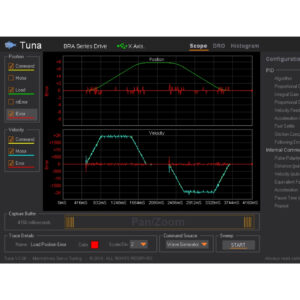
Oscilloscope traces of position, velocity, and following error are essential tools for validating tuning results, showing command versus feedback behavior during real motion.
Conclusion
Servo motor tuning in CNC systems is not a one-time parameter adjustment, but a structured engineering process that balances dynamic performance, stability, and long-term reliability. Effective tuning starts with sound mechanics and correct feedback, then progresses through the servo control hierarchy—current, velocity, and position—before being refined with feedforward and filtering techniques.
In real CNC applications, the goal is not maximum aggressiveness, but predictable motion, controlled following error, and thermal and mechanical safety under continuous operation. Over-tuned systems may appear precise in short tests, yet lead to vibration, surface defects, or premature component wear in production.
A disciplined tuning approach—supported by measurement tools, repeatable test profiles, and an understanding of machine mechanics—ensures that CNC axes remain accurate, stable, and dependable over their full operating lifecycle.
Contact Radonix or use the chatbot in the bottom right corner to learn how linear encoders integrate with Radonix control systems.
For machine integration, compare Radonix CNC controller hardware for independent multi-axis motion, pulse/direction signals and industrial I/O. Radonix CNC controller hardware.