

Tangential C-Axis and Its Industrial Applications
Written by: Nima Rad, Content Specialist – Radonix
What Is a Tangential C-Axis?
In standard CNC axis nomenclature, the C-axis is a rotary axis around the Z-axis, meaning rotation of the tool or spindle about the vertical direction.
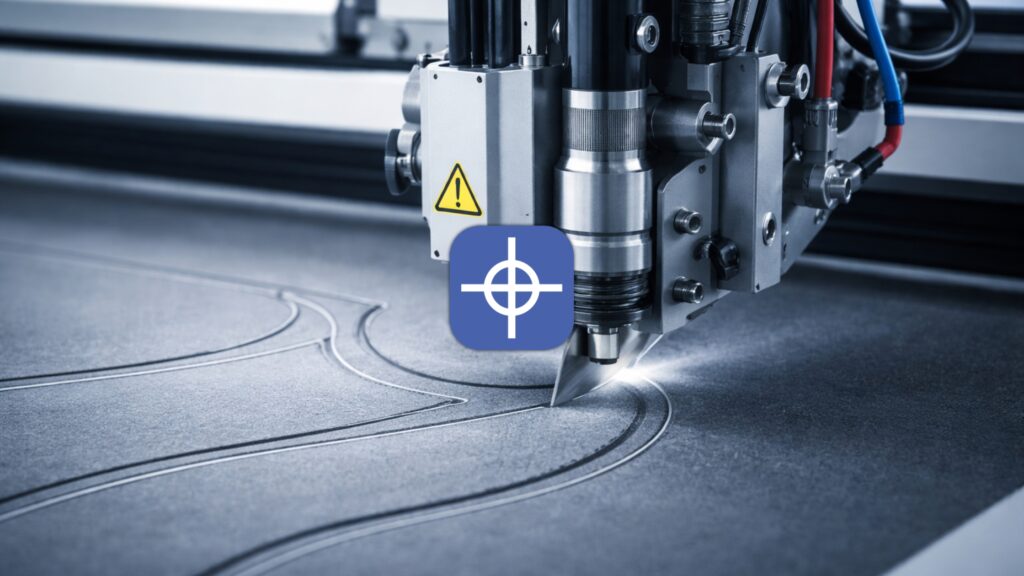
When we refer to a Tangential C-Axis (Tangential Knife Axis), we mean a control strategy in which the CNC controller continuously adjusts the C-axis angle simultaneously with X and Y motion so that the cutting blade remains tangent to the toolpath at all times. In practical terms, the blade is always aligned with the instantaneous direction of motion and effectively “faces” the path.
Important distinction: In CNC turning centers, the C-axis typically refers to spindle indexing or controlled spindle rotation. In contrast, a tangential C-axis is primarily used in flatbed cutters, CNC routers equipped with tangential knife heads, oscillating knife systems, and blade-based cutting applications. The axis name is the same, but the function is fundamentally different.
Why Is a Tangential Axis Needed? (The Drag Knife Problem)
In drag knife cutting, the blade is passive and rotates freely in the direction of motion. This inevitably introduces angular lag, which leads to several common issues:
- Rounded or torn corners
- Increased risk of tearing or path deviation in thick, stiff, or fibrous materials such as cardboard, foam, leather, or gasket materials
- Surface scratching or marking during sharp direction changes
With a tangential knife, the blade orientation is actively driven by a motorized C-axis. This produces sharper corners, higher contour accuracy, and significantly reduced unwanted lateral forces on the material.
Control Mechanisms of a Tangential C-Axis
Controllers or CAM post-processors typically implement one of the following control strategies:
Continuous Tangential Rotation
The C-axis angle is calculated continuously from the XY velocity vector and rotates smoothly while the tool is moving.
Lift–Rotate–Plunge (Indexing Mode)
When the angular change between consecutive toolpath segments exceeds a defined threshold, the system:
- Slightly lifts the Z-axis
- Rotates the C-axis to the new orientation
- Lowers the Z-axis and resumes cutting
This logic is specifically designed to prevent blade rotation inside the material, which is a critical requirement for clean cutting in many applications.
Key Configuration Parameters
Several parameters are essential for reliable tangential operation:
- C-axis Homing / Referencing: The C-axis must be homed before operation to establish a valid angular reference for the blade.
- Blade Offset / Knife Offset: The distance between the blade tip and the axis of rotation. Incorrect values are a primary cause of corner and curve inaccuracies.
- Maximum Angular Speed and Acceleration: Insufficient limits cause lag at high feed rates; excessive values may damage sensitive materials.
- Arc Motion Synchronization: Some controllers synchronize C-axis motion during G2/G3 circular interpolation.
Primary Applications of a Tangential C-Axis
A tangential axis is most valuable when the tool is a blade and edge quality is critical:
- Digital cutting and die-cutting of cardboard, paperboard, foam board, foamed PVC, polypropylene, polycarbonate, and similar materials
- Packaging, model making, POS displays, signage, and post-print cutting
- Soft to semi-rigid materials such as leather, textiles, felt, foam, rubber, and gaskets, often combined with oscillating tangential knives for greater thickness
- Kiss-cutting of films and vinyl, where clean corners and precise force control are required
CNC Machines Equipped with Tangential Knife Systems
In most cases, tangential capability is offered as an optional knife head or module:
- Kongsberg / MultiCam Apex series routers, where tangential knife cutters are listed as optional features in models such as Apex1R and Apex3R Evo
- Zünd flatbed cutters in the S3 series and related families, featuring modules with explicit tangential blade positioning for fine contours
- Laguna Tools CNC routers with tangential knife modules such as TCM-3 and EOT-2, which specify C-axis rotation about Z and mandatory homing procedures
- iECHO digital cutting systems (BK and Pro Series), where tangential knives are referenced as standard tools in service documentation
Note: Many manufacturers market these machines as “4-axis,” but the fourth axis is often only the rotational C-axis for the knife head, not a true continuous 4-axis machining configuration.
Practical Implementation Tips
- If corner defects or blade rotation within the material occur, review and tune the Lift–Rotate–Plunge parameters.
- Blade offset calibration is critical; many contour errors originate from incorrect offset values.
- The CAM output must use a tangential-specific post-processor, or the controller must explicitly support tangential knife logic. Otherwise, the C-axis may rotate without maintaining true tangency to the path.
Common Industrial Use Cases
- Digital cutting tables for cardboard, paperboard, foam, and thin plastics
- Industrial gasket and rubber cutting
- Leather, textile, and felt cutting
- Kiss-cutting for vinyl and label production
- Gantry or robotic cutting systems using oscillating tangential knives for thicker materials
Contact Radonix or use the chatbot in the bottom right corner to learn how linear encoders integrate with Radonix control systems.
For machine implementation, explore Radonix CNC control for tangential knife cutters, conveyor tables and automated sewing systems. Radonix textile cutting and sewing CNC control.