
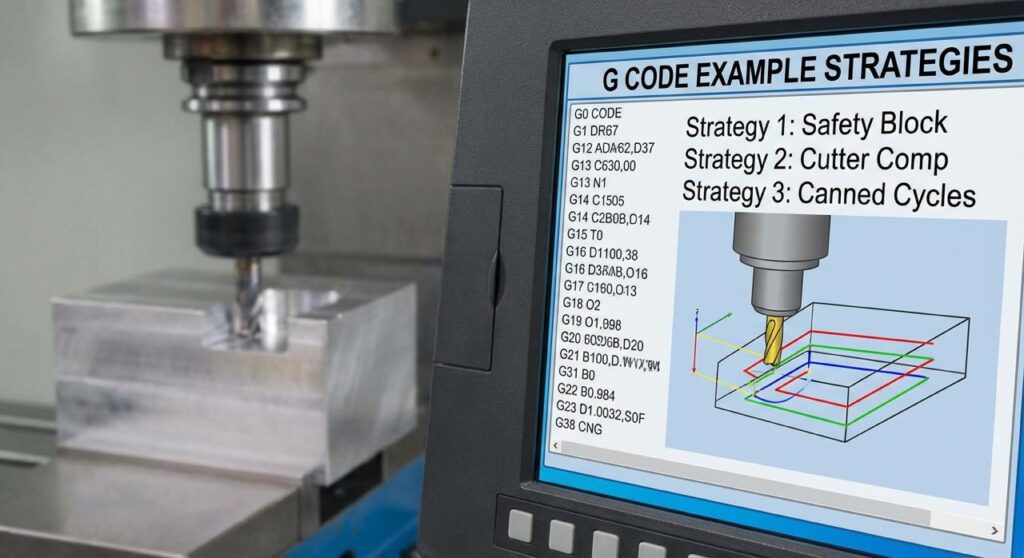
Best G-Code Example Strategies for Reliable CNC Projects
Well-structured G-Code examples are a foundation of reliable CNC machining.
Beyond making a program run, good strategies directly influence cycle time, dimensional stability, tool life, and controller compatibility.
For CNC operators, programmers, and manufacturing engineers, strong G-code practices translate into predictable outputs across milling, turning, engraving, and multi-axis operations.
Modern CNC environments, especially those running complex jobs, tight tolerances, or short production batches—demand code that is readable, modular, and safe to execute. The following strategies focus on practical execution quality based on real shop-floor conditions, not abstract theory.
Why G-Code Strategy Quality Directly Impacts CNC Performance
Poorly structured G-code increases risk long before a tool touches material. Inefficient motion planning adds unnecessary air cuts, while unclear logic makes troubleshooting slow and error-prone.
High-quality G-code strategies help achieve:
- Shorter cycle times by eliminating redundant moves
- More consistent dimensional results through controlled feeds and offsets
- Reduced scrap caused by programming errors
- Longer tool life through balanced cutting loads
In production environments, even small inefficiencies compound quickly. Well-planned G-code examples support repeatability and stability—two performance metrics modern CNC operations cannot compromise.
Core Principles Behind Strong G-Code Examples
Readability and Structure
Readable code is safer code. Clear formatting, consistent line spacing, and meaningful comments allow operators to understand intent quickly. This is critical during setup, dry runs, troubleshooting, and hand edits at the controller.
Best practices include:
- Logical program flow from setup to finish
- Clear section comments for operations
- Consistent coordinate and feed conventions
Feed and Speed Control
Feeds and speeds should be selected based on material, tooling, machine rigidity, and operation type—not reused blindly from previous jobs. Stable values reduce chatter, deflection, thermal distortion, and premature tool wear.
Example considerations:
- Aluminum: higher spindle speed, moderate feed
- Steel: controlled speed with conservative engagement
Tool Compensation and Safety Logic
Tool radius and length compensation (G41/G42, G43) protect dimensional accuracy and reduce rework. Safety moves such as rapid retracts, clearance planes, and controlled approach paths help prevent collisions and spindle overload.
Practical G-Code Example Strategies for CNC Projects
Modular Programming with Subroutines
Breaking programs into subroutines reduces repetition and simplifies updates. This approach is especially effective for repeated features such as pockets, slots, bolt circles, and recurring contours.
% (Main Program)
G21 G90 G40
M06 T01
G00 X0 Y0 Z50
M03 S2000
CALL O1000
G00 Z50
M05 M30

O1000 (Pocket Milling)
G01 Z-5 F500
G01 X50 Y0
G01 X50 Y50
G01 X0 Y50
G01 X0 Y0
G00 Z50
RET
This structure allows reuse across multiple parts without rewriting geometry, improving consistency in batch production.
Tool-Path Optimization
Efficient tool paths reduce machining time and mechanical stress. Smooth arcs and logical transitions minimize abrupt direction changes and vibration.
% (Optimized Contour)
G21 G90
G00 X10 Y10 Z50
G01 Z-10 F300
G01 X100 Y10
G03 X100 Y100 R45
G01 X10 Y100
G02 X10 Y10 R45
G00 Z50
M30
Replacing sharp corners with arcs improves surface finish, reduces servo shock loads, and enhances overall motion stability.
Canned Cycle Usage
Canned cycles simplify repetitive operations such as drilling, tapping, and boring. They reduce code length and standardize motion behavior across hole patterns.
% (Drilling Cycle)
G21 G90
G00 X20 Y20 Z50
G81 X20 Y20 Z-15 R5 F200
X50 Y20
X50 Y50
X20 Y50
G80
M30
This approach is effective for hole arrays and repetitive layouts while minimizing manual programming errors.
Parametric Programming
Parametric logic allows programs to adapt to dimensional changes without rewriting geometry. This is valuable in batch production, prototyping, and custom fabrication.
% (Parametric Rectangle)
#1 = 50 (Length)
#2 = 30 (Width)
G21 G90
G00 X0 Y0 Z50
G01 Z-5 F400
G01 X#1 Y0
G01 X#1 Y#2
G01 X0 Y#2
G01 X0 Y0
G00 Z50
M30
Parameter-driven code improves flexibility while maintaining structural consistency and reducing human error.
Error-Proofing and Logic Checks
Simple conditional logic can prevent serious mistakes. Feed limits, tool checks, and motion conditions protect machines and workpieces.
% (Feed Safety Check)
G21 G90
IF [#500 GT 1000] GOTO 100
G01 X100 Y0 F#500
M30
N100 #3006=1 (Feed Rate Too High)
M30
These checks act as safeguards in automated, shared, or production-intensive environments.
Controller Influence on G-Code Execution Quality
Even well-written G-code depends on the controller’s ability to execute it reliably. Stable interpolation, buffer handling, acceleration control, and real-time monitoring directly affect machining results.
Modern CNC controllers support:
- High-speed motion without hesitation
- Complex subroutines and parametric logic
- Simulation and dry-run validation before cutting
Integrated simulation and diagnostics reduce trial-and-error on the shop floor and improve overall process confidence.
Industrial Applications of Advanced G-Code Strategies
In aerospace machining, optimized G-code with smooth interpolation supports high surface quality and minimal post-processing.
In automotive production, parametric and canned-cycle strategies reduce setup time across variant parts.
For engraving and fine detailing, controlled feeds and dwell logic ensure clarity without tool drag or surface damage.
Across industries, strong G-code strategies scale from prototyping to full production environments.
Testing and Validation Best Practices
Before running any program at full speed:
- Simulate tool paths using CAM or controller-based simulation
- Perform dry runs with reduced feed
- Validate subroutines independently
- Monitor spindle load and axis behavior
Consistent testing turns G-code examples into reliable production assets rather than one-off solutions.
Conclusion
The best G-code example strategies focus on clarity, efficiency, and safety. Modular structure, optimized motion, parametric logic, and validation practices collectively improve CNC output quality and process stability.
By applying these strategies consistently, CNC professionals can reduce risk, improve precision, and maintain reliable performance across modern machining projects.
Contact Radonix or use the chatbot in the bottom right corner to learn how linear encoders integrate with Radonix control systems.
For production implementation, explore Radonix CNC control software, CAM-Pro and machine-specific operator workflows. Radonix CNC control software and CAM-Pro.