
Unlocking Potential with CNC Auto Design in Precision Engineering
Written by: Radonix R & D Team.
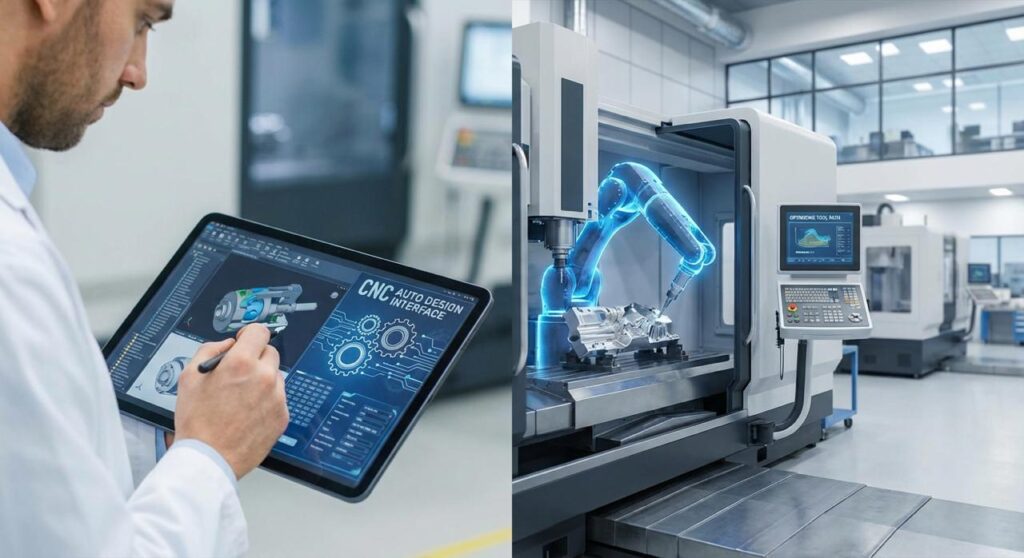
CNC auto design unlocks new levels of efficiency in precision engineering by automating feature recognition, toolpath generation, simulation, and post-processing.
Instead of relying on manual interpretation between CAD and CAM, automated systems streamline the transition from design to machining, reducing human intervention while improving consistency and accuracy.
For industrial manufacturers, CNC auto design directly translates into faster prototyping, fewer programming errors, optimized resource usage, and scalable production workflows.
As machining complexity increases, automation becomes less of an advantage and more of a necessity.
The Evolution and Importance of CNC Auto Design
CNC auto design emerged from early CAD/CAM integrations in the late twentieth century, where basic two-dimensional toolpaths were generated with limited automation.
As computing power increased, systems evolved to support three-dimensional modeling, multi-axis machining, and real-time optimization.
Modern CNC auto design platforms incorporate intelligent algorithms that analyze geometry, machining intent, and material behavior.
In practice, this evolution reduces design preparation time by up to 50 percent in high-speed machining environments and significantly lowers the risk of human error, which historically accounts for a large share of defects in manual programming workflows.
By automating repetitive and error-prone tasks, CNC auto design allows engineers to focus on process optimization and problem-solving rather than manual data entry.
Core Components of Effective CNC Auto Design Systems
Feature recognition
Feature recognition automatically identifies machinable elements such as pockets, slots, holes, and contours directly from CAD models.
Algorithms classify these features and assign machining strategies without manual tagging, reducing preparation time by approximately 30 to 40 percent on complex parts.
Automatic toolpath generation
Once features are identified, the system generates optimized toolpaths using strategies such as adaptive clearing, trochoidal milling, and high-speed finishing. Toolpaths are adjusted dynamically based on geometry complexity to balance material removal rate, surface quality, and tool life.
Material-based optimization
Advanced CNC auto design systems account for material properties such as hardness, heat generation, and chip formation. Feed rates, step-over values, and cutting strategies are adapted automatically for materials ranging from aluminum to titanium and composites.
Integrated simulation
Simulation modules visualize toolpaths in three dimensions and detect collisions, over-travel, and inefficiencies before machining begins. Virtual validation typically reduces rework and correction cycles by up to 30 percent, especially in multi-axis operations.
Post-processing automation
Automated post-processing converts validated toolpaths into machine-specific G-code, accounting for kinematics, offsets, and compensation logic. This ensures consistency between design intent and machine execution without repetitive manual adjustments.
Together, these components form a complete CNC auto design workflow that connects CAD data directly to production.
How CNC Auto Design Transforms Precision Engineering Workflows
Before CNC auto design adoption, engineers manually interpreted CAD models, defined features, generated toolpaths, and validated programs in separate steps. This process consumed significant time and introduced variability between programmers.
With CNC auto design, these steps are consolidated into an automated pipeline. Feature recognition reduces oversight, simulations ensure first-pass success, and optimized paths shorten machining cycles. In multi-axis environments, prototyping cycles are commonly reduced by 50 to 75 percent.
The impact becomes especially clear when comparing manual and automated workflows.
| Workflow Aspect | Manual Design (Pre-Auto) | Auto Design (Post-Implementation) | Time Savings (%) |
|---|---|---|---|
| Feature Identification | 4–6 hours | 0.5–1 hour | 80–90 |
| Toolpath Creation | 5–8 hours | 1–2 hours | 75–80 |
| Simulation & Validation | 3–5 hours | Integrated (0.5 hours) | 85–90 |
| Post-Processing | 2–3 hours | Automated (0.2 hours) | 90–95 |
| Overall Project Cycle | 20–30 hours | 5–10 hours | 65–75 |
These measurable gains demonstrate how CNC auto design reshapes efficiency in smart manufacturing environments.
Radonix CAM Pro and CNC Auto Design Capability
Radonix CAM Pro represents an advanced implementation of CNC auto design principles. The platform integrates intelligent feature recognition, adaptive toolpath strategies, and machine-aware simulation to support complex geometries and tight tolerances.
Key capabilities include rest machining to target uncut material, collision-aware simulation for multi-axis setups, and robust post-processors that generate reliable machine-ready G-code. Real-time monitoring and optimization features further enhance machining stability in demanding applications.
By aligning design automation with machine behavior, Radonix CAM Pro reduces material waste, shortens setup time, and improves repeatability across production runs.
Best Practices for Implementing CNC Auto Design
Successful adoption of CNC auto design requires structured implementation rather than immediate full automation.
Best practices include:
- Evaluating existing workflow bottlenecks before software selection
- Ensuring seamless CAD and CAM data compatibility
- Training engineers to understand and adjust automated strategies
- Starting with pilot parts before scaling to complex assemblies
- Monitoring performance metrics such as cycle time and scrap rate
Gradual adoption ensures automation supports engineering intent rather than replacing it blindly.
Challenges and Considerations in CNC Auto Design
Despite its benefits, CNC auto design introduces challenges. Software complexity can overwhelm inexperienced users without proper training. File compatibility issues may arise between different CAD formats, requiring standardized exchange protocols.
Over-reliance on automation can limit customization in specialized applications, which is why hybrid workflows that allow manual overrides remain important. Initial investment costs can be significant, but long-term efficiency gains and reduced rework typically justify adoption.
Addressing these challenges proactively ensures sustainable, future-ready automation.
Conclusion
CNC auto design transforms precision engineering by reducing manual effort, increasing consistency, and accelerating production workflows. Through automated feature recognition, optimized toolpaths, integrated simulation, and reliable post-processing, manufacturers gain measurable improvements in efficiency and accuracy.
With platforms such as Radonix CAM Pro, CNC auto design evolves from a productivity enhancement into a strategic foundation for modern, high-performance manufacturing.
Contact Radonix or use the chatbot in the bottom right corner to learn how linear encoders integrate with Radonix control systems.
For production implementation, explore Radonix CNC control software, CAM-Pro and machine-specific operator workflows. Radonix CNC control software and CAM-Pro.