
Electronic Linear Scale (Linear Encoder) Explained
Author: Nima Rad
What Is an Electronic Linear Scale?
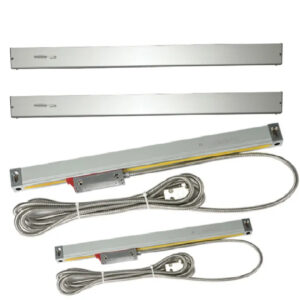
An electronic linear scale, also known as a linear encoder, measures the real linear movement of a machine axis and converts it into an electrical signal.
In machine tools, this signal is used in two main ways:
- Displaying accurate axis position on a digital readout (DRO)
- Providing direct position feedback to CNC controllers or servo drives for true closed-loop control
Unlike rotary encoders mounted on motors, a linear encoder measures the actual table or slide position. This allows the CNC system to compensate for backlash, ball screw pitch error, mechanical compliance, and thermal expansion.
Types of Electronic Linear Scales by Sensing Technology
Optical Linear Encoders
Optical linear encoders are widely used in glass or steel scale systems. They rely on fine grating patterns combined with optical scanning to generate sinusoidal (Sin/Cos) or digital signals. Advanced optical designs reduce sensitivity to localized contamination such as dust or oil mist, making them suitable for precision machine tools when properly protected.
Magnetic Linear Encoders
Magnetic linear encoders use a magnetized tape with defined pole patterns. They offer higher resistance to oil, chips, and harsh environments, making them suitable for heavy-duty applications. Final accuracy and thermal stability depend strongly on tape quality, installation, and environmental conditions.
Inductive Linear Encoders
Inductive linear encoders are designed for demanding industrial environments involving vibration, coolant splash, and airborne contamination. Many manufacturers specify accuracy as micrometers per meter, making these systems attractive for CNC machines operating in less controlled conditions.
Capacitive / Electrostatic Encoders
In some absolute linear encoder systems, capacitive or hybrid capacitive–optical technologies are used. These designs may offer advantages such as battery-free absolute position detection and elimination of repeated homing cycles after power-up.
Linear Encoders by Output Type and Interface
Incremental Linear Encoders
Incremental encoders generate position information through quadrature A/B signals with an additional Z (reference or index) pulse. Common signal formats include TTL or RS-422 digital outputs and 1 Vpp Sin/Cos signals. Incremental linear encoders remain widely used in DRO systems and many CNC installations.
Absolute Linear Encoders
Absolute linear encoders provide a unique position value immediately after power-on, without requiring axis movement to a reference point. Typical communication protocols include EnDat, BiSS-C, and SSI. Differences between these serial interfaces involve data structure, integrity checking, transmission speed, and system flexibility, as documented in industrial standards.
Key Technical Criteria When Selecting a Linear Encoder
Resolution
Defines the smallest measurable increment, such as 5 µm, 1 µm, or 0.1 µm. Display resolution does not automatically equal positioning accuracy.
Accuracy
Specifies the maximum permissible positioning error over a defined measuring length, often stated as µm over a fixed distance or µm per meter.
Repeatability
Describes how consistently the encoder reports the same position during repeated forward and backward movements.
Maximum Speed and Bandwidth
Each linear encoder has a maximum axis speed and signal bandwidth. Exceeding these limits leads to signal loss or counting errors.
Environmental Resistance
Resistance to coolant, oil, chips, dust, and vibration is critical in CNC machining environments.
Mounting Tolerances
Gap, parallelism, and alignment tolerances between the readhead and scale directly affect signal stability and long-term accuracy.
Common Errors and Why Accurate Numbers Still Produce Inaccurate Parts
Cosine Error
Occurs when the scale is installed at an angle relative to the true axis motion, causing measured displacement to differ from actual movement.
Abbe Error
Arises when the measurement line is offset from the axis of motion and angular deviations exist, amplifying positioning errors.
Thermal Expansion
Temperature changes affect both machine structure and the scale itself, particularly over long travel lengths.
Electrical Noise and Grounding Issues
Poor shielding, electromagnetic interference, or incorrect grounding can lead to unstable counts, reference loss, or intermittent errors.
Contamination
Oil, chips, and debris can degrade signal quality, especially in optical systems without adequate protection.
The Role of Linear Encoders in CNC Machines
In DRO-based systems, the linear encoder serves primarily as a position display aid for manual or semi-automatic machines.
In closed-loop CNC configurations, linear encoders provide direct position feedback of the machine table. This allows the controller to compensate for transmission errors, backlash, coupling compliance, and thermal effects, significantly improving final accuracy and contouring performance.
Installation Guidelines: Practical Checklist
Correct installation is as important as encoder quality.
- Mount the scale on a flat, mechanically stable surface
- Use shims or spacers according to manufacturer instructions
- Verify parallelism across the full axis travel using a dial indicator
- Maintain the specified readhead gap and offset
- Route encoder cables away from power cables and inverters
- Use proper shielding and single-point grounding
- Protect the scale with covers or scrapers
After installation:
- Perform bidirectional travel tests
- Verify reference or index repeatability
- Check signal stability at low and high axis speeds
Quick Selection Guide by Application
Manual milling or turning machines requiring operator accuracy benefit from DRO kits with protected glass scales.
Highly contaminated or oily environments favor magnetic or rugged industrial encoder systems.
High-precision CNC machines with tight surface and tolerance requirements benefit from industrial linear feedback encoders, often optical or inductive.
Applications requiring fast startup without homing cycles may justify absolute linear encoder solutions, subject to controller compatibility.
Common Terminology
Electronic linear scale = Linear scale / Linear encoder
Readhead = Scanning head
Reference or index = Reference mark / Z pulse
Accuracy, repeatability, and resolution retain their standard metrology definitions.
Contact Radonix or use the chatbot in the bottom right corner to learn how linear encoders integrate with Radonix control systems.
For machine integration, compare Radonix CNC controller hardware for independent multi-axis motion, pulse/direction signals and industrial I/O. Radonix CNC controller hardware.